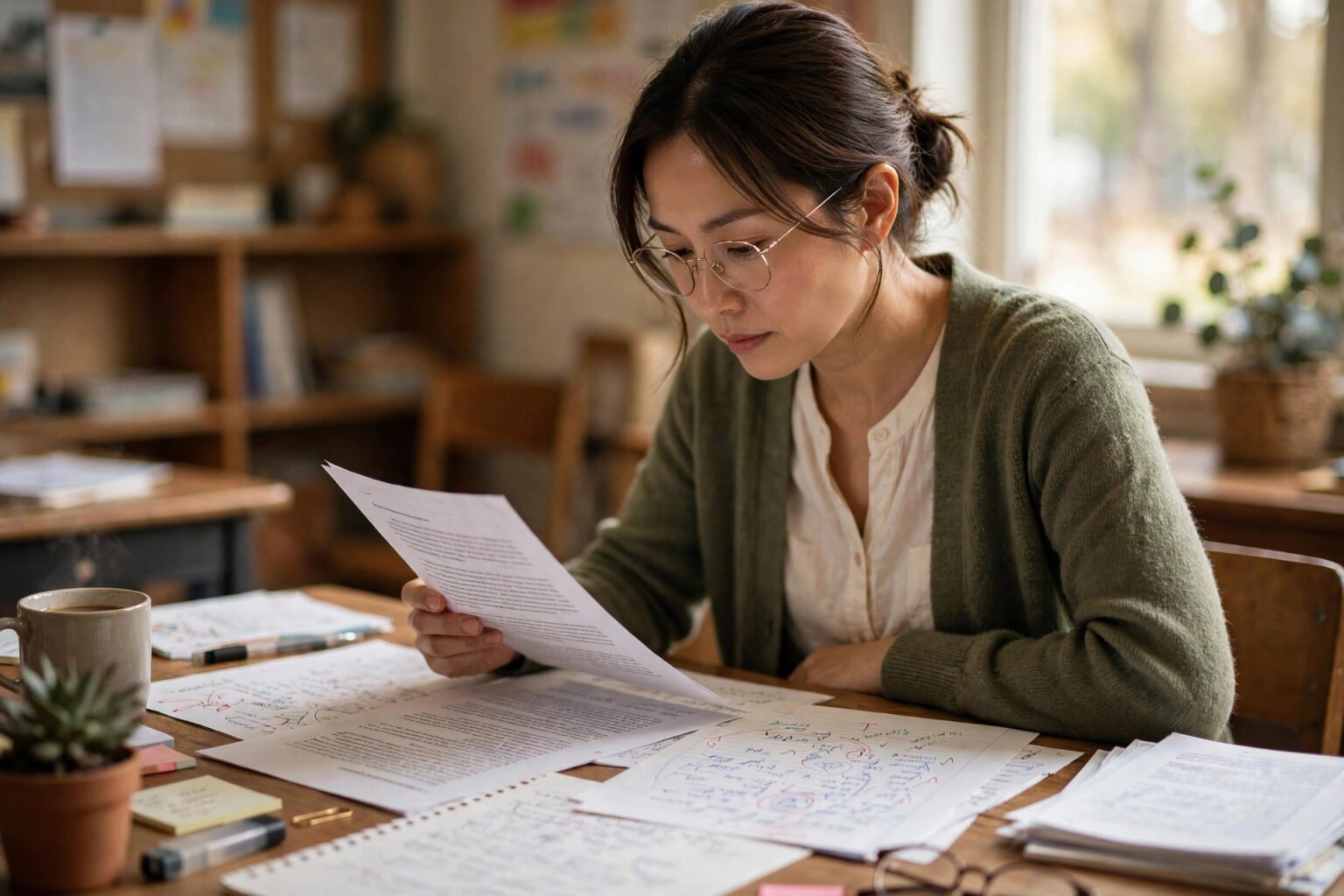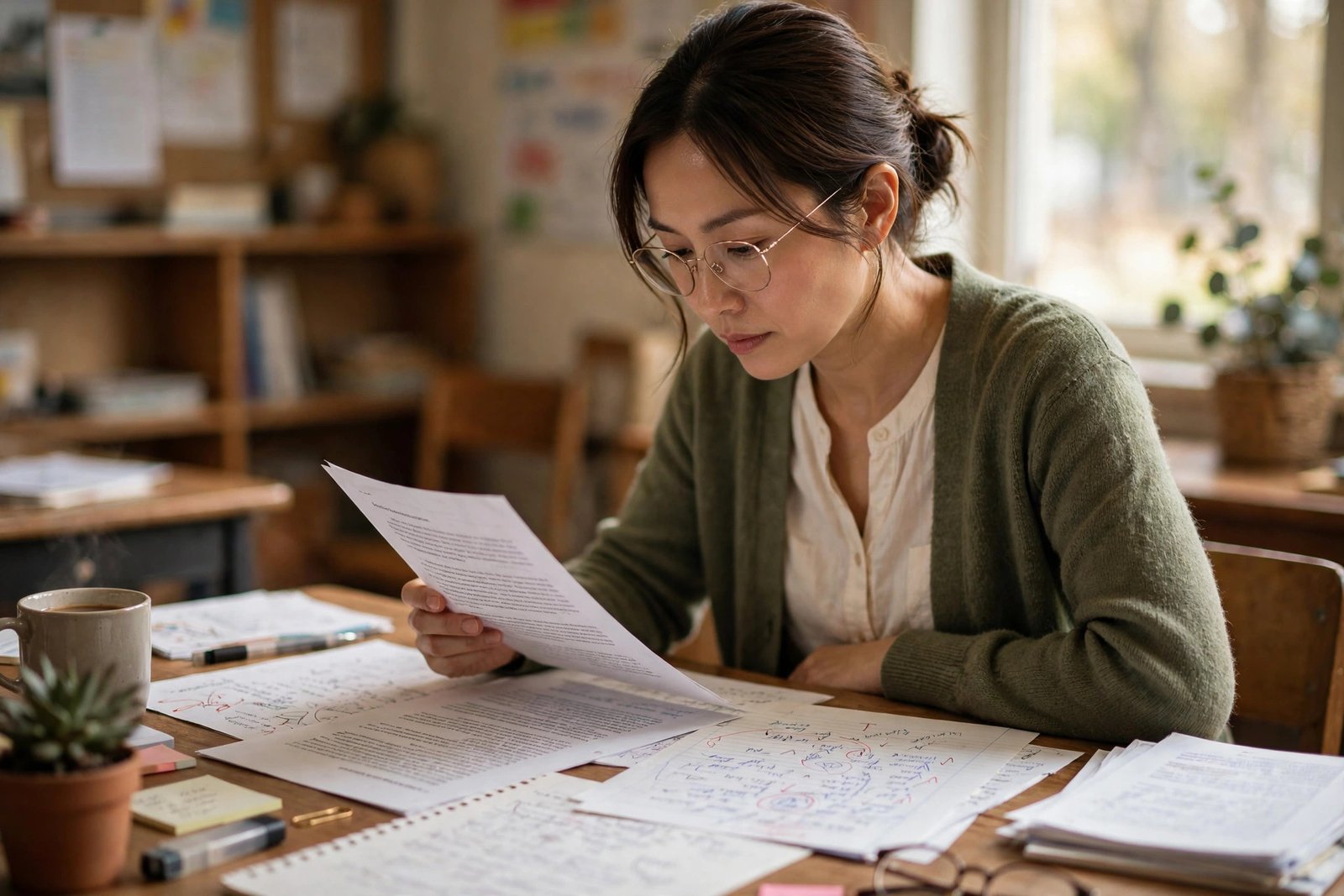
A pupil hands in a flawless essay, and something feels wrong. How teachers can detect AI-written homework fairly is now one of the hardest questions in school, because the tools that claim to answer it are far less reliable than their headlines suggest. Can a teacher tell, with confidence, whether AI wrote it?
The honest answer is no — not from a detector score alone. A detector can prompt a closer look, but cannot prove authorship. The fairest approach combines what you know about a pupil, evidence from how the work was made, and a conversation in which the pupil explains it.
Key Takeaways
- A detector score is not evidence. Treat a flag as a prompt to look, never as proof.
- Detectors are biased against non-native English writers: a 2023 Stanford study found they falsely flagged 61.22% of human-written TOEFL essays on average.
- Turnitin aims for a false positive rate under 1% for documents with more than 20% AI writing, but independent tests show it also misses a lot of AI text.
- The most reliable signals are a pupil’s known voice, the homework–test gap, and missing drafts.
- Never open with an accusation. Ask the pupil to explain their work first.
- The best detection is prevention: design assignments that are hard to outsource.
How AI Detectors Actually Work
An AI detector does not read an essay the way a teacher does. It measures how statistically predictable the text is, using two ideas: perplexity and burstiness. Perplexity measures how surprising each word is, given the words before it. AI models tend to choose likely word combinations, so their text has low perplexity. Burstiness measures variation in sentence length and structure. Human writers usually mix short and long sentences. AI output tends to be more uniform. That is why a detector can look convincing on unedited AI text, and fail elsewhere. Careful, formal human writing can look predictable too, and heavily edited AI text can look human. A detector estimates predictability, not authorship.
What the Accuracy Numbers Really Mean
Vendor numbers deserve careful reading. Turnitin states that it aims to keep its false positive rate — incorrectly identifying fully human-written text as AI-generated — under 1% for documents with more than 20% of AI writing. That claim covers whole documents scored above 20%. It says nothing about scores in the 1% to 19% range, which Turnitin found less reliable and now hides, showing only an asterisk.
Independent research tells a more mixed story. The most-cited study is Liang and colleagues, published in Patterns in July 2023. They tested seven detectors on 91 human-written TOEFL essays by non-native English speakers and 88 essays by US eighth-graders. The detectors were near-perfect on the eighth-graders’ essays, but falsely flagged an average of 61.22% of the TOEFL essays as AI-generated. The mechanism is structural. Non-native writers tend to use simpler vocabulary, shorter sentences and more repetitive transitions, and those patterns overlap with the patterns detectors flag as AI. When researchers asked ChatGPT to enrich the vocabulary, the false positive rate fell to 11.77%. The detector was reacting to style, not authorship.
More recent tests point the other way: missed AI, not false accusation, is now the weaker spot. A study in the International Journal for Educational Integrity on 29 June 2026 tested four detectors on 160 master’s-level papers. All four classified every fully human paper correctly. On the fully AI-generated set, Turnitin placed every paper below 20%, while Copyleaks missed 75% and GPTZero missed 70%. A second study in the same journal, from 2 February 2026, tested 192 texts and found Turnitin’s overall accuracy was 0.61 and Originality.ai’s was 0.69. A Wageningen University evaluation, published in December 2025, found about 1.5% of fully human samples passed Turnitin’s 20% threshold, and about 30% of fully AI-written samples were not detected. Detectors are not accurate enough to settle authorship on their own.
AI Detectors Compared
| Detector | Best for | Free option | Paid price | Main weakness |
|---|---|---|---|---|
| Turnitin AI Detection | Schools that already use Turnitin, with LMS integration | No — institutional licence only | By quote; bundled into a Turnitin subscription | Misses paraphrased and hybrid AI text; scores under 20% are hidden |
| GPTZero | Individual teachers who need a quick check | Yes — 10,000 words a month | Premium $12.99 a month billed yearly, or $23.99 monthly | False positives on formal and technical prose; accuracy falls on edited AI text |
| Copyleaks | Multilingual classes and LMS workflows | Limited free scans, up to 25,000 characters without an account | Personal $13.99 a month billed yearly, or $16.99 monthly | Paid plans are expensive for a single teacher |
| Originality.ai | AI and plagiarism checks in one scan | Free Basic plan | Pro from $14.95 a month | Less classroom integration than Turnitin or Copyleaks |
| Pangram Labs | Low false positive rate, according to the vendor | 20 free checks a day after sign-up | Individual $20 a month | Less widely used in schools, so less independent classroom evidence |
AI detectors compared for teachers. Prices are as listed on vendor pages and in independent comparisons checked in November 2026. Confirm the current price before you pay. Vendor accuracy claims are the vendor’s own, not independent measurements.

Best for: Turnitin is the most practical choice for a school that already licenses it, because it runs inside Canvas, Blackboard, Moodle and Google Classroom. GPTZero is the best free starting point for an individual teacher, with 10,000 words a month and no card required. Copyleaks is the strongest option for multilingual classes, with detection in more than 30 languages.
The Signals That Actually Work
The most reliable signals come from knowing your pupils.
Voice
You know how each pupil writes and talks. Work that is suddenly far more fluent, formal or generic than their established voice is worth a second look.
The homework–test gap
Spotless homework and sinking test scores is the most durable tell there is: the homework was outsourced, and the test was not.
Missing process
Work with no reference to your class, no personal example and no trace of the process — no draft, no notes, no version history — is generic in a way a pupil who was present usually is not.
Unverifiable content
Invented citations and facts that do not check out are a strong signal of unedited AI — see what AI hallucination is. A pupil who did the reading can usually tell you where a fact came from.
Sudden style shifts
A polished introduction followed by a much simpler middle is worth a question. It is not proof, but it is a reason to talk.
A Fair Process: The Five-Step Framework
Use this framework every time a piece of work raises a question.
- Pause the judgement. Do not write “AI” on the work, do not change the mark yet, and do not tell other staff that a pupil cheated. A flag is a hypothesis, not a finding.
- Gather process evidence. Look at drafts, version history, class notes and earlier work by the same pupil. Check whether the work matches their voice and their recent performance.
- Ask, do not accuse. Invite the pupil to explain their work: the argument, the choices they made, where a fact came from, what they would change. Understanding cannot be faked as easily as a fluent paragraph can.
- Decide on the whole picture. A detector score plus a pupil who cannot explain their work is a different case from a detector score alone. A pupil who can explain their work, even imperfectly, has given you the best evidence available.
- Document what you observed. If the case escalates, record the pupil’s inability to explain their work, the missing process work and your specific observations about voice and content — not a detector percentage.
If a case needs to go further, document your notes, the drafts and the conversation. A detector percentage on its own is weak evidence.
How to Talk to a Pupil About AI
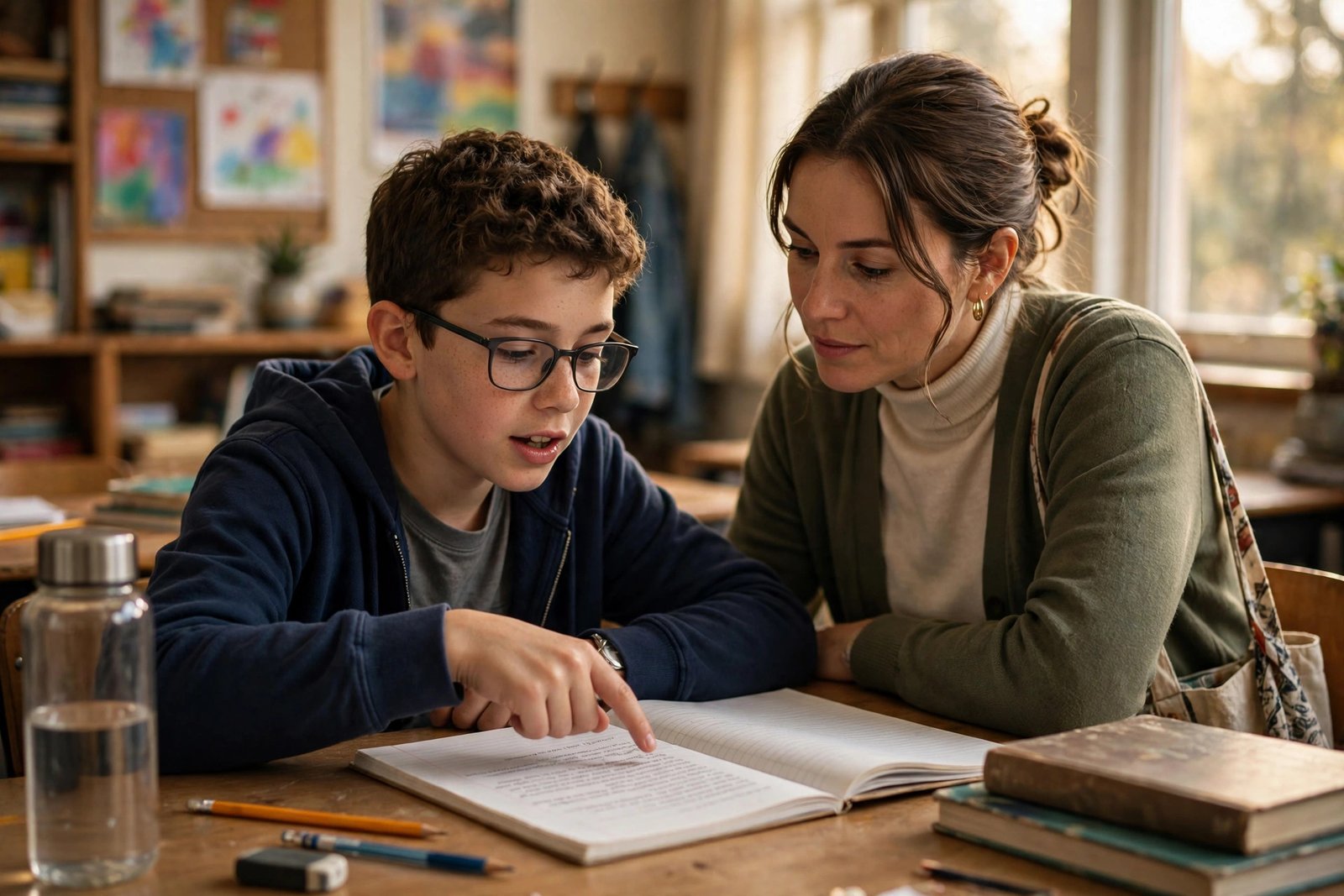
Open with curiosity, not a charge. “Talk me through this paragraph — what did you mean here?” gives an honest pupil a chance to show their thinking. “Did you use AI for this?” puts any pupil on the defensive. Listen for specifics. A pupil who wrote the work can usually name the source and say what they found hard. A pupil who did not write it will often stay vague or repeat the text back to you. End with a clear next step. If you are satisfied, say so and move on. If you are not, explain what happens next and what the pupil can do — for example, redoing the work under supervision.
The Best Detection Is Prevention
The most effective way to detect AI-written homework is to make it hard to outsource. Assignments that ask for personal experience, class discussion or local detail are far harder for AI to fake than a generic essay. Try in-class writing for at least part of an assessment, so you have a baseline for each pupil’s voice — see AI tools for teachers. Ask for drafts or a short reflection on what changed between drafts. Use oral follow-ups: a two-minute conversation tells you more than any detector. Be explicit about what AI use is allowed — see how students can use AI to study without cheating. Many schools allow AI for brainstorming or checking grammar, and forbid it for writing the final submission. Write the rule down, share it with pupils and parents, and apply it consistently.
What Not to Do
Do not use a detector score as the only evidence in a misconduct case. Do not run a pupil’s work through a free detector that stores submissions without checking its privacy policy. Do not assume a fluent essay from a pupil who usually struggles must be AI-written — it may be hard work or tutoring. Above all, do not let a tool decide a child’s reputation. A false accusation can damage trust for years, and the pupils most at risk of a false flag are the ones who already face the most barriers in school.
A Fairer Way Forward
That flawless essay is still on your desk. You do not need a better detector. You need a better process: know the pupil’s voice, keep the drafts, ask the pupil to explain the work, and design the next assignment so it cannot be handed to a machine. Start there this week, and the detector can go back to being what it always was — a hint, not a verdict.
Frequently Asked Questions
Can teachers reliably detect AI-written homework?
Not from a detector alone. Combine a pupil’s known voice, process evidence and a conversation in which the pupil explains their work.
How accurate is Turnitin AI detection?
Turnitin aims for a false positive rate under 1% for documents with more than 20% AI writing, according to its own FAQ. Independent tests show it rarely flags fully human writing, but it also misses a lot of AI text.
Is GPTZero free for teachers?
Yes. GPTZero’s free plan covers 10,000 words a month. Premium costs $12.99 a month billed yearly, as listed in November 2026.
Why do AI detectors flag non-native English writers?
Detectors measure how predictable text is, and non-native writers tend to use simpler vocabulary and more repetitive patterns. A 2023 Stanford study found they falsely flagged an average of 61.22% of human-written TOEFL essays.
What should a teacher do if a detector flags a pupil’s work?
Pause, gather drafts and version history, and ask the pupil to explain their work. Do not open with an accusation.
How can teachers prevent AI cheating in homework?
Design assignments that are hard to outsource: personal experience, class discussion and process work. Use in-class writing and ask for drafts.