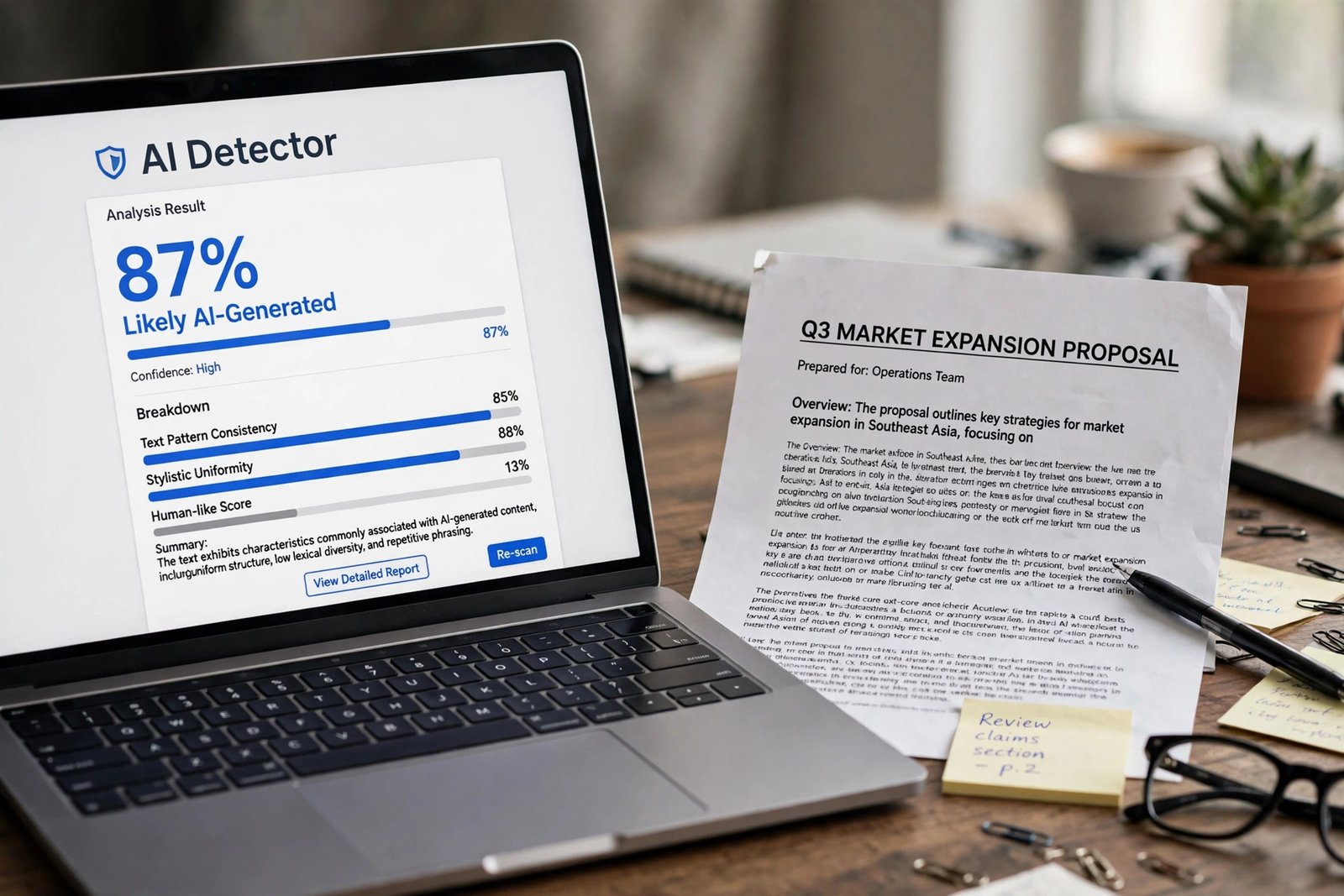
Learning how to check if text was written by AI usually starts with pasting it into a detector and reading the score. That score is a clue, not a verdict: detectors measure how predictable the writing looks, and they get it wrong in both directions often enough that no single result should settle the question.
You can check, but you cannot prove authorship from a score alone. The reliable approach combines two detectors, a careful human read, and the context around the text — this guide shows how, what the research says, and what to do when a detector gets it wrong.
Key takeaways
- A detector score is a probability signal, not proof of authorship — a reason to look closer, never a finding on its own.
- Use two different detectors and compare — agreement means more than any single score.
- Short, heavily edited and paraphrased text are the least reliable cases for every detector.
- Human writing is flagged too, and non-native English writers are flagged far more often than native writers.
- Pair every tool result with a human read and the surrounding context before acting on it.
How AI detectors actually work
Most detectors look at two statistical patterns: perplexity, how predictable each word is given the words before it, and burstiness, how much sentence length and structure vary. AI text tends to be more predictable, because models favour the most likely next word, and more uniform, while human writing mixes short and long sentences. Some detectors are trained classifiers, built on thousands of human and AI texts. Either way, no detector reads like a person: it does not know what the words mean, whether the claims are true, or who wrote them. It measures surface patterns and returns a probability — which explains almost every failure.
Predictable writing — simple vocabulary, safe structures, formal phrasing — scores as “AI”; editing, paraphrasing and asking the model to vary its style push the score towards “human”. The detector measures style, not authorship.
A practical way to check a piece of text
Checking well takes a few minutes and three steps: run the tools, mind the length, and read the text yourself.
- Start with two detectors, not one: Use two different tools and compare. GPTZero, Originality.ai, Copyleaks and ZeroGPT offer free checks with limits; Turnitin’s indicator is available inside institutions. If both flag the same passage strongly, that is a meaningful signal. If they disagree, the result is inconclusive. Do not treat a percentage as precise. “87% AI” does not mean 87% of the text was machine-written; most tools report a probability for the whole passage. Read the tool’s own explanation before quoting a score.
- Mind the length of the text: Detectors need enough writing to find a pattern. OpenAI said its own classifier was very unreliable under 1,000 characters; Turnitin sets a 300-word minimum. A single paragraph, a short email or a social post is too little evidence to judge fairly. Check a longer sample — several hundred words — in one piece, not sentence by sentence. Sentence highlights are the least reliable part of most reports: Turnitin reports a sentence-level false-positive rate of around 4%, so roughly one highlighted sentence in 25 may be human.
- Read it yourself: the signs worth looking for: A human read catches things no detector measures. AI-generated text often has a polished, even rhythm: sentences of similar length, paragraphs of similar shape, transitions that feel pasted in. Look for vague claims with no concrete detail — no names, dates, numbers or examples — and confident statements about facts that turn out to be wrong. Checking the claims is often more revealing than checking the style, because fabricated references and invented facts are a known weakness of AI writing. Our guide to what AI hallucination is and how to check AI answers explains how to verify claims rather than taking them on trust. Also look for what is missing. Human writing usually carries traces of a real person: an odd example, a personal aside, an opinion held with force. AI text tends to be balanced to a fault, covering every side and committing to none. No single sign proves anything, but several together, with a high detector score, are worth taking seriously.
The main detectors, compared
No detector suits every situation. The best-known options:
| Detector | Best for | Known limits | Cost |
|---|---|---|---|
| GPTZero | Quick checks of essays and articles | Weak on short texts; flags polished non-native writing more often | Free tier; paid plans |
| Turnitin AI detection | Academic work inside institutions that use Turnitin | Institution-only; scores below 20% shown with an asterisk as less reliable | Institutional licence |
| Originality.ai | Publishers checking web content and freelance work | Accuracy drops on edited or paraphrased AI text, like every detector | Paid, pay-as-you-go |
| Copyleaks | Schools and businesses combining plagiarism and AI checks | Short or translated passages are harder to judge | Free trial; paid plans |
| ZeroGPT | A fast free second opinion | Simpler analysis; treat its verdict as a rough signal only | Free with limits |
What the research says about accuracy
Vendor claims are impressive; independent tests are less so. That gap matters most before trusting any score. The largest independent evaluation, by Weber-Wulff and colleagues (International Journal for Educational Integrity, 2023), ran 54 documents through 14 tools, including Turnitin and GPTZero. No tool scored above 80% overall, and only five cleared 70%. Accuracy was 96% on human writing and 74% on unmodified AI text, but fell to 42% after light human editing and 26% after machine paraphrasing — the authors concluded the tools were neither accurate nor reliable enough to use as sole evidence.
A Stanford study in Patterns (2023) tested seven detectors on 91 TOEFL essays by non-native English speakers and 88 essays by US eighth-graders, all human-written. On the eighth-graders the detectors were near-perfect. On the TOEFL essays they wrongly flagged an average of 61.3% as AI-generated; 97.8% were flagged by at least one detector, and 19.8% by all seven. When ChatGPT enriched the flagged essays’ vocabulary, false positives fell to about 11.6% — the detectors measured how elaborate the writing was, not who wrote it.
OpenAI’s own experience is instructive. Its classifier, launched in January 2023, correctly identified only 26% of AI-written text on its own challenge set, while wrongly flagging 9% of human-written text. OpenAI withdrew it in July 2023 for low accuracy — a company with direct access to its own models’ output decided its detector was not good enough to keep online.
Turnitin’s figures are stronger but conditional: under 1% false positives at document level for papers scored at 20% or more AI writing, based on 800,000 pre-ChatGPT papers. That is a vendor self-report, and it does not cover most submissions, which score below 20% — the range Turnitin itself marks as less reliable. GPTZero advertises around 95.7% detection on the academic RAID benchmark at a 1% false-alarm threshold, while an independent study by Walters in 2023 found it correctly identified 81% of papers and wrongly identified 4%. The pattern is consistent: detectors do well on plain, unedited AI text and poorly everywhere else.
A checklist before you act on a score
Use this framework before treating any detector result as evidence. If you cannot tick most of these boxes, the answer is “inconclusive”.
- Is the sample long enough? At least 300 words, checked as a single passage.
- Do two detectors agree? Run the text through a second tool and compare.
- Have you read it yourself? Note specific signs — uniform rhythm, vague claims, factual errors — not just the number.
- Have you checked the facts? Invented details point to AI more reliably than style does.
- Does the context fit? Consider the writer’s usual style and drafts, and whether they had reason to use AI.
- Is there process evidence? Drafts, edit history or notes often settle what a detector cannot.
- Would you act on this alone? If not, do not present the score as proof.
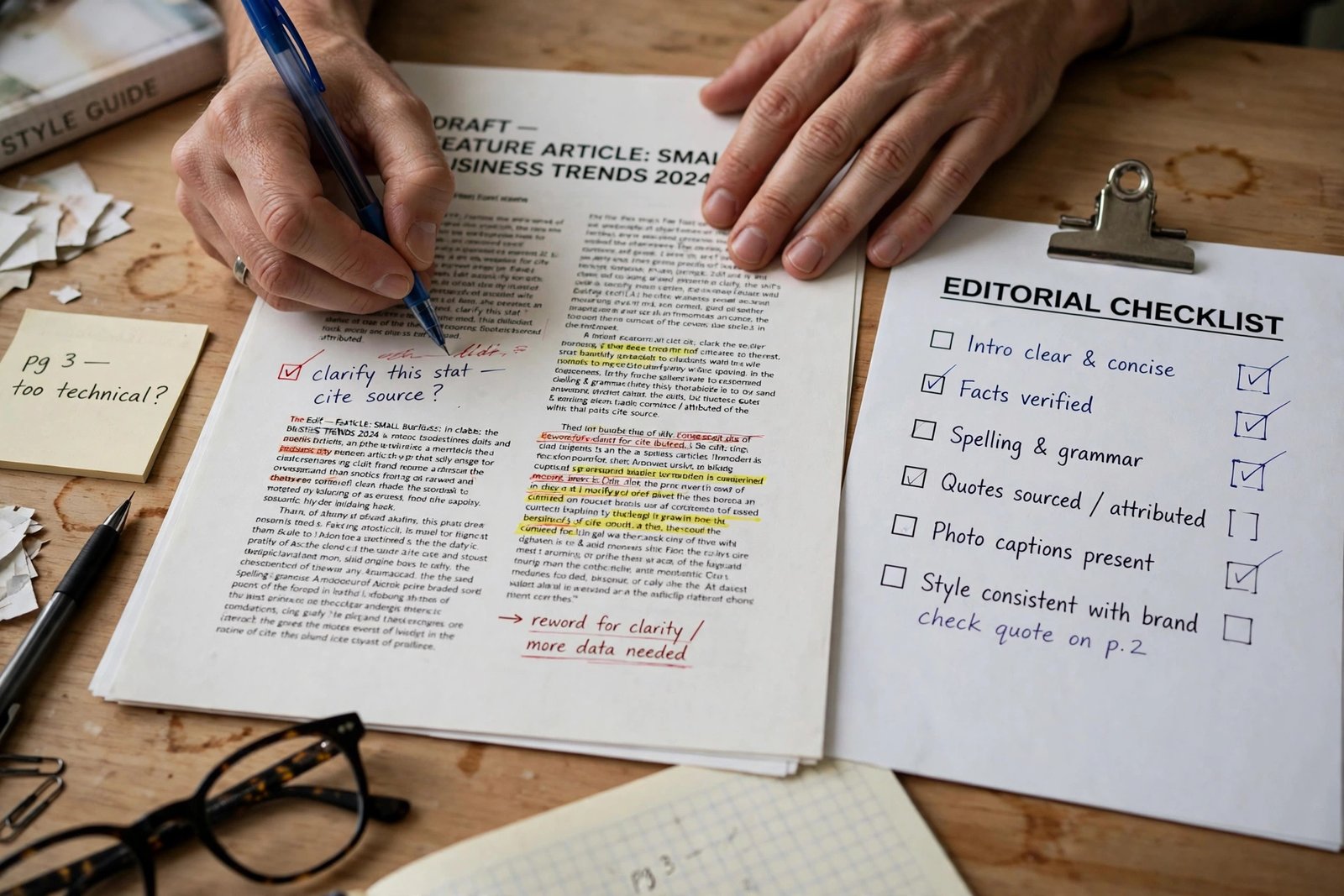
If two detectors agree, the manual signs point the same way, and the context supports it, you have a basis to ask questions. If the tools disagree, the text is short, or the only evidence is one score, the result is inconclusive — say so.
What to do if a text is flagged
If you are checking someone else’s work, do not start with an accusation. Start with a conversation: show what was flagged, explain that detectors make mistakes, and ask about their process — how they drafted it, whether they used AI for any part of it. Many people use AI for brainstorming or polishing, which differs from submitting AI-written work as their own. A detector cannot make that distinction for you.
If you are a teacher, fairness matters more than catching every case. Our guide on how teachers can detect AI-written homework fairly sets out an approach that protects students who wrote their own work while addressing genuine misuse. The principle is the same: a detector score starts a conversation, it does not end one.
Frequently asked questions
Can an AI detector prove a text was written by AI?
No. Detectors estimate how much a text resembles patterns associated with AI writing. No published detector can prove authorship, and independent tests show error rates high enough that a score alone is never proof.
How accurate is GPTZero?
It depends on the test. GPTZero reports around 95.7% detection on the RAID benchmark at a 1% false-alarm threshold. Independent tests are lower: one 2023 study found it correctly identified 81% of papers and wrongly identified 4%.
Why was my own writing flagged as AI?
Most likely because it shares the patterns detectors look for: predictable word choices, even sentences and formal phrasing. It happens most often to non-native English writers — a Stanford study found seven detectors wrongly flagged an average of 61.3% of human-written TOEFL essays — but also with short, technical or templated writing.
Can paraphrasing fool AI detectors?
Yes. In the Weber-Wulff study of 14 tools, accuracy on AI text fell from 74% unedited to 42% after light human editing and 26% after machine paraphrasing. Paraphrasing does not make AI text human-written, but it makes it much harder to spot.
What is the most reliable way to check if text was written by AI?
Combine methods: run the text through two detectors, read it yourself for style and factual errors, and weigh the context — drafts, usual style, and whether AI use was plausible. No single method is reliable alone; together they give a judgement you can defend.
The bottom line
You can check if text was written by AI, and you should — but the check will not give you certainty. Detectors have documented blind spots: they miss edited and paraphrased AI text, and they wrongly flag human writing, most of all from non-native English speakers. The score is a starting point, not an answer. The approach that holds up is unglamorous: two detectors, a long enough sample, a careful human read, and the context. When they agree, you can ask hard questions with confidence. When they do not, say so and look for better evidence. That restraint separates a fair check from an unfair accusation.
Start with the next text you are unsure about: run it through two detectors, read it yourself with the checklist above, and note where the evidence agrees and where it does not. If you want a broader grounding in how AI works and where its limits lie, the AI Atlas hub collects our guides in one place.