Learning how to cite AI in essays and research papers starts with one rule: if AI words or ideas appear in your work, say so, and name the exact tool that produced them. Cite it like any source you did not write yourself — tool, company, date and prompt.
The three main style guides do this differently, and your tutor’s policy comes first. This guide covers APA 7th, MLA 9th and Chicago, with examples for ChatGPT, Claude and Gemini.
Key takeaways: Cite AI whenever you quote, paraphrase or summarise its output. A citation never makes unauthorised use acceptable — check your tutor’s policy first. APA 7th names the company as author; MLA 9th starts with your prompt; Chicago usually uses a footnote. Record the tool, model, date and prompt while you work. Never cite AI as an author, and check every reference it produces.
When do you need to cite AI?
Cite AI whenever its output appears in your paper: quotations, paraphrases, summaries, translations and images it generated. If a reader could mistake AI words for your own, they need a citation. Describe the use even when nothing is quoted. If AI helped you outline, draft or polish, most style guides expect an acknowledgement — a sentence in your introduction or method section, or a short disclosure note. APA advises describing the use in the method section; MLA advises acknowledging substantive uses so a reader can see where the tool’s part ends and yours begins. The line for light editing varies by course, and course rules matter more than any style guide. When in doubt, disclose. Harvard, Oxford and Cambridge all treat unauthorised or unacknowledged AI use in assessed work as academic misconduct, with the detail set by the instructor. Citing AI is not the same as using AI well. Using AI to study without cheating means keeping the thinking yours and the AI’s role visible.
What every citation needs
Every style needs the same four facts — collect them while you work. First, the tool and model: “ChatGPT, GPT-5”, “Claude Sonnet 4.5” or “Gemini 2.5 Flash”. Second, the company: OpenAI, Anthropic or Google. Third, the date, because the same prompt can give a different answer tomorrow. Fourth, the prompt, or a short description of it. Save a shareable link to the chat where the tool offers one — ChatGPT, Claude and Gemini all let you share a conversation link. Keep a copy of important outputs too, pasting the full text into an appendix if the passage matters. APA suggests this for long responses, since a chat behind a login is not retrievable by other readers.
APA 7th: cite the company as author
APA 7th treats the AI tool as software, and the company that made it as the author. Cite a specific chat when you have a shareable link and a title for it; cite the tool generally when describing its use rather than reproducing a particular output. For a specific chat: OpenAI. (2025, August 21). High school grammar concepts [Generative AI chat]. ChatGPT. https://chatgpt.com/share/…
The author is OpenAI, the date is the full date of the chat, and the title is the chat’s title in italics, followed by a bracketed description, the tool name and the shareable URL. The in-text citation is simply (OpenAI, 2025). For the tool in general, the entry is shorter, with the year of the version you used: OpenAI. (2025). ChatGPT [Large language model]. https://chatgpt.com/
The same pattern works for Claude (Anthropic) and Gemini (Google). In your text, give the prompt and then the relevant passage: “When prompted with ‘Summarise the causes of the French Revolution in 200 words’, the ChatGPT-generated text listed fiscal crisis, food shortages and political deadlock (OpenAI, 2025).”
MLA 9th: start with the prompt, not an author
MLA 9th takes a different position: an AI tool cannot be an author, because only humans can be authors. So the works-cited entry begins with the prompt, treated as the title of the source, and the tool becomes the container. The model goes in the version element, the company is the publisher, and the entry closes with the date and a shareable URL. A works-cited entry for ChatGPT looks like this: “Describe the theme of nature in Jane Austen’s Mansfield Park” prompt. ChatGPT, model GPT-4o, OpenAI, 23 Sept. 2024, chatgpt.com/share/…
The in-text citation uses the first words of the prompt: (“Describe the theme”). If you already described the prompt in your prose, shorten the title element to a description of what was generated — but keep the prompt visible somewhere. The same template works for Claude (Claude, Anthropic) and Gemini (Gemini, Google). Name the model precisely.
Chicago: a footnote first, a bibliography entry only sometimes
For most writing, Chicago says it is enough to acknowledge the tool in your sentence: “The following recipe for pizza dough was generated by ChatGPT.” For a student paper, use a numbered footnote instead: 1. Text generated by ChatGPT, OpenAI, March 7, 2023, https://chat.openai.com/chat. If the prompt is not in your text, put it in the note: “1. ChatGPT, response to ‘Explain how to make pizza dough from common household ingredients,’ OpenAI, March 7, 2023.” If you edited the AI text, say so — “edited for style and content” is enough. Here is the strict part. Chicago treats a chatbot conversation like a personal communication, such as an email. Do not put it in the bibliography unless you can give a publicly available link; a chat URL that requires your login does not count. With a public link, the entry goes under the company, not the tool: “Google. Response to ‘How many copyeditors does it take to fix a book-length manuscript?’ Gemini 1.0, February 10, 2024. https://g.co/gemini/share/…”
APA vs MLA vs Chicago at a glance
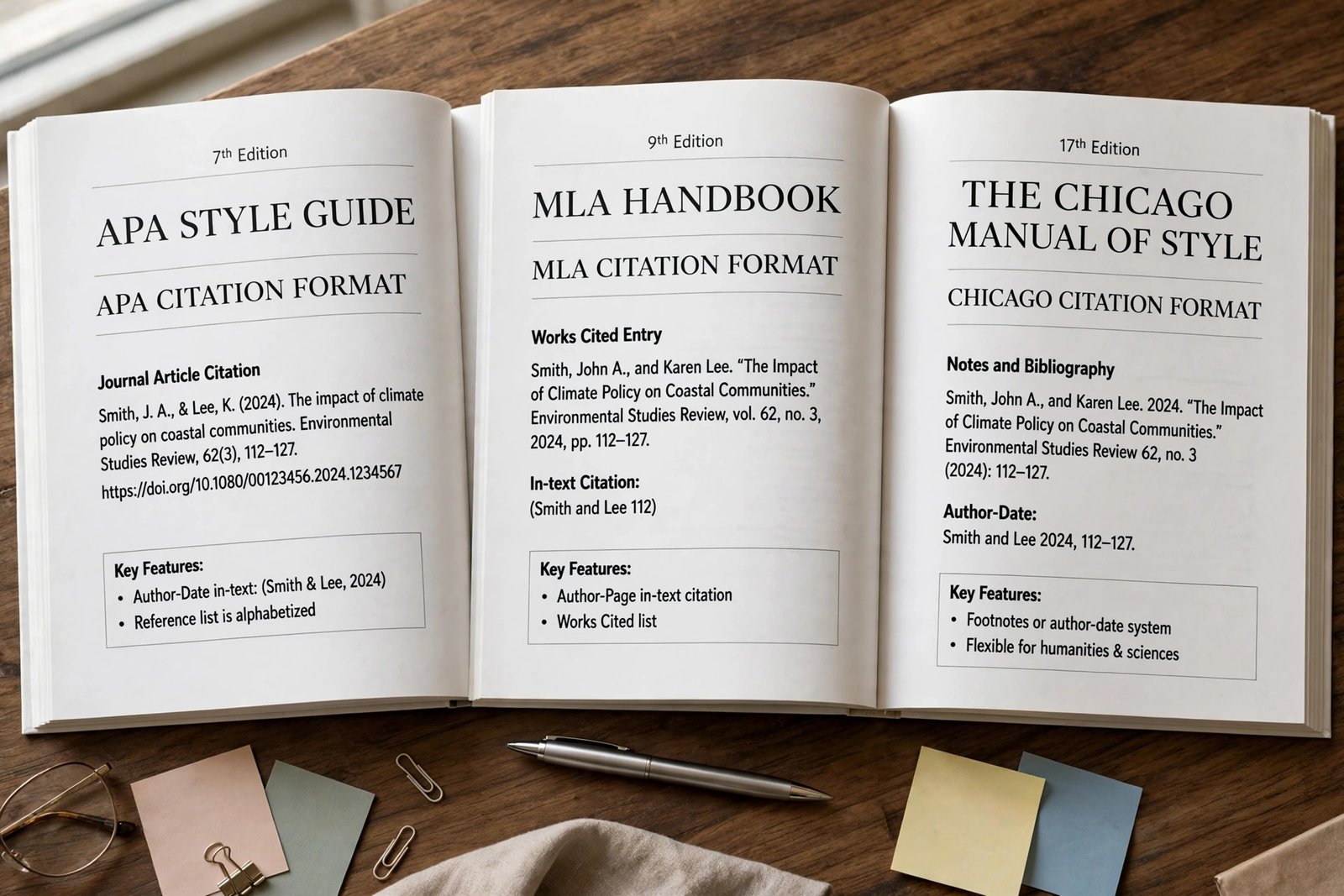
The three guides agree on the principle and disagree on the shape.
| Style | Author element | Where it goes | Key detail |
|---|---|---|---|
| APA 7th | Company (e.g. OpenAI) | Reference list and in-text citation | Full date for a chat, year of the version for the tool |
| MLA 9th | None — entry starts with the prompt | Works Cited and a shortened prompt in text | Tool is the container, model is the version |
| Chicago | Tool named in the note; company in a bibliography entry | Footnote or endnote first | Bibliography entry only with a public link; say if you edited the output |
Writing the disclosure: what to say beyond the citation
A citation points at one passage; a disclosure tells the reader what the tool did across the whole paper. Many courses want both. Keep it specific — “AI was used in this essay” tells the marker nothing. A workable template: “I used [tool and model] on [date] to [brainstorm, outline, draft, edit, translate]. I wrote the argument and the analysis myself. I checked every fact and reference the tool produced against [the sources you used].” Adjust it to the truth: if the tool only fixed your grammar, say that; if it drafted a paragraph you rewrote, say that and what you changed. Put it in the method section, a note after the introduction, or a declarations section. Some courses supply their own wording — use theirs when they do.
Five mistakes that cost marks
First, treating AI as an author. No style guide allows it, and publishers do not permit AI authorship. In APA the company is the author of the reference; in MLA there is no author; in Chicago the tool is named in a note. You remain responsible for everything in the paper, including the AI’s errors.
Second, citing a reference the AI invented. AI tools can produce plausible-looking references to papers that do not exist. AI can invent references that look real, so every source the tool suggests must be found and read independently first. If you cannot find it, do not cite it.
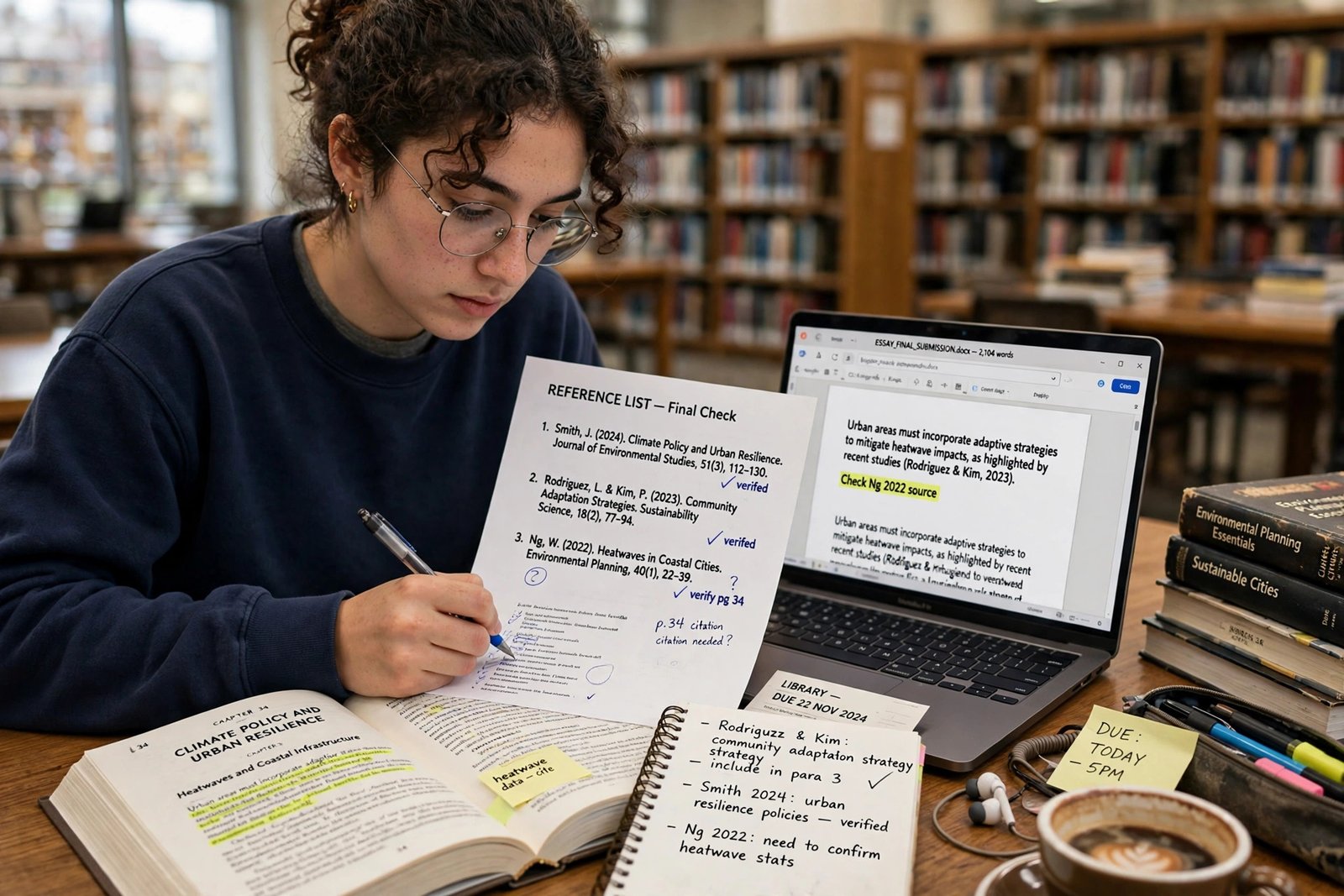
Third, citing the AI instead of the real source. If the AI summarised a journal article, cite the article, not the chatbot. The chatbot is a route to the source, not the source itself. A genuine paper will exist in a library catalogue; a fabricated one will not.
Fourth, leaving the citation vague. “ChatGPT” with no model, date or prompt is not a citation; it is a brand name.
Fifth, assuming a citation fixes an unauthorised use. If your brief says not to use AI for drafting, citing the AI does not make it acceptable — it makes the breach easier to see. Check the brief first, then cite. How teachers check AI-written work is a reminder that detection is only part of the picture; the policy decides the outcome.
A checklist before you submit
Run through this list with your finished draft open, and fix every no before you hand the work in.
- Is this use allowed? Does the brief or course policy permit what I used AI for?
- Have I disclosed it? Is there a note saying which tool I used and what it did?
- Is every AI passage cited? Does each quotation, paraphrase and summary have an in-text citation and a matching entry?
- Are the four facts present? Tool and model, company, date, and prompt — in every entry?
- Have I checked the references? Is every source the AI suggested verified in a library catalogue?
- Is the AI’s role honest? Does my disclosure match what actually happened, including anything I edited?
Frequently asked questions
Do I need to cite AI if I only used it for grammar and spelling?
It depends on your course, but disclose it either way. APA advises describing the use and citing the tool generally, rather than referencing every chat. Many departments accept a one-line note: “ChatGPT (GPT-5) was used for grammar and spelling checks only.” Follow your department’s rule if it is stricter.
What if my AI chat has no shareable link?
Cite the tool generally instead of the specific chat. In APA: the company, the year of the version, the italicised tool name with a bracketed description, and the tool’s home page URL. In MLA, give the tool’s general URL. In Chicago, use a footnote and leave the conversation out of the bibliography.
How do I cite an AI-generated image?
Cite it like any other figure, adding the tool, company and prompt. In APA, put a figure number and title above the image and a note below it naming the tool and prompt, with a reference list entry for the chat. In MLA, the caption carries the prompt, tool, version, company and date. In Chicago: “‘A modern office rendered as a cubist painting,’ image generated by OpenAI’s DALL·E 2, March 5, 2023.”
My tutor has no AI policy. What should I do?
Ask them, in writing, before you submit. Until you have an answer, use AI only for brainstorming and editing, disclose exactly what you did, and cite any AI wording you keep.
The bottom line
Citing AI is not complicated once you know your guide, but it is unforgiving of vagueness. APA names the company, MLA starts with your prompt, and Chicago keeps it in a footnote unless you have a public link. All three expect you to record the tool, model, date and prompt — and to have checked your tutor’s policy first. Start with one step before your next essay: open your department’s style guide, copy the format for your tool into a note, and save the shareable link and prompt every time you use AI. That habit takes thirty seconds per chat, and turns citation from a last-minute scramble into a record you already have.