Los Angeles Schools Just Blocked Google’s AI Features
Los Angeles Unified School District has quietly disabled Google’s AI Overviews on school-issued devices, making it the largest school district in the United States to strip the AI summaries out of Google Search. The district, enrolling about half a million students, made no formal announcement. Parents and students simply noticed the AI-generated answers had vanished.
The move is the sharpest clash yet between American schools and Google over who decides what AI children see. Earlier in November 2026, Google told schools that if they wanted AI switched off, they would lose Google Search altogether, because the company says search and AI cannot be separated. Los Angeles answered by keeping Google Search as the default and blocking the AI layer with a third-party tool anyway.
That answer matters far beyond one district. Los Angeles is the second-largest school district in the country, and its devices number about a million. If a district that big can route around Google’s AI, smaller districts will ask why they cannot do the same, and Google will have to decide whether its all-or-nothing position can survive.
Key takeaways
- Los Angeles Unified disabled AI Overviews on school-issued devices in mid-November 2026, days after a 13 November school board AI committee meeting, and kept Google Search as the default.
- Google had told schools that blocking AI would mean losing Google Search, saying the two cannot be separated; Los Angeles used a third-party tool to block the AI summaries instead.
- The district describes the suspension as temporary and aimed at keeping student experiences age-appropriate and safe, and it had already disabled Google’s AI Mode at the start of the school year.
- Fairfax County in Virginia built its own in-house app to block AI in search and Seattle said it would use a web filter, while New York and Los Angeles both announced one-year moratoriums in September 2026.
- What is not confirmed: the exact third-party tool Los Angeles used, how long the temporary suspension will last, and whether the district will actually drop Google products if Google refuses a permanent workaround.
What actually happened in Los Angeles
On Friday 13 November 2026, members of Schools Beyond Screens LA, a local group campaigning for screen-time limits and closer oversight of classroom technology, spoke at a meeting of the Los Angeles school board’s AI committee. By the following Monday, AI Overviews were gone from district devices. Bridie Lee, a leader of the group, told reporters it was the talk of the playground.
The district did not issue a press release. Parents noticed the change themselves, and Schools Beyond Screens LA asked them to send videos of their children’s laptop screens. The district then confirmed the summaries had been disabled. The exact method has not been confirmed in public: NPR reported that the district is using a third-party app.
In a statement, the district said it had temporarily suspended AI Overviews to ensure student experiences are age-appropriate and safe. The wording leaves the door open: the suspension can be lifted if Google offers a proper off switch, or extended if it does not.
The district blocked AI Overviews, the AI-generated summaries above ordinary search results, and it had already disabled Google’s AI Mode on school-issued student devices at the beginning of the school year. Google Docs, Google Drive and Google Search itself remain in use. Our report on Google’s data-center pauses in Belgium and Virginia shows the same company facing pushback on two continents in the same month.
Why the district blocked the AI summaries
The objections from educators are not abstract. Districts that have moved against AI Overviews say the summaries shortcut students’ critical thinking by handing them an answer before they have read any of the underlying material. A student handed a finished paragraph has little reason to open a source or compare claims.
The second objection is accuracy. AI Overviews can present incorrect information confidently, to children still learning how to judge a source. Districts have also raised the risk of students being shown wrong or unsuitable information with the authority of a search result.
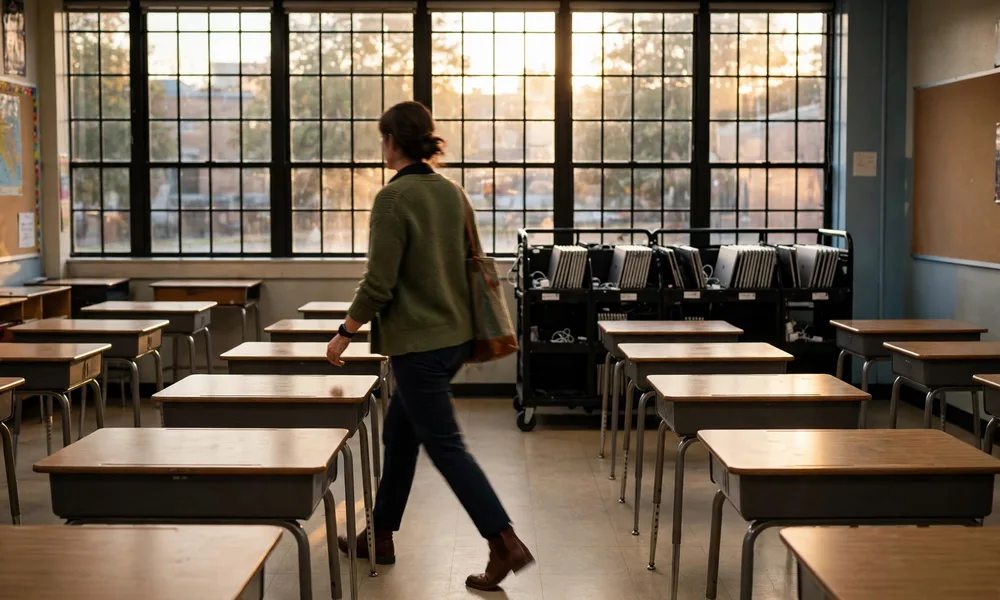
Those concerns had already produced action before November. In September 2026, the country’s two largest school districts, New York and Los Angeles, announced one-year moratoriums on student use of generative AI. In New York the ban covers elementary and middle school students; in Los Angeles it covers all students from kindergarten through grade 12. The November move extends that moratorium into the search results students cannot avoid seeing.
When the district’s chief information officer, Jack Kelanic, spoke about the options at the board meeting, the room cheered. Kelanic said the district has about a million managed devices and can change the default search engine literally overnight. The devices are overwhelmingly Chromebooks, as our report on Chromebook versus Windows laptops explains.
Google’s position: search and AI are one product
Google’s stance is that AI Overviews are not an optional extra on top of search but part of search itself. Earlier in November 2026, the company told schools that districts wanting to ban AI would no longer be able to use Google’s search engine. Chris Phillips, Google’s vice president and general manager of education, put it bluntly to the New York Times: search and AI are deeply integrated, and districts that blocked AI would lose search access.
That position is a gamble. A company that tells its largest education customers to take AI or leave search is betting that the customers have nowhere else to go. But New York City, Los Angeles and Chicago are all reported to be considering switching search engines if the dispute comes to that.
Google has already retreated on one front. Earlier in November 2026, it walked back a policy that would have switched on its Gemini chatbot by default for many kindergarten-through-grade-12 students; the tools will now be opt-in for students instead. More than 500 Google employees signed a petition asking the company to reconsider. NPR reported it reached out to Google about the Los Angeles block and had not heard back as of 29 November 2026. Our report on DeepMind’s self-improving AI and its Gemini releases covers that pace.
The wider pushback: Fairfax, Seattle and New York
Los Angeles is the largest district to act, but it is not the first. Fairfax County Public Schools in Northern Virginia developed an in-house app to block the AI components of search and is piloting it before rolling it out district-wide. Seattle Public Schools said it would use a web filter to block AI Overviews. The goal in both cases is the same: keep the search engine and lose the AI summary.
That variety is also the problem. Education experts quoted in the coverage worry that smaller districts may not be able to keep up with the IT demands of building or maintaining a workaround, or have the budget to license a third-party app to filter out AI. A large district can hire engineers and run a pilot; a small rural district with a part-time technology coordinator cannot. If Google holds its line, wealthy districts may buy their way out while poorer ones are left with the default.
The caveats that matter
Several important details remain unconfirmed. The exact third-party tool Los Angeles used has not been publicly confirmed. The suspension is described as temporary, but no end date or review date has been published. The Associated Press reported districts are considering dropping Google products unless the company gives them a permanent workaround, but no public statement confirms Los Angeles itself has decided to do so.
There is also no published evidence yet on whether blocking AI Overviews changes learning outcomes, and no district has released data on classroom time saved or lost. The debate is being fought on principle and on anecdote, which is understandable in a fast-moving dispute but means the educational case for and against the summaries is still largely asserted rather than measured. NPR disclosed in its coverage that Google is a financial supporter of the network.
| Detail | What is known |
|---|---|
| District | Los Angeles Unified, the second-largest district in the US, about half a million students |
| What was blocked | Google AI Overviews in search on school-issued devices; AI Mode had already been disabled at the start of the school year |
| When | Days after the school board AI committee meeting on 13 November 2026; summaries gone by Monday 16 November 2026 |
| How | A third-party app or filter, according to NPR; the exact tool has not been publicly confirmed |
| District’s stated reason | Temporarily suspended to ensure student experiences are age-appropriate and safe |
| Google’s position | Search and AI are deeply integrated and cannot be separated; districts blocking AI would lose Search access |
| Other districts acting | Fairfax County built an in-house app; Seattle plans a web filter; New York and Los Angeles announced one-year moratoriums in September 2026 |
| Scale | About a million managed devices, according to chief information officer Jack Kelanic |
Checklist: judging the AI-in-schools fight honestly
Use these checks before sharing the story or drawing conclusions from it.
- Separate what was blocked from what was kept: AI Overviews and AI Mode are off, but Google Search, Docs and Drive remain.
- Ask who confirmed a detail: the district confirmed the block, while the exact tool and any plan to drop Google products are unconfirmed.
- Remember the scale: about a million devices give Los Angeles leverage most districts do not have.
- Watch for the two-tier risk: ask whether smaller districts can afford the same workaround.
- Do not confuse a temporary suspension with a permanent ban: the district has set no public end date, and the move could be reversed or extended.
- Follow Google’s response, not just the districts’: the company’s next statement, or its silence, decides whether this becomes a precedent or a standoff.
Frequently asked questions
What did Los Angeles schools actually block?
Los Angeles Unified disabled Google’s AI Overviews on school-issued devices. It had already disabled Google’s AI Mode at the start of the school year.
Why did Google say schools could not turn AI off?
Google told schools that search and AI cannot be separated, and that districts wanting to ban AI would lose Google Search. Its education chief, Chris Phillips, said districts that blocked AI would lose search access.
How did Los Angeles block AI Overviews if Google said it was impossible?
The district used a third-party tool to filter the AI summaries out while keeping Google Search as the default. The exact tool is unconfirmed.
Are other school districts doing the same thing?
Yes. Fairfax County Public Schools built an in-house app to block the AI components of search, Seattle Public Schools said it would use a web filter, and New York and Los Angeles both announced one-year moratoriums in September 2026.
Will Los Angeles drop Google products entirely?
That has not been confirmed. Reporting says districts are considering dropping Google products unless the company provides a permanent AI workaround, but Los Angeles has not publicly announced such a decision.
What happens next?
Google has not publicly responded to the Los Angeles block as of 29 November 2026. The next steps to watch are whether Google enforces its threat to cut off search, offers schools a genuine off switch, or quietly lets districts keep filtering.
The bottom line
Los Angeles did something Google said could not be done: it kept Google Search and removed Google’s AI from it, on about a million school devices. The district’s reasons are straightforward, that AI summaries shortcut the reading and thinking school is meant to teach, and that they can put wrong or unsuitable information in front of children. The workaround, a third-party filter, is one smaller districts may struggle to afford.
The real test now belongs to Google. It can offer schools the off switch they have been asking for, it can follow through on cutting off search for districts that block AI, or it can say nothing and let the standoff spread district by district. Los Angeles has made its position clear, and with other large districts moving the same way, Google is finding its biggest customers willing to push back.