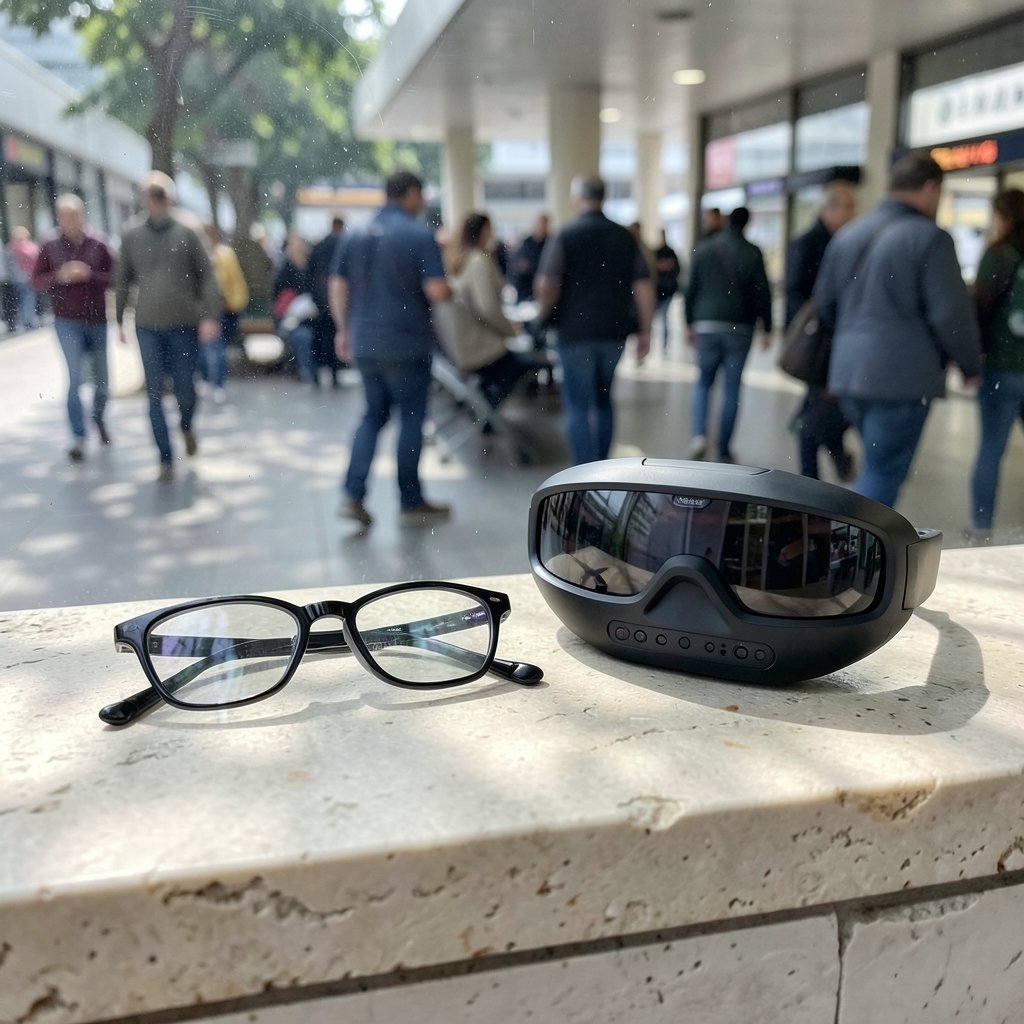
Smart glasses stopped being a science project the moment a pair sold in six figures during its first year on shelves. Ray-Ban and Meta shipped their second-generation frames in late 2023, and the category quietly crossed from novelty to normal. Xreal took a different road, building a wearable display for people who want a cinema or a monitor strapped to their face. Both products get called “smart glasses,” but they solve opposite problems. One is an AI companion you happen to wear. The other is a screen you happen to wear.
This comparison breaks down what each pair actually does, where each one frustrates real owners, and how to pick without wasting money on features you will never touch.
What Each Product Actually Is
The Ray-Ban Meta is a pair of sunglasses or clear-lens frames with cameras, open-ear speakers, and a microphone built into the temples. You tap or talk to control it. It answers questions, takes photos, livestreams, and plays music through tiny speakers aimed at your ears. The frames look like normal Ray-Bans because they are normal Ray-Bans with hardware hidden inside. Meta has been steadily expanding its on-glasses assistant, and the company has signaled that display-equipped versions are the next step.
The Xreal One is a head-mounted display. It has no camera worth mentioning and no interest in telling you the weather. It projects a large virtual screen in front of your eyes so you can watch video, play games, or mirror a laptop. Xreal built its own spatial computing chip into the One so the glasses can handle stabilization and screen positioning without a separate accessory puck. The pitch is simple: a private big screen that fits in a glasses case.
One product is about ambient intelligence. The other is about ambient display. That single distinction explains almost every difference below.
Design, Comfort, and How They Look in Public

Meta wins the style contest by default. The frames carry Ray-Ban branding and come in recognizable shapes, so nobody assumes you are wearing a gadget. Weight sits near the temples, and most people report wearing them for hours without issue. The open-ear speakers mean you stay aware of traffic and conversation, which matters if you plan to wear them while walking or cycling.
Xreal One looks like eyewear from a sci-fi film. The lenses are dark, the front is bulky, and the temples are thick. That is unavoidable when you cram optics, a chip, and display panels into a frame. Comfort is decent for an hour or two of viewing, but these are not all-day glasses. They are a device you put on when you sit down to watch something.
A practical rule from owners: if you want glasses you forget you are wearing, pick Meta. If you want a screen you wear, pick Xreal. Trying to use either outside its lane leads to disappointment fast.
Camera, Audio, and Everyday Use
The Meta frames shine in small moments. You take a photo without pulling out a phone. You ask a question and hear the answer in your ear. You take a call while your hands are full. The camera quality is fine for social sharing, not for serious photography, and the speakers are surprisingly usable at moderate volume.
Privacy is the elephant in the room. Wearing a camera on your face invites questions, and some venues and businesses have pushed back on recording. Meta added a capture LED and shutter sounds to signal when the camera is active, but the social friction is real. If you work in a setting where people are sensitive to being filmed, think hard before buying.
Xreal One has no camera feature that matters, so that friction disappears. Its audio comes from built-in speakers near your ears, and the focus is entirely on what you see. For calls and quick captures, Meta is the obvious pick. For a quiet, private viewing session, Xreal is the calmer choice.
Display and Viewing Experience
This is where Xreal One runs away with the category. The glasses project a virtual screen that feels like sitting a few meters from a large television. Because the chip handles stabilization, the screen stays anchored even when your head moves, which fixes the nausea and drift problems that plagued earlier tethered models. You can connect a phone, a handheld console, or a laptop and get a private display anywhere.
Meta’s standard frames have no display at all. You get audio and camera, not visuals. Display-equipped Ray-Ban models are arriving, but the purpose is different: short notifications and assistant responses floating in your peripheral vision, not a two-hour movie. Do not buy Meta expecting a screen, and do not buy Xreal expecting an assistant.
| Feature | Ray-Ban Meta | Xreal One |
|---|---|---|
| Primary purpose | AI assistant, camera, audio | Wearable virtual display |
| Display | None on standard models | Large virtual screen |
| Camera | Yes, front-facing | No camera feature that matters |
| Audio | Open-ear speakers | Built-in speakers |
| Best for | Hands-free daily wear | Media, gaming, productivity |
| All-day comfort | High | Moderate |
| Standout risk | Privacy concerns | Bulk and limited use cases |
Software, AI, and the Platform Question
Meta’s advantage is integration. The glasses pair with a phone app, and the on-glasses assistant handles voice queries, translation, and photo capture. The company keeps adding capabilities, and its broader push into enterprise agents shows how seriously it treats AI as the product’s core. If you want to understand where this is heading, the race between OpenAI, Meta, and other enterprise agent platforms is a decent preview of the assistant features that will land on wearables next.
Xreal’s software is narrower but sharper for its niche. You get screen mirroring, adjustable screen size and distance, and support for common devices. There is no assistant trying to be your friend. The trade-off is that Xreal depends on whatever you plug into it. Without a source device, the glasses are just dark lenses.
One overlooked point: anything with a camera and a microphone deserves a hard look at security. Wearables collect ambient data constantly, and the same vigilance you apply to your phone applies here. A guide to what a keylogger is and how to detect one is worth a read if you plan to pair either device with a laptop for work. And if you travel with gear like this, running your connections through a VPN on public networks is basic hygiene, not paranoia.
Battery Life and Real-World Practicality
Meta’s frames last roughly a day of mixed use, less if you livestream or take lots of video. The charging case tops them up, and the case itself is pocketable. Most owners settle into a rhythm: wear them out, drop them in the case, repeat.
Xreal One draws more power because it is pushing light into your eyes. Battery life depends on the connected device, since the glasses pull from your phone or laptop. That means your viewing session is capped by your phone’s battery, which is a real annoyance on long flights. A power bank solves it, but now you are carrying a small kit instead of just glasses.
Common mistake number one: buying either pair expecting a phone replacement. Neither is. Meta extends your phone. Xreal borrows your phone’s screen. Both still need the phone.
Common mistake number two: skipping the fit check. Meta offers different frame shapes and lens options, and the fit affects camera angle and audio quality. Xreal’s nose pads and temple arms need to sit right or the virtual screen blurs at the edges. Try before you buy if you can, and check return policies if you cannot.
Who Should Buy Which
Buy the Ray-Ban Meta if you want glasses you can wear all day, you value hands-free photos and calls, and you are comfortable with a camera on your face. It suits commuters, content creators, and anyone who lives with their phone in hand.
Buy the Xreal One if your priority is a private big screen for flights, gaming, or focused work, and you do not mind looking like you stepped out of a tech demo. It suits travelers, handheld gamers, and remote workers who want a second monitor that packs flat. (The Verge)
Buy neither if you expect either product to feel finished. Both are early-category devices with rough edges, and both will be meaningfully better in two years. That is not a reason to wait forever, but it is a reason to buy for the features that exist today, not the ones promised in a keynote.
There is also a middle path worth watching. As display technology shrinks and assistant software matures, the two categories will collide. The same convergence is reshaping other industries, from how AI is being used in real estate to how carriers are fighting over spectrum for connected devices, a fight with real consequences for consumers. Wearables sit on the same curve.
Conclusion
The Meta Ray-Ban and the Xreal One are not really rivals. They are two answers to the question “what should glasses do?” Meta says glasses should help you capture, ask, and listen without reaching for a phone. Xreal says glasses should give you a screen wherever you are. Both answers are good. Neither is complete.
Pick based on the job you actually have. If you want a daily companion that looks normal and handles small tasks, Meta is the safer, more polished buy. If you want a private cinema or monitor and can live with bulk and a tether, Xreal delivers something Meta cannot. The worst outcome is buying one and expecting the other. Know which problem you are solving, and the decision gets much easier.
FAQ
Is the Ray-Ban Meta worth it if I already wear prescription glasses?
Yes, if you order prescription lenses through Ray-Ban’s compatible options. The frames support prescription builds, which makes them one of the few smart glasses you can wear as your primary pair. Check current lens availability before ordering, since options vary by region and frame shape.
Can the Xreal One work without a phone or computer?
No. The glasses need a source device to send video over a cable. Without a connected phone, console, or laptop, there is nothing to display. Think of them as a monitor, not a standalone computer.
Which one is better for watching movies on a flight?
The Xreal One, clearly. It gives you a large private screen that blocks out the cabin. The Ray-Ban Meta has no display on standard models, so it can play audio but not video. Just bring a power bank, because the glasses drain your phone.
Do the Ray-Ban Meta glasses record video without people knowing?
Meta built in a capture light and audio cues to signal recording, and the company has faced criticism over privacy since launch. The light helps, but social norms are still catching up. Be upfront when filming near others, and follow local rules about recording in public and private spaces.
Is the Xreal One comfortable enough for all-day work?
Most people find it fine for a few hours, not a full workday. The frames are heavier than normal glasses and the lenses are dark, which limits use in bright rooms. For focused sessions, it works well. For eight hours straight, expect breaks.
Will these products be obsolete in a year or two?
The hardware will improve, as it always does, but neither device becomes useless. Meta keeps updating its glasses through software, and Xreal’s display works with any source you connect. Buy for what the product does now, and treat future features as a bonus rather than a promise.