
What if you could swap out a laptop’s ports, screen, or even its processor the way you swap a lens on a camera? That question has driven modular computer announcements for more than a decade, and the past year has finally produced some answers. Some of them are shipping products. Others are still glass-case prototypes that may never reach a store shelf. Telling the two apart is the whole game, and this guide walks through what has actually been announced, what it means, and how to judge the next wave of promises.
Why Modular Computer Announcements Keep Coming Back
The pitch behind modular computing is simple: buy a frame once, then upgrade or repair individual pieces instead of replacing the whole machine. It is an appealing story for buyers tired of throwing away a perfectly good screen because one port died, and for businesses that want to stretch hardware budgets across several refresh cycles.
The problem is that modular design fights against everything else the industry prizes. Thin laptops, sealed batteries, and soldered memory all exist because they are cheaper to build and easier to make durable. Every modular announcement is therefore a bet that enough people will trade a little thinness for a lot of flexibility.
That tension explains the pattern readers keep seeing. Companies announce modular concepts with real enthusiasm, then quietly shelve them when the math stops working. Razer’s Project Christine, a fully modular desktop tower, became the classic cautionary tale. So when a new batch of announcements arrives, the sensible reaction is curiosity plus a healthy dose of skepticism.
The Big Announcements That Defined the Category
Three very different players have shaped the current conversation: Intel, Lenovo, and the small open-hardware outfit MNT Research. Each represents a different theory of who modular computers are for.
Intel’s “The Element”: A Modular PC Built Around a Single Board
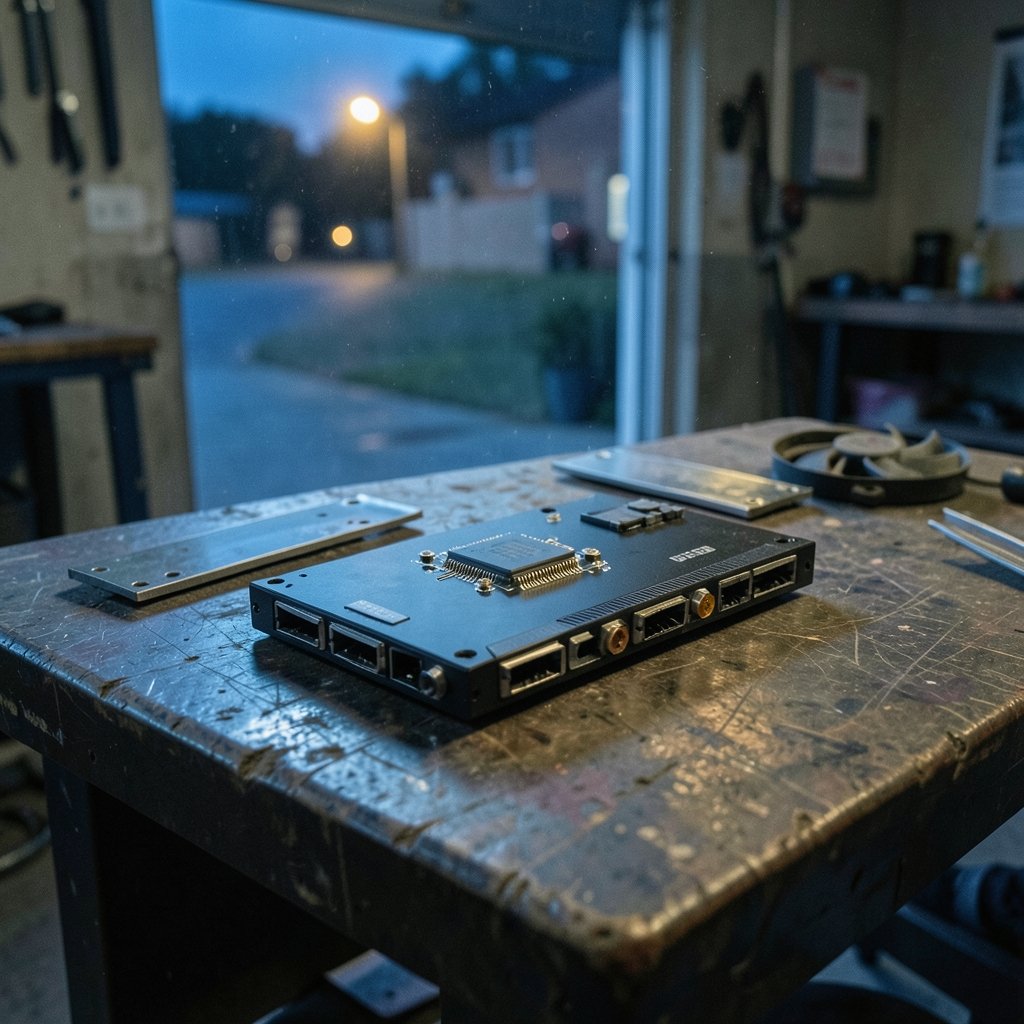
Intel hosted an event in London where it demonstrated a concept product simply called The Element. The idea is a complete PC built from a CPU, RAM, and storage on a core module, with a PCIe slot attached and a generous set of ports including Thunderbolt, HDMI, Ethernet, USB, and Wi-Fi. In the demo, Intel soldered a BGA Xeon processor onto the board with room for two SODIMM memory slots.
What makes The Element interesting is the direction of modularity. Instead of letting you swap every component, it puts the essentials on one board and lets the rest of the system attach around it. That is closer to how small form factor PCs already work than to the dream of a fully upgradable machine, but it does simplify assembly and replacement. Intel framed it as a way to bring part-swapping to people who have wanted it for years. Whether it becomes a product or stays a demonstration is an open question, and readers should treat it as a concept until Intel says otherwise.
Lenovo’s ThinkBook Modular AI PC: Modularity for Fleets
At MWC 2026 in Barcelona, Lenovo showed a prototype it calls the ThinkBook Modular AI PC. The design starts with a slim 14-inch base system and lets you attach extra displays, keyboards, input devices, and modular input/output modules. You can swap the keyboard for a secondary display to make a dual-screen two-in-one, or attach a panel beside the base unit to stretch the working area to as much as 19 inches.
Lenovo’s framing is telling. The company describes the modular architecture as a way to support evolving AI workflows and extend device lifespan, and coverage of the announcement notes the concept is aimed more at enterprise fleets than at individual consumers. That makes commercial sense: a business that can repair and reconfigure a thousand laptops without replacing them saves real money, and standardized modules are easier to manage than a drawer full of adapters.
The same event produced other Lenovo prototypes, including a foldable gaming handheld and a 3D display concept, none of which are final or have a confirmed release date. Lenovo has a long history of showing concept devices that never ship, so the ThinkBook Modular AI PC belongs in the “promising but unconfirmed” bucket.
MNT Reform Next: The Modular Laptop That Actually Ships
The most concrete news of the period came from Berlin. MNT Research began shipping the MNT Reform Next, a 12.5-inch modular open-source laptop with a mechanical keyboard and a swappable CPU, after crowdfunding on Crowd Supply in early 2025. The first batch of 16 units went to Crowd Supply in the top-end Hyper configuration, following two test units sent in September to check customs and delivery. Another 25 units were due to leave in early to mid-November, with more batches to follow.
The road was not smooth. Parts sourcing and firmware work pushed the schedule back several times, eventually to September 2026. Storage changed along the way as well: in March, MNT cut the SSD capacities promised during the campaign, swapping 2 TB drives for 1 TB and 1 TB drives for 500 GB, blaming soaring memory and storage prices driven by AI data center demand.
That last detail matters more than it looks. It shows that even a small, principled modular project is exposed to the same component market as everyone else. Modularity protects you from replacing a whole machine, but it does not protect you from the price of the parts inside it.
Concept Versus Shipping: A Quick Comparison
| Announcement | Company | Status | Who it targets | Modular element |
|---|---|---|---|---|
| The Element | Intel | Concept demonstrated in London | PC builders wanting easier assembly | Core board with CPU, RAM, storage, PCIe slot |
| ThinkBook Modular AI PC | Lenovo | Prototype, no release date | Enterprise fleets | Detachable displays, keyboards, I/O modules |
| MNT Reform Next | MNT Research | Shipping to backers in batches | Open-hardware enthusiasts | Swappable CPU, mechanical keyboard, open design |
| Foldable Legion Go | Lenovo | Concept, no release date | Gamers | Folding display, detachable controllers |
The table tells the story in one glance. Two of the four are demonstrations, one is a niche product in limited batches, and one is a gaming concept that happens to share a stage with modular hardware. None of them is a mainstream laptop you can walk into a shop and buy today.
What These Announcements Actually Solve
Strip away the marketing and modular announcements tend to promise three concrete benefits: repairability, upgradability, and longer useful life. Each one is real, but each comes with a catch.
Repairability is the strongest case. If a port module fails on a modular laptop, you replace the module, not the mainboard. That is a genuine win for anyone who has ever paid for a full motherboard swap because a single USB-C port wore out. It also matters for businesses, where a failed port can take a whole machine out of service for days.
Upgradability is the shakier promise. Swapping memory and storage is easy and already common. Swapping a processor is where things get complicated, because CPU sockets, firmware support, and thermal design all have to cooperate. MNT’s swappable CPU module works because the whole machine was designed around that constraint from day one. Bolting the same idea onto a mainstream chassis is much harder.
Longer useful life follows from the first two, but only if spare parts stay available. A modular laptop with no replacement modules in stock is no better than a sealed one. Buyers should ask how long the maker plans to sell parts, rather than only how clever the design is.
Practical Tips for Following Modular Announcements
Anyone tracking this space can save themselves a lot of disappointment with a few habits.
- Check the verb. “Announced,” “unveiled,” “teased,” and “demonstrated” all mean something different from “shipping.” A concept with no date is a design study, not a product.
- Look for a price and a date. If neither exists, the announcement is marketing. That is not a crime, but it is not a buying signal either.
- Ask what is actually swappable. “Modular” can mean anything from a replaceable battery to a fully open mainboard. Read the specifics.
- Check the spare parts plan. A modular device is only as good as the supply of modules behind it.
- Watch the component market. Memory and storage prices move, and small makers feel it first, as the MNT storage cuts showed.
- Separate the fleet story from the consumer story. Enterprise modularity and consumer modularity are different products with different economics.
A related habit applies to the software side. A modular machine is still a computer, and it still needs the same care as any other. Understanding what a computer virus actually is, and knowing how to prevent computer viruses, matters just as much on a repairable laptop as on a sealed one. If you are setting up a new machine, it is also worth learning how to choose the best antivirus for your computer so the first thing you install is protection rather than a problem.
Common Mistakes Buyers Make With Modular Hardware
The most frequent mistake is assuming that modular means cheap to own. It often means the opposite at first: modular frames can cost more up front because the maker cannot spread costs across a sealed design. The savings arrive later, if you actually use the upgrade path.
A second mistake is buying into a format too early. Standards fragment, small makers pivot, and a module you bought this year may not fit next year’s revision. Waiting for a second generation is usually the safer play with any new hardware format.
A third mistake is ignoring the boring parts. Ports, hinges, and keyboards fail far more often than processors, so a design that makes those easy to replace may deliver more real-world value than one that promises a future CPU upgrade you will never buy.
Finally, do not overlook basic maintenance habits. Backing up your data is still the single best protection against hardware failure, and the process is straightforward whether you use a Mac or a PC; a guide to backing up an iPhone to a computer with Finder or iTunes on Windows covers the phone side of that routine. Knowing what Ctrl+Z does on a computer will not save a dead drive, but a backup will.
Where Modular Computing Goes Next
The honest read on the current wave is that modular computing is splitting into two tracks. One track is enterprise: Lenovo’s fleet-focused ThinkBook concept suggests manufacturers see modularity as a service and lifecycle tool rather than a consumer feature. The other track is enthusiast and open hardware: MNT’s Reform Next proves a small team can ship a genuinely modular laptop, just slowly and in small batches.
Intel’s The Element sits between the two, a demonstration of how a compact, board-based PC could simplify assembly without promising infinite upgradability. If anything comes of it, expect it to influence small form factor designs more than consumer laptops.
What readers should not expect is a sudden flood of fully modular mainstream laptops. The economics have not changed, and the announcements so far are experiments rather than commitments. The more useful signal is the direction of travel: repairability and longer device life are now selling points that manufacturers are willing to put on a stage, which was not true a few years ago.
Conclusion
Modular computer announcements are easy to get excited about and easy to misread. The past year delivered a genuine shipping product in the MNT Reform Next, a serious enterprise prototype in Lenovo’s ThinkBook Modular AI PC, and a thought-provoking Intel concept in The Element. Only one of those three is something a buyer can actually order. The rest are bets on a future where replacing a part beats replacing a machine. That future is plausible, and the announcements are moving in its direction, but the gap between a stage demo and a box on your desk is still wide. Watch for prices, dates, and spare parts plans, and you will know which announcements deserve your attention.
Frequently Asked Questions
What is a modular computer?
A modular computer is a machine built from interchangeable parts, so you can replace or upgrade components like memory, storage, ports, or even the processor without buying a whole new system. The goal is easier repair and a longer useful life.
Did Intel actually release a modular PC?
No. Intel demonstrated a concept called The Element at an event in London, showing a compact PC built around a core board with a soldered Xeon processor, two SODIMM slots, a PCIe slot, and ports including Thunderbolt, HDMI, Ethernet, USB, and Wi-Fi. It has not been announced as a shipping product.
Is Lenovo’s modular ThinkBook available to buy?
Not yet. Lenovo showed the ThinkBook Modular AI PC as a prototype at MWC 2026 in Barcelona, alongside other concept devices. Coverage noted the devices are not final and have no confirmed release date, and Lenovo has a history of showing concepts that never reach shelves.
Which modular laptop is actually shipping?
The MNT Reform Next, a 12.5-inch open-source modular laptop with a mechanical keyboard and swappable CPU, began shipping to crowdfunding backers in batches. The first batch of 16 units went out in the top-end configuration, with more batches planned to follow.
Why was the MNT Reform Next delayed?
Parts sourcing and firmware work pushed the schedule back several times, eventually to September 2026. MNT also reduced promised SSD capacities, swapping 2 TB drives for 1 TB and 1 TB drives for 500 GB, citing soaring memory and storage prices driven by AI data center demand.
Should I wait for a modular laptop before buying?
Only if repairability is a top priority for you. Mainstream modular laptops are still concepts without prices or dates, while conventional laptops remain cheaper and easier to buy. If you do buy a modular device, check that the maker plans to keep selling replacement modules.