
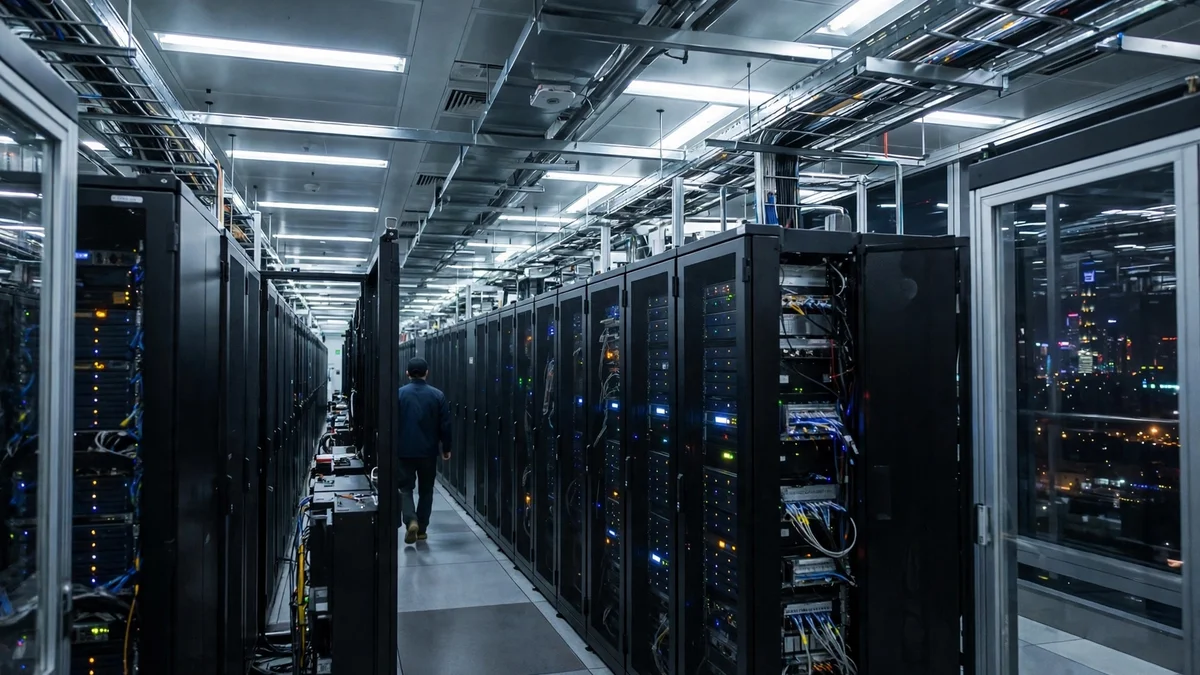
Nvidia Blackwell chips have turned up inside a data centre in Shanghai, at a site linked to Alice Huang, according to reporting published by Bloomberg on 27 November 2026. Two Chinese firms installed the export-restricted hardware at the Yangtze River Delta Project, and the trail was found in loan documents filed with Chinese regulators.
The finding matters because Blackwell chips are among the most powerful artificial intelligence processors Nvidia makes, and Washington has never authorised their export to China. If the hardware described in those filings is where the documents say it is, some of the most tightly controlled computing gear in the world reached a Chinese data centre anyway.
What follows is what the reporting established, what it did not, and why the gaps matter. The names, loan figures, serial-number check and denials are on the record. The route the chips took and who moved them are not.
Key takeaways
- Bloomberg reported on 27 November 2026 that Nvidia Blackwell chips were installed at the Yangtze River Delta Project in Shanghai, a data centre linked to Alice Huang.
- A GB300 NVL72 rack was identified by serial number in documents filed with Chinese regulators in November, and Shanghai Shuoyao offered it as collateral for a 96 million yuan loan, about $14 million.
- A second firm, Shanghai Kezhan, described a GB200 server at the same facility in documents linked to a 90 million yuan loan in late 2025.
- Blackwell chips have always required a United States licence to ship to China, and Washington has never authorised such exports, according to the reporting.
- How the hardware reached China remains unconfirmed, and Bloomberg reported that it has no evidence Megaspeed itself diverted the hardware there.
What Bloomberg’s reporting actually found
The core of the story is a pair of loan filings. Shanghai Shuoyao, one of the companies active at the Yangtze River Delta Project, offered a GB300 NVL72 rack as collateral for a 96 million yuan loan, about $14 million, from Shanghai Innovation Bank, according to filings reviewed by Bloomberg News. The documents filed with Chinese regulators in November specified a serial number for the rack.
A second firm, Shanghai Kezhan, described a GB200 server at the facility in documents for a 90 million yuan loan in late 2025. Both models rely on Blackwell chips, so the filings point to more than one piece of restricted hardware at the same site. Shanghai Kezhan also disclosed 32 servers with H200 chips there, an earlier restricted Hopper model. For context, our report on who is building what in the AI chip war sets out the companies and supply chains behind stories like this one.
How a serial number traced the rack to Gigabyte
The GB300 NVL72 is a standard two-metre-tall server rack containing 72 Blackwell Ultra chips and 36 Grace processors, weighing more than 1,500 kilograms. Its scale is part of why the story drew attention: Nvidia chief executive Jensen Huang once argued that hardware of this size was too big to smuggle, a claim the new reporting puts under fresh pressure.
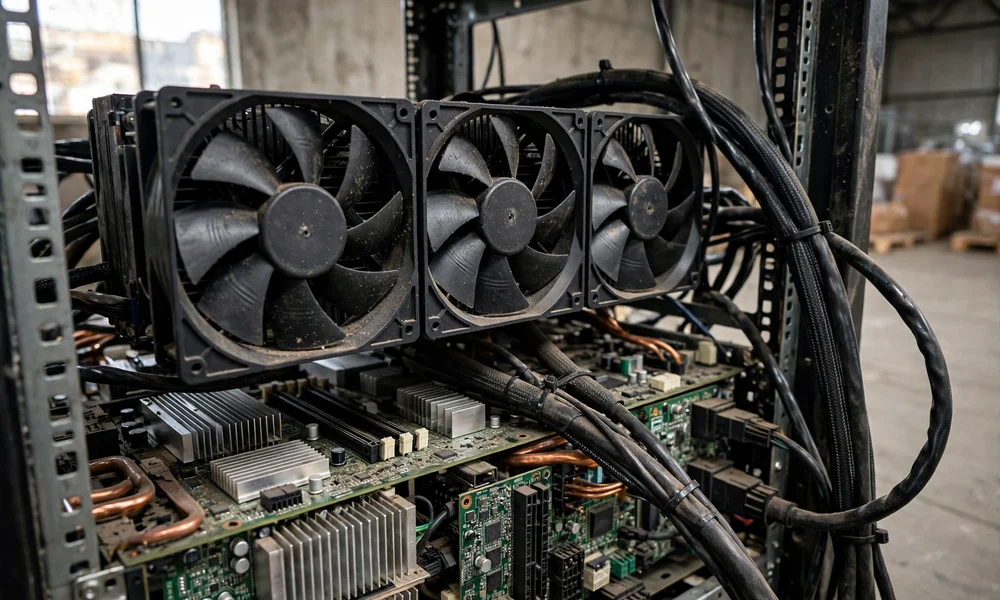
Bloomberg identified the rack by entering its serial number into a public warranty database, which showed it was manufactured by Taiwan’s Gigabyte Technology and supplied a model name matching a GB300 NVL72 rack. Gigabyte declined to say to whom it had originally sold the hardware. A serial number can identify the manufacturer and model, but it cannot reconstruct the chain of buyers and intermediaries. Local media describe the project as designed for up to 800,000 servers, yet the filings cover only hardware offered as collateral, so they give a small snapshot rather than a full inventory.
Why Blackwell matters, and why it is restricted
Blackwell is Nvidia’s flagship data centre architecture, the hardware most leading AI laboratories want for training large language models. Blackwell processors are used by companies including OpenAI and Anthropic to train their most advanced models, which is why Washington treats access to them as a strategic question.
United States export controls require a licence to ship advanced computing items to China, with applications facing a presumption of denial. President Donald Trump has said he does not want these chips going to China, and in June 2026 the Commerce Department confirmed licence requirements applied to entities headquartered in China even when located outside China. Nvidia has also stopped shipping Hopper-generation chips to China, according to interim chief executive Colette Kress on 17 November 2026. Demand for AI computing has outstripped supply, and our report on why AI compute is scarce and costly explains how that shortage raises the premium on obtaining restricted hardware outside official channels.
Who Alice Huang and Megaspeed are
Alice Huang founded Megaspeed in 2023. Megaspeed is a so-called neocloud, renting out AI computing capacity, and it won approval from Nvidia within four days of its creation, going on to become the chipmaker’s largest Southeast Asian customer. That rapid rise is central to the controversy.
Shanghai Shuoyao, which procured the GB300 rack, is active at the data centre linked to Alice Huang and has significant overlap with Singapore-based Megaspeed, which is under United States investigation over concerns it smuggled Nvidia chips to China. Shanghai Shuoyao confirmed this month that it is one of Megaspeed’s service providers, describing the partnership as limited to ordinary commercial cooperation. The other 83.3 per cent of Shanghai Kezhan is ultimately owned by NeXPower Japan, which Caixin said is controlled by Alice Huang, and Bloomberg could not reach NeXPower for comment. Allegations in United States media about Alice Huang’s personal life are unconfirmed as explanations for how the chips moved.
What this means for Nvidia and for export controls
For Nvidia, the timing is awkward. Jensen Huang resigned as chief executive on 12 November 2026, one day before a Reuters investigation found more than 23 billion yuan, about $3.2 billion, in Chinese AI data centre projects designed around export-restricted Nvidia H100, H200 and H800 processors. He has since been reinstated, and the company faces intense scrutiny over diversion of its products to China. Nvidia shares fell as much as 2.6 per cent to $145.39 after markets opened in New York on the Friday the Bloomberg story was published.
Nvidia has long insisted there was no black market for its products, and it did not respond to questions for this story. Megaspeed has denied wrongdoing, and the Trump administration this month put Megaspeed on a United States trade blacklist, citing a significant risk of involvement in chip diversion. That does not prove Megaspeed diverted the specific hardware in the new filings, and Bloomberg explicitly reported it has no evidence Megaspeed itself did so. For export controls, the story tests whether licensing can keep up with a global supply chain: a two-tonne rack reached Shanghai by a route nobody has publicly traced. Our roundup of five trends that will define 2027 places the chip contest among the forces shaping the year ahead.
The caveats that matter
The most important caveat is the one Bloomberg itself states: it is unclear how the GB300 rack made its way to China, to Shanghai Shuoyao, or to this specific site, and unclear whether Megaspeed diverted it. Any account presenting the story as proof that a named company smuggled a named rack has gone beyond what the documents show.
A second caveat concerns scale: the filings cover only hardware offered as collateral, so they show that at least some restricted hardware is at the site, but not how much is there in total or whether it is running. A third caveat is ownership: several links rest on registry data and other outlets’ reporting rather than direct confirmation from the companies involved.
| Detail | What is known |
|---|---|
| Report published | 27 November 2026, by Bloomberg News, syndicated the same day |
| Site | Yangtze River Delta Project, Shanghai, linked to Alice Huang; designed for up to 800,000 servers, according to local media |
| Key hardware | One GB300 NVL72 rack, with 72 Blackwell Ultra chips and 36 Grace processors, weighing more than 1,500 kilograms |
| How it was found | Serial number in loan documents filed with Chinese regulators in November, checked against a public warranty database |
| Manufacturer | Gigabyte Technology of Taiwan, which declined to say to whom it originally sold the rack |
| Loans involved | 96 million yuan, about $14 million, to Shanghai Shuoyao; 90 million yuan to Shanghai Kezhan in late 2025 |
| Export status | Blackwell chips require a United States licence to ship to China; Washington has never authorised such exports |
| Unconfirmed | How the hardware reached China, who moved it, and whether Megaspeed diverted it |
Checklist: reading chip-diversion claims honestly
Use these checks before sharing a claim about restricted chips, or drawing conclusions from one.
- Check whether the claim names a specific piece of hardware, a serial number, or a document, or rests on general suspicion alone.
- Separate what a filing proves, such as a loan secured against named hardware, from what it does not prove, such as who moved it.
- Look for the response, or the absence of one, from every named company.
- Ask whether the reported scale matches the evidence, since a few racks in loan papers are not a full inventory of a data centre.
- Distinguish a trade-blacklist designation based on risk from a finding that a company diverted a specific shipment.
- Wait for a second source, such as a regulator or a further filing, before treating an unconfirmed route as established fact.
Frequently asked questions
What exactly was found in Shanghai?
According to Bloomberg, a GB300 NVL72 rack containing Blackwell chips was listed as collateral in loan documents for the Yangtze River Delta Project, and a GB200 server was described at the same facility in separate loan documents.
Are Blackwell chips banned from export to China?
Yes, in practical terms. Blackwell chips require a United States licence to ship to China, applications face a presumption of denial, and Washington has never authorised such exports. President Trump has said publicly that he does not want the most advanced Blackwell chips going to China.
Who is Alice Huang?
Alice Huang founded Megaspeed, a Singapore-based neocloud, in 2023. Megaspeed became Nvidia’s largest Southeast Asian customer, and Huang has ties to companies involved in the Yangtze River Delta Project. Allegations about her personal life reported in United States media are unconfirmed as explanations for how the chips moved.
Did Megaspeed smuggle the chips?
That is unconfirmed. Bloomberg reported that it does not have evidence Megaspeed itself diverted Nvidia hardware to the site, and Megaspeed has denied wrongdoing. The Trump administration put Megaspeed on a trade blacklist this month, citing a significant risk of involvement in chip diversion.
How big is the Yangtze River Delta Project?
Local media have described it as designed to house as many as 800,000 servers, which would put it on par with hyperscale facilities used by companies such as OpenAI. It is unclear how far operators have come towards that goal.
What happens next?
Watch for responses from Gigabyte, Nvidia and Megaspeed, for any United States enforcement action, and for further filings showing whether more restricted hardware is at the site.
The bottom line
The Shanghai filings are a solid, document-based finding: restricted Blackwell hardware, identified by serial number, was offered as loan collateral at a data centre linked to Alice Huang, and a second firm described further Blackwell hardware at the same site. That much is established, and it shows that the most tightly controlled AI chips in the world reached China despite years of export controls.
Everything beyond that finding is still open. Nobody has publicly explained how the rack got there, nobody has shown who moved it, and nobody has proved that Megaspeed diverted it. The story will develop through filings, company statements and enforcement steps.



