Nvidia’s Jensen Huang Walks Into a Hostile Congress
After a warm welcome from many Nvidia employees last week, reinstated chief executive Jensen Huang now faces a more demanding audience: members of Congress concerned about Chinese espionage and chip smuggling. Huang is due before three House committees in a closed-door transcribed interview on Tuesday 1 December, with Nvidia general counsel Tim Teter appearing the following day, and then a public Senate Banking Committee hearing on Thursday 3 December. It is the pivotal moment of the comeback tour.
Huang’s return was extraordinary by any measure. He resigned on 12 November after reports of multiple extramarital affairs, including one with Alice Huang, a former Megaspeed executive whom US intelligence officials suspect of working for Chinese intelligence. Eleven days later, on 23 November, the board voted unanimously to reinstate him, after lobbying by President Donald Trump. Shares surged 31.5 percent that day, adding roughly $952 billion. But the reinstatement settled nothing.
Lawmakers from both parties want answers about the same underlying question: how did Nvidia’s most advanced AI chips end up in Chinese hands, and what did Huang know? Congress is also asking whether Huang himself was targeted by a spying operation and what Nvidia’s board knew before it brought him back.
Key takeaways
- Huang testifies in a closed-door House interview on 1 December and a public Senate Banking Committee hearing on 3 December; Nvidia general counsel Tim Teter appears before the House committees on 2 December.
- Huang resigned on 12 November 2026 and was unanimously reinstated on 23 November, after President Donald Trump lobbied the board; Nvidia shares rose 31.5 percent that day.
- Lawmakers want to know whether Nvidia’s advanced chips reached China in violation of US export controls, and whether Huang was targeted by a suspected Chinese intelligence operation.
- Bloomberg reported on 27 November 2026 that Blackwell hardware was installed at a Shanghai data centre linked to Alice Huang; how it got there remains unconfirmed.
- Three bipartisan bills to tighten chip export controls are being prepared for the defence package, and the hearings are expected to shape whether they pass.
| Date | Session | What to expect |
|---|---|---|
| 1 December | Closed-door transcribed interview, three House committees | Huang on Megaspeed, Alice Huang and export compliance; transcript may take months to surface |
| 2 December | Closed-door transcribed interview, same committees | Teter on Nvidia’s compliance systems |
| 3 December | Public Senate Banking Committee hearing, 10 a.m. | Huang as sole witness; livestreamed, with Commerce Secretary Howard Lutnick also summoned |
The three hearings, and why they are different
The week opens behind closed doors. On Tuesday 1 December, Huang sits for a transcribed interview with the House Foreign Affairs Committee, the Select Committee on the Chinese Communist Party and the House Intelligence Committee. The three chairmen — Brian Mast, John Moolenaar and Rick Crawford — first requested his testimony in a letter on 4 November, before he resigned. The session is not public, and transcripts of closed-door interviews can take months to appear. General counsel Tim Teter follows in the same seat on 2 December.
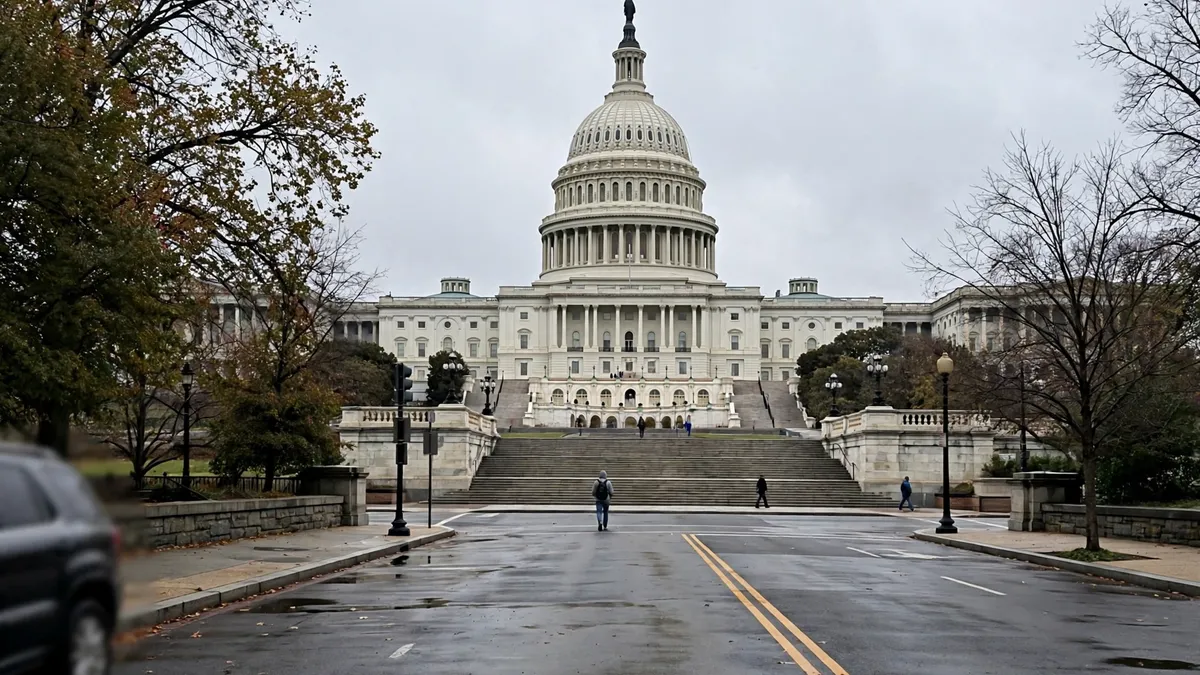
Thursday 3 December is the hearing that will move markets. The Senate Banking Committee, chaired by Tim Scott, holds a public, livestreamed hearing titled “Protecting America’s AI Advantage: Oversight of U.S. Export Controls,” with Huang as the only witness. Commerce Secretary Howard Lutnick has also been summoned. It is the first time Huang answers questions in public since his reinstatement, and a poor performance would harden the push for legislation.
What Congress actually wants to know
The first question is the simplest and the hardest: were any laws broken? Senator Dave McCormick, a Pennsylvania Republican on the Banking Committee, put it first in a television interview. Lawmakers want to know what Nvidia knew about Megaspeed — a Singapore cloud company that became the single largest Southeast Asian buyer of Nvidia chips in less than three years — and whether the company ignored warnings that its hardware was being diverted to China.

The second question is about the Shanghai data centre. Bloomberg reported on 27 November 2026 that Nvidia Blackwell processors were installed at the Yangtze River Delta Project in Shanghai, at a site linked to Alice Huang. Shanghai Shuoyao offered a GB300 NVL72 rack as collateral for a 96 million yuan loan, about $14 million, and Shanghai Kezhan described a GB200 server and 32 H200 servers in documents for a 90 million yuan loan. The filings were identified by serial number — but the route the chips took there remains unconfirmed, a gap flagged as unconfirmed here.
The third question is about Huang himself. US officials believe Alice Huang was recruited by Beijing to target him, according to a New York Times investigation published on 29 October 2026, and lawmakers want to know whether she obtained trade secrets or sensitive information, and whether Huang was warned. Senator John Cornyn has asked whether the FBI gave Huang a defensive briefing; Senator John Curtis has asked who in government weighed in on his return.
Confirmed, alleged and unproven
The confusion around this story comes from three separate questions being merged into one. First, what Huang did: he has admitted to cheating on his wife with Alice Huang, a former Megaspeed executive. That is confirmed, by his own admission to staff on 8 November. Second, what Alice Huang did: US intelligence officials suspect her of working for China’s Ministry of State Security. That is an allegation, not a finding — she has not been charged, and China calls the claims unsubstantiated.
The third question is where the chips went, and it is the one that matters most for the law. Megaspeed is under investigation by the Commerce and Justice departments, which have run a criminal export-control probe since 2024, and the company was added to the Entity List on 23 November. A separate case unsealed in March 2026 charged three men tied to Super Micro Computer with diverting about $2.5 billion of servers packed with Nvidia chips to China — a different scheme, and Super Micro itself was not named as a defendant.
What has not been established is the link between those questions. Bloomberg has reported that it has no evidence Megaspeed itself diverted the Blackwell hardware found in Shanghai, and no reporting shows that Huang knowingly facilitated any diversion. Trump has said the US has not found evidence that Huang did anything unlawful. Other claims are also unconfirmed: an allegation that Nvidia donated $25,000 to the Trump administration, and a call to examine stock trades made before the reinstatement was announced.
The market stakes of a hostile hearing
The hearings arrive at a moment when Nvidia’s valuation is unusually exposed to politics. The company lost about $1.16 trillion in market value between Huang’s resignation and the low on 20 November, when it was worth about $3.04 trillion. The reinstatement reversed it in a day: shares rose 31.5 percent on 23 November to close at $165.05, adding roughly $952 billion — the largest one-day gain in market value on record — and lifting the Nasdaq 6.5 percent and the S&P 500 by 4.7 percent. Shares fell more than 5 percent the next day.
That volatility is the reason the hearings are must-see television for investors. A strong, credible performance by Huang could defuse the immediate political pressure; a poor one would, in the words of one analyst, further cement the push towards legislative action. The underlying business, for now, is strong: Nvidia reported record revenue of $115.8 billion for the third quarter of fiscal 2027 on 17 November, up 103 percent year over year. But the eleven days without Huang exposed a succession problem the board has not solved, as our earlier report on eleven days without Jensen Huang set out.
The political stakes extend beyond Nvidia. Senator Tom Cotton, who chairs the Senate Intelligence Committee, has said the Megaspeed controversy is just the tip of the iceberg, and that Congress will pass overwhelmingly bipartisan chip export-control bills. Senator Elizabeth Warren, the Banking Committee’s ranking Democrat, called the decision to bring Huang back reckless. The return itself is covered in our report on Huang’s reinstatement and the AI trade, and the hardware at the heart of the dispute is detailed in our report on Blackwell chips at the Shanghai site.
What happens after the hearings
The hearings are the start of the process, not the end. The closed-door House interviews will produce transcripts, but they may take months to become public, and the committees can follow up with subpoenas if they are not satisfied. The Senate hearing is public, so its impact will be immediate — but it is an oversight hearing, not a trial, and the legal questions belong to the Justice Department, the Securities and Exchange Commission and California’s attorney general.
The more durable outcome is legislative. Three bills — the AI Overwatch Act, the Chip Security Act and the MATCH Act — have bipartisan backing, and lawmakers are finalising talks to attach them to the annual defence package that usually passes in December. The Chip Security Act, which would require chipmakers to track the location of chips shipped abroad, would change how Nvidia and its rivals sell hardware everywhere.
For Nvidia, the practical question is whether the company can keep selling its best hardware while under this kind of scrutiny. The November rule already requires licences for data centres serving China-headquartered customers and for shipments to five named countries. Huang’s testimony will not decide that on its own, but it will set the tone: plain answers give the industry room to argue for workable rules, while evasive answers hand the argument to those who want the strictest controls possible.
Frequently asked questions
When does Jensen Huang testify to Congress?
Huang sits for a closed-door transcribed interview with three House committees on Tuesday 1 December, and testifies in a public Senate Banking Committee hearing on Thursday 3 December at 10 a.m. Tim Teter appears before the House committees on 2 December.
Why is Huang testifying?
Congress wants answers about whether Nvidia’s advanced AI chips reached China in violation of US export controls, what Nvidia knew about Megaspeed, and whether Huang was targeted by a suspected Chinese intelligence operation.
What is confirmed and what is only alleged?
Confirmed: Huang admitted an affair with Alice Huang, resigned on 12 November, and was reinstated on 23 November. Alleged but unproven: that Alice Huang is a Chinese intelligence asset, that Megaspeed diverted chips to China, and that Huang knowingly facilitated any diversion. She has not been charged.
What hardware was found in Shanghai?
Bloomberg reported on 27 November 2026 that loan filings showed Nvidia Blackwell hardware — a GB300 NVL72 rack, a GB200 server and 32 H200 servers — installed at a Shanghai data centre linked to Alice Huang. How the hardware got there remains unconfirmed.
How has Nvidia’s share price reacted?
Shares fell 27.7 percent between the resignation and a low of about $3.04 trillion in market value on 20 November, then rose 31.5 percent on 23 November to $165.05, adding roughly $952 billion in a single session — the largest one-day gain on record — before falling back.
Will Congress pass new chip-control laws?
Three bipartisan bills — the AI Overwatch Act, the Chip Security Act and the MATCH Act — are being prepared for the annual defence package that usually passes in December. The hearings are expected to shape whether they pass, and in how strict a form.
The bottom line
Jensen Huang’s comeback tour reaches its hardest stop this week. The employees who cheered his return cannot protect him from the questions Congress will ask, and the board’s decision to reinstate him will be judged not by the share price on 23 November but by what he says under oath.
Whatever Huang says, the episode has already changed the politics of AI chips. Export controls are no longer a technical subject for trade lawyers: they are a bipartisan cause in Congress, a live Justice Department investigation, and a source of trillion-dollar swings in the stock market. The hearings will not settle every allegation — but they will decide the direction of the next round of rules.