What if the vacuum that looks best on paper is the one you quietly stop using after a month? That’s the trap with cordless vacuums. Every box promises huge suction, and every listing shows a sleek stick leaning against a wall. The real question is whether the machine still has charge when you’re halfway through the stairs, whether it chokes on pet hair, and whether the battery dies for good two years in. The best cordless vacuum isn’t the one with the biggest number on the box. It’s the one that fits your floors, your home size, and your patience.
This guide breaks down what actually matters, where the marketing stretches the truth, and how to match a machine to the way you really clean.
Start With Your Floor Type, Not the Spec Sheet
Flooring decides more than any other factor. A vacuum tuned for plush carpet needs a motorized brush roll and strong sealed suction. A vacuum for hard floors mostly needs good airflow and a soft roller that won’t scatter debris.
| Floor situation | What matters most | What to avoid |
|---|---|---|
| Wall-to-wall plush carpet | Motorized brush roll, high air watts, sealed system | Soft rollers, tiny dust bins |
| Hardwood and tile | Soft roller or combo head, edge cleaning | Stiff bristles that scratch |
| Mixed floors | Quick head swaps, auto floor detection | Single fixed head |
| Area rugs on hard floor | Adjustable height, brush on/off | Brushes that grab rug edges |
| Pet households | Tangle-resistant brush, strong filtration | Hair-wrapping bristle rolls |
A vacuum that excels on carpet can be mediocre on bare floors, and the reverse is just as true. If your home is mostly hard flooring with a couple of rugs, a soft-roller machine will serve you better than a carpet specialist. If you’re weighing dedicated machines instead, it helps to look at what makes the best vacuum for carpet genuinely effective rather than just powerful.
The Runtime Number Is a Best-Case Figure
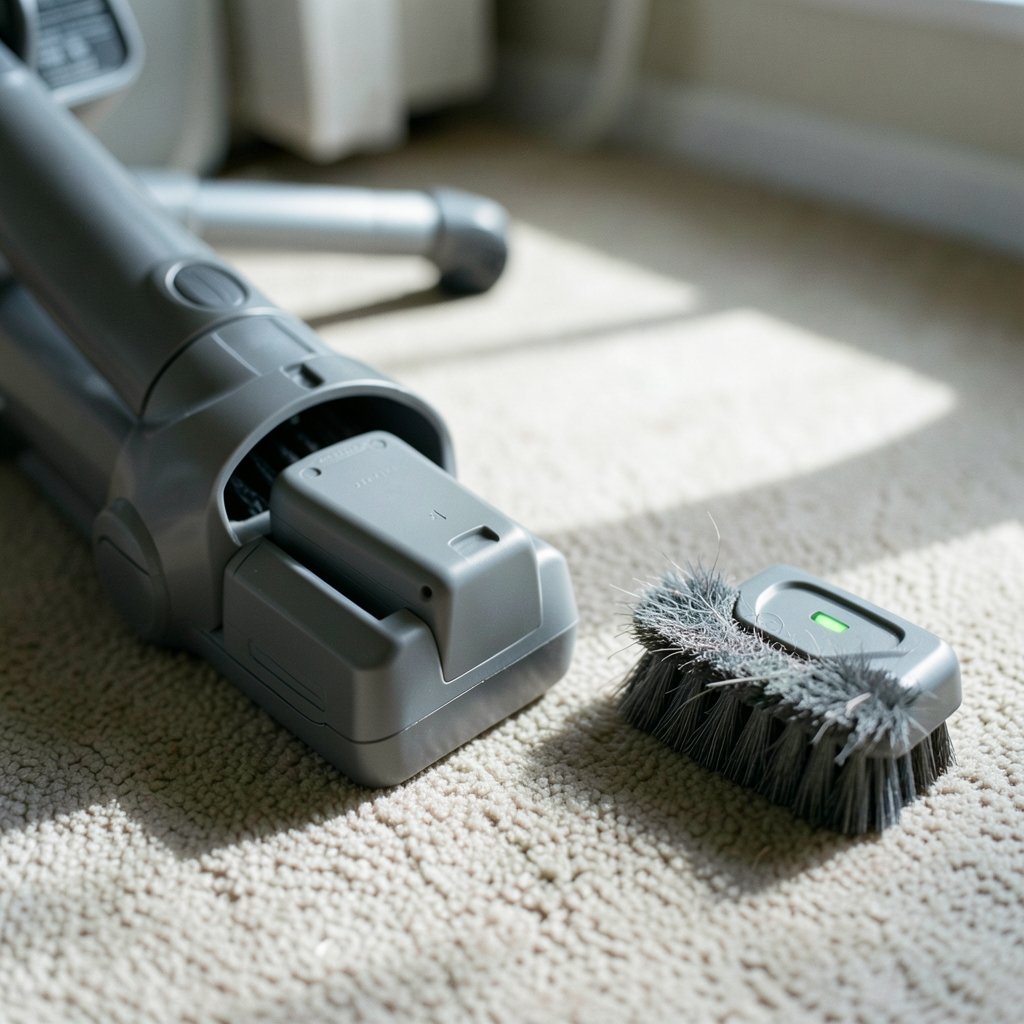
Here’s the first place buyers get misled. Published runtime is usually measured with a non-motorized tool at low power. The moment you attach a motorized brush roll and run it on carpet, runtime drops, sometimes by half.
That doesn’t make the numbers dishonest. It makes them a ceiling, not an average. A vacuum rated at 60 minutes might give you 25 to 35 minutes of real carpet cleaning. For a one-bedroom apartment, that’s plenty. For a four-bedroom house with stairs, it’s a race.
Practical rule of thumb: divide the advertised runtime by two, then compare that figure to how long you actually clean. If you need more than 30 minutes of motorized cleaning in one go, either buy a machine with a swappable battery or keep a second battery charged.
Suction Claims Need Context
Air watts (AW) is the most common suction metric. It’s calculated from airflow and pressure together, which is why it’s more meaningful than “Pa” alone. But brands test differently, and there’s no single mandatory consumer test standard that makes every cordless vacuum directly comparable.
What this means in practice: don’t compare air watts across brands as if they’re lab-certified equivalents. Compare within a brand’s lineup, read independent hands-on tests, and pay more attention to pickup performance on real debris than to a headline number.
A related trap is the “sealed system” claim. Suction at the nozzle means little if air leaks past the filter or the bin seal. A well-sealed 150 AW machine can outperform a leaky 200 AW one on carpet.
Filtration and Allergy Claims Deserve Scrutiny
If anyone in the house has allergies or asthma, filtration matters. But “HEPA filter” on a box doesn’t guarantee HEPA-rated air at the exhaust. Whole-machine HEPA filtration is a specific engineering claim: the entire air path is sealed and the exhaust filter meets a defined standard.
The EN 1822 series defines HEPA and ULPA filter classes, including the H13 and H14 grades commonly cited in vacuum marketing. A filter element rated H13 is genuinely high-efficiency. Whether the vacuum delivers H13 air to the room depends on seals, gaskets, and housing design.
Practical check: look for “whole-machine HEPA” or “sealed HEPA” wording, rather than only “HEPA filter.” Then check whether replacement filters are easy to buy and reasonably priced. A great filter you can’t replace is a countdown timer.
Weight and Balance Beat the Headline Weight
Stick vacuums get judged on grams, but balance matters more. A 3 kg vacuum with the motor at the top feels heavier in the hand than a 3.5 kg machine with a lower center of gravity.
Two tests you can do in a store, or infer from reviews:
- Hold the vacuum at full extension and imagine cleaning a ceiling corner or the top of a curtain rail.
- Hold it one-handed at hip height and picture cleaning a staircase for five minutes.
Most reviews under-report overhead fatigue. If you plan to clean above shoulder height regularly, prioritize a lighter handheld mode and a wand that lets you detach the main body.
Bin Size, Emptying, and the Chore You’ll Actually Notice
A small bin sounds trivial until you’re emptying it three times per clean. Cordless bins typically run from about 0.3 to 0.8 liters. Pet hair and carpet fuzz fill them fast.
Look for:
- A bin you can empty with one hand over a trash can
- A release that doesn’t fling dust back at you
- A design without deep corners where hair jams
This is also where hair wrap becomes a daily annoyance rather than a monthly one. Tangle-resistant brush rolls and combs genuinely reduce maintenance, and if long hair is a recurring problem in your home, it’s worth understanding what makes a robot vacuum handle long human hair before you assume any brush roll is immune.
Battery Chemistry, Replacement, and Repairability
Most cordless vacuums use lithium-ion packs. Two things matter beyond runtime:
Is the battery user-replaceable? Some brands seal the pack inside the housing, turning a worn battery into a repair-shop job or a reason to replace the whole vacuum. Others sell swap-in packs, which also lets you keep a spare charged.
What’s the warranty on the battery? Batteries are often covered for a shorter period than the motor, sometimes just one year. Read that line before you buy.
Repairability rules are shifting. EU ecodesign discussions around vacuum cleaners have focused on durability, battery replaceability, and spare parts availability, and right-to-repair laws in several US states push in a similar direction. The details and timelines vary by market, so check what applies where you live rather than assuming.
Navigation and Smart Features: Useful or Noise?
Cordless stick vacuums rarely need mapping. But some premium models now include particle sensors, automatic power adjustment, and app dashboards.
Be clear-eyed about what these do. A laser that reveals dust on a hard floor is genuinely handy for spotting missed spots. A particle counter that displays a number is harder to verify independently, and its practical value is limited. Automatic power boost on detected dirt can extend runtime meaningfully, which is a real benefit.
If you’re comparing navigation technology across categories, the same principles apply: sensors have strengths and blind spots. The differences between lidar vs camera navigation explain why some machines map a room perfectly and others bump around, and that logic carries over to how smart stick vacuums sense dirt.
Cordless vs Robot: They Solve Different Problems
A cordless stick vacuum and a robot vacuum aren’t competitors. They cover different jobs.
| Task | Cordless stick | Robot vacuum |
|---|---|---|
| Stairs | Yes | No |
| Quick spills | Yes | Poor |
| Daily floor upkeep | Manual | Automatic |
| Under low furniture | With attachments | Often yes |
| Car interiors | Yes | No |
| Hands-off cleaning | No | Yes |
Many households end up with both: a robot for daily maintenance and a cordless for stairs, cars, and spot work. If you’re leaning toward automation for the bulk of floor cleaning, it’s worth comparing what a robot vacuum and mop combo actually cleans before deciding the stick can do it all.
Mistakes Buyers Make Again and Again
These come up constantly in owner complaints and return data:
- Buying for the brochure runtime. Then discovering motorized cleaning lasts half as long.
- Ignoring the bin size. Small bins mean constant emptying on carpet.
- Skipping the filter replacement cost. Filters every few months add up.
- Assuming all brush rolls handle hair. Many don’t, and clearing them gets old fast.
- Buying the heaviest-duty model for a small apartment. Overkill machines are bulky and awkward in tight spaces.
- Not checking battery replaceability. A sealed pack shortens the vacuum’s useful life.
- Forgetting attachments. Crevice tools and upholstery brushes are what make a stick vacuum versatile.
Matching the Machine to Your Home
A few profiles make the decision easier:
Small apartment, mostly hard floors. Prioritize light weight, a soft roller, and a bin around 0.4 liters. Runtime of 25 real minutes is fine.
Family home with carpet and pets. Prioritize motorized brush roll, tangle resistance, whole-machine HEPA, and a swappable battery. Expect to pay more and accept more weight.
Stairs and cars as the main job. Prioritize handheld mode, low weight, and a crevice tool that actually stores on the machine.
Allergies as the top concern. Prioritize sealed filtration and easy filter replacement over smart features.
Maintenance That Keeps Performance From Dropping
A cordless vacuum loses suction gradually, and owners often blame the machine when the fix is basic:
- Wash or replace filters on the schedule the manual states, and let them dry fully before reinstalling
- Cut hair off the brush roll regularly, before it wraps the bearings
- Empty the bin before it hits the max line, not after
- Check the wand and head for blockages, especially after cleaning pet beds
- Store the battery at room temperature, not in a hot garage
If a machine suddenly loses power or stops mid-clean, the cause is often simpler than a dead motor. The same troubleshooting logic behind a robot vacuum wheel stuck error applies to stick vacuums: check for obstructions, reset the machine, and confirm the battery is seated properly before assuming the worst.
Conclusion
The best cordless vacuum is the one that matches your floors, your home size, and your tolerance for maintenance. Start with floor type, discount the advertised runtime by roughly half, verify that filtration claims mean whole-machine HEPA rather than a filter label, and check whether the battery can be replaced. Weight and balance matter more than grams on a spec sheet, and bin size matters more than most buyers expect.
Get those fundamentals right and the smart features become a bonus rather than a distraction. Get them wrong and even a premium machine ends up in the closet.
Frequently Asked Questions
How long do cordless vacuum batteries actually last?
Most lithium-ion packs hold useful capacity for roughly two to four years of regular use, depending on how often they’re fully drained and how they’re stored. Expect gradual runtime loss rather than sudden failure. A user-replaceable battery extends the vacuum’s life considerably, since the motor and housing usually outlast the pack.
Is a higher air watt rating always better?
No. Air watts combine airflow and pressure, and brands measure differently, so figures aren’t directly comparable across manufacturers. A well-sealed machine with moderate air watts can outperform a leakier one with a higher rating, especially on carpet. Real-world pickup tests matter more than the headline number.
Do cordless vacuums work well on carpet?
Yes, if they have a motorized brush roll and a sealed air path. The limitation is runtime, not capability. Motorized cleaning on plush carpet drains batteries faster than the advertised figure suggests, so a swappable battery or a second pack makes carpet cleaning far more practical.
What does whole-machine HEPA actually mean?
It means the entire air path, from nozzle to exhaust, is sealed and the final filter meets a defined efficiency class, such as H13 under the EN 1822 standard. A vacuum labeled simply “HEPA filter” may have an efficient filter element but leaks around the housing, which reduces real-world filtration.
Should I buy a cordless vacuum or a robot vacuum?
They solve different problems. A cordless stick handles stairs, cars, upholstery, and quick spills, while a robot handles daily floor upkeep with no effort. Households with both needs often buy a robot for maintenance and a cordless for everything the robot can’t reach.
How often should I replace the filter?
Follow the manufacturer’s schedule, which is usually every three to six months depending on use. Washable filters need rinsing monthly in many models and must dry completely before reinstalling, since a damp filter can damage the motor and cause odors. Replace rather than wash when suction stays weak after cleaning.