
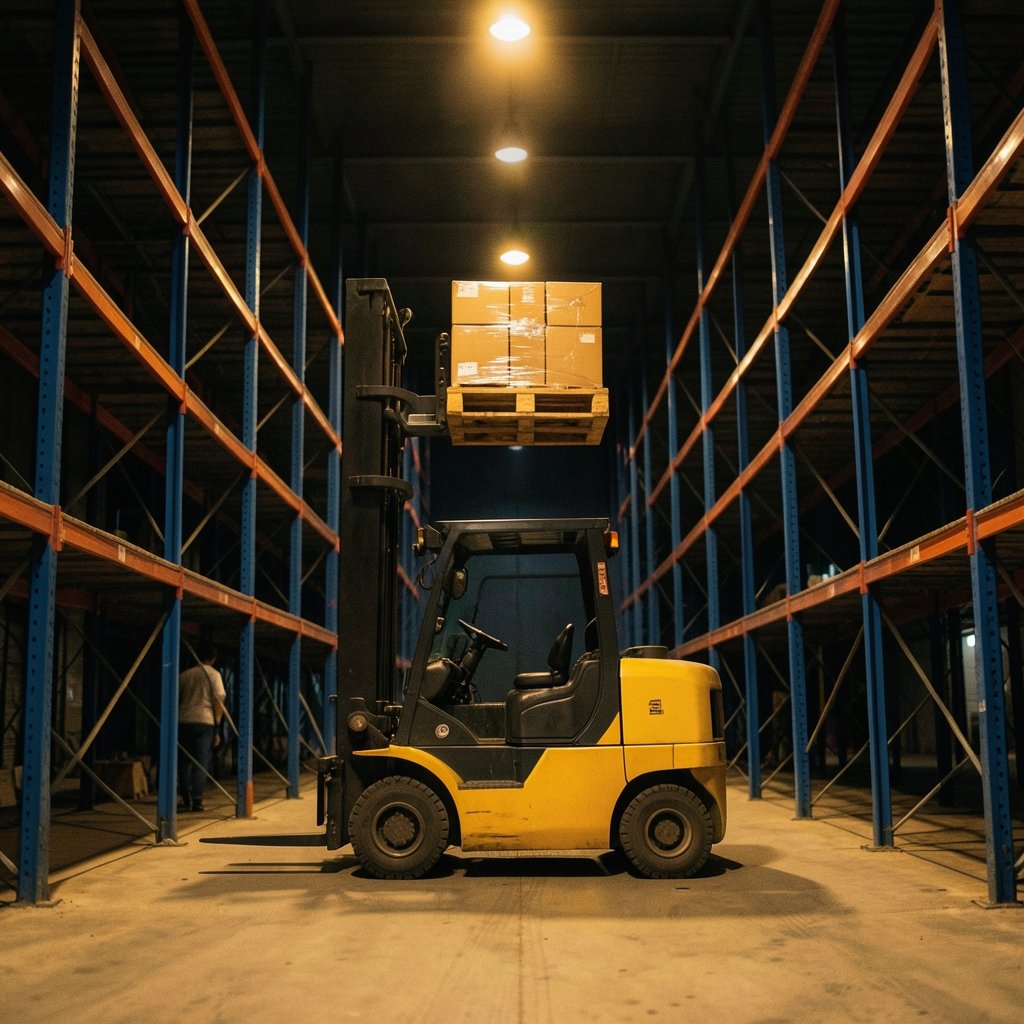
What happens when a warehouse runs out of floor space but still needs to stack pallets ten metres high? That is the exact problem the reach truck was invented to solve. Instead of driving straight into a racking aisle and turning, the operator sits sideways and a sliding mast pushes the forks forward, grabs the pallet, and pulls it back over the wheels. The truck never needs to turn around. That single design trick is why a machine barely wider than a person can service racking that a conventional counterbalance forklift could never squeeze into.
This article breaks down how reach trucks work, where they fit, what they cost to run, and the mistakes that cause most accidents and downtime.
What Is a Reach Truck?
A reach truck is a narrow-aisle counterbalance forklift whose forks sit on a moving mast assembly. The mast extends forward to pick a load and retracts to carry it. The operator typically stands or sits sideways relative to the direction of travel, which keeps the truck’s body compact while giving a clear view down the aisle.
Three features define the category:
- A reach mechanism. The inner mast moves horizontally on rails, so the truck picks and places without moving its chassis closer to the racking.
- A compact footprint. Most models are around 1.2 to 1.5 metres wide, letting them work in aisles of roughly 2.7 to 3 metres.
- High lift with a small base. Typical lift heights run from about 5 metres up to 12 metres or more on larger models.
It is worth separating the reach truck from its cousins, because the terms get mixed up constantly. An order picker lifts the operator up to the pick face. A turret truck (also called a very narrow aisle or VNA truck) has a rotating mast and works in aisles under 2 metres. A reach truck sits between them: more flexible than a turret truck, far more space-efficient than a counterbalance machine. Definitions do vary between manufacturers and regions, so always check the spec sheet rather than the label.
How the Reach Mechanism Changes the Job
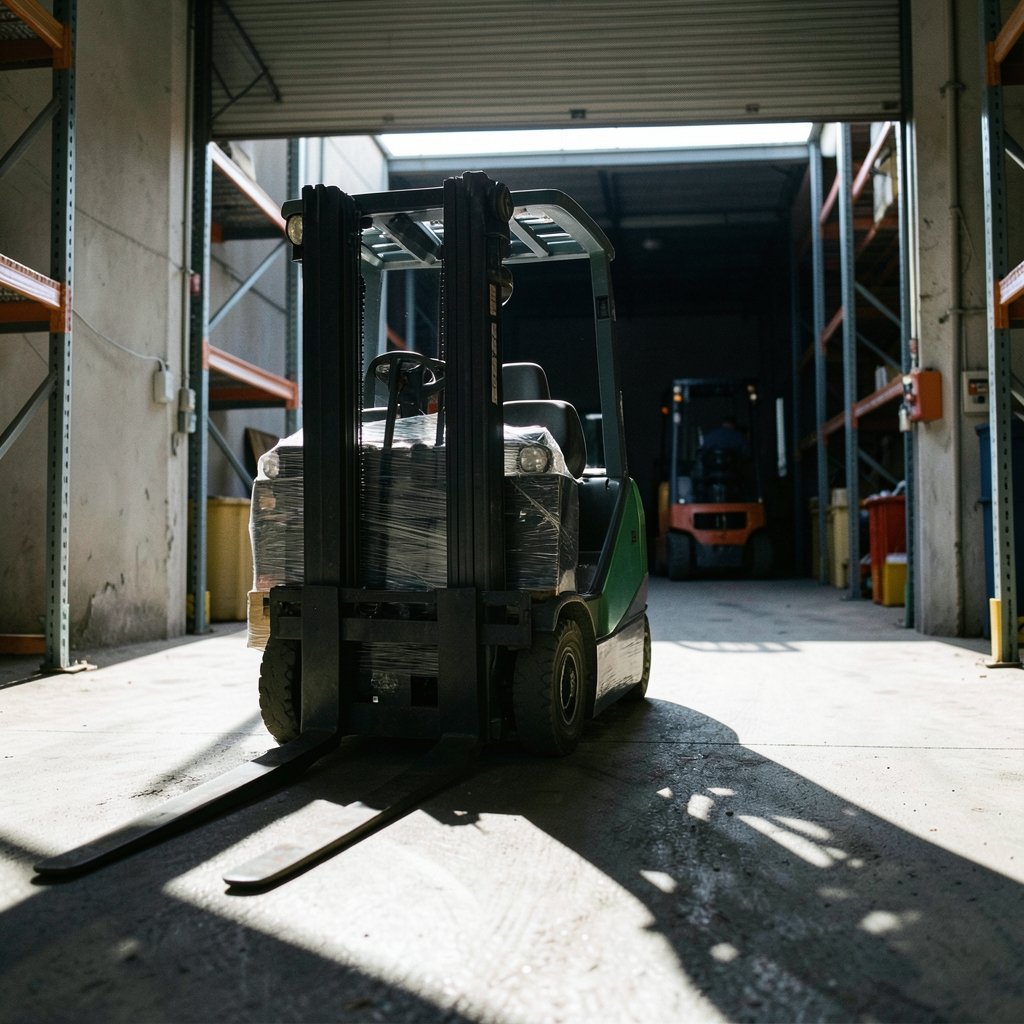
The physics matter more than the marketing. On a standard counterbalance forklift, the load sits ahead of the front wheels, so the counterweight at the rear has to balance it. The further out the load, the less the truck can lift. A reach truck pulls the load back over the chassis, which shortens the load centre and improves stability at height.
That has practical consequences:
- Higher capacity at height. Because the load is retracted before lifting, reach trucks often retain more rated capacity at 8 metres than a comparable counterbalance truck.
- Tighter turning. The sideways operator position and compact chassis allow tight 90-degree turns inside racking aisles.
- Better visibility. With no long load dangling ahead of the wheels, the operator sees the forks and the pallet more clearly.
However, the reach mechanism introduces its own risks. Extending the mast shifts the centre of gravity forward, so lifting a heavy load while reaching out is a classic tip-over scenario. The rule that experienced instructors repeat: reach out empty, retract loaded, then lift.
Matching the Truck to the Racking
Buying or leasing a reach truck without measuring the aisle is the single most common and most expensive mistake. A few numbers decide everything:
| Factor | What to Measure | Why It Matters |
|---|---|---|
| Aisle width | Clear distance between racking uprights | Determines whether a standard or compact chassis fits |
| Lift height | Top beam of the highest pick face | Sets the mast spec and residual capacity |
| Load weight | Heaviest pallet plus attachment weight | Prevents overloading at height |
| Pallet depth | Front-to-back dimension | Affects fork length and reach stroke |
| Floor condition | Flatness and joint quality | Rough floors wear mast rails and tyres fast |
A useful rule of thumb: the truck’s right-angle stack figure (often quoted as a radius in the datasheet) must be smaller than the aisle width minus a safety margin. Manufacturers publish this number, and it is far more reliable than a salesperson’s assurance that “it’ll be fine.”
Load charts deserve special attention. Every reach truck has a data plate showing rated capacity at a given load centre and lift height. Capacity drops as height increases and as the load centre moves forward. Operators who ignore the plate, or who lift a pallet whose weight is unknown, are the ones who end up with a bent mast or a collapsed rack.
Power, Charging, and Running Costs
Almost all reach trucks are battery-electric, which suits indoor work because there are no exhaust emissions. The two main chemistries are lead-acid and lithium-ion.
Lead-acid batteries are cheaper upfront but need watering, equalising charges, and a dedicated ventilated charging room. They also lose capacity as they discharge, so a truck near the end of a shift feels sluggish.
Lithium-ion packs cost more but can be charged during breaks, hold steady voltage, and need no watering. For multi-shift operations, the productivity gain often outweighs the higher purchase price.
Operators consistently underestimate three running costs:
- Tyres. Polyurethane tyres on reach trucks wear quickly on rough or dirty floors. Smooth, clean floors can double tyre life.
- Mast rails and chains. These need lubrication on a fixed schedule. Skipping it causes expensive rail wear and, eventually, a mast rebuild.
- Battery handling equipment. If you run lead-acid, you need a charger, a changing station, and someone trained to swap packs safely.
Fleet managers who plan charging around shift patterns rather than squeezing it into gaps usually report fewer mid-shift slowdowns. It is unglamorous planning, but it is where the money is saved.
Training and the Law
Reach trucks are not something you learn by watching a video. In the UK, the Provision and Use of Work Equipment Regulations 1998 (PUWER) require employers to ensure anyone using work equipment, including lift trucks, has received adequate training. The Health and Safety Executive publishes detailed guidance on rider-operated lift trucks covering selection, training, and safe systems of work.
In the United States, OSHA’s Powered Industrial Trucks standard, 29 CFR 1910.178, requires formal training and a practical evaluation, with refresher evaluation at least every three years. The standard applies to forklifts broadly, and reach trucks fall squarely within it.
On the safety side, the EN ISO 3691 series sets out safety requirements for industrial trucks, with EN 3691-1 covering self-propelled trucks other than driverless ones. Note that edition dates and national adoptions change, so check the current version with the standards body before you write it into a procurement spec.
What does good training actually look like in practice? It includes the boring stuff that saves lives:
- Pre-shift checks: tyres, chains, horn, brakes, and battery state.
- Load assessment before lifting, not after the pallet is in the air.
- A clear rule on pedestrian segregation and aisle walkways.
- Practice on the actual racking the operator will use, not a training bay with different dimensions.
The digital side of warehouse work gets overlooked too. Modern operations run on shared terminals and handhelds, and a compromised browser on a shop-floor PC can expose inventory systems. Tools like browser isolation that blocks attacks before they reach you are worth understanding if your reach truck operators log picks on networked devices. Password hygiene matters as well, and a comparison of 1password vs lastpass vs roboform helps teams pick a manager that suits shift-based shared logins. Hardware tokens add another layer, and the difference between a FIDO2 PIN versus an account password is worth knowing when a stolen key could give access to a whole warehouse management system.
Common Mistakes That Cost Real Money
After enough site visits, patterns emerge. These are the errors that show up again and again.
Overestimating capacity. A truck rated at 1,600 kg at 500 mm load centre might only handle 900 kg at 9 metres. Loads creep up over time; nobody re-checks the plate.
Ignoring aisle tolerances. Racking gets bumped, uprights shift, and a formerly comfortable aisle becomes tight. Regular aisle surveys catch this before an impact does.
Skipping the pre-shift check. A worn chain or a low tyre is cheap to fix on a Monday morning and expensive to fix after a dropped pallet.
Buying on price alone. A cheap truck with poor parts availability can sit idle for weeks. Service network coverage matters as much as the sticker price.
Treating the reach truck like a counterbalance. Operators trained on counterbalance machines sometimes reach out with a load still elevated. Retraining on the specific machine is essential.
There is a lighter side to all this machinery enthusiasm, too. Simulation games have made truck handling oddly popular, and some new operators arrive already fascinated by the mechanics, as this piece on how the American truck simulator makes long haul addictive illustrates. Real warehouses are less forgiving than a game, but the interest is a genuine recruiting asset.
Ergonomics and the Operator’s Day
A reach truck operator might make several hundred movements in a shift. Small ergonomic details add up fast:
- Stand-on versus sit-on. Stand-on trucks suit frequent get-on-get-off work; sit-on models reduce fatigue over long shifts.
- Joystick layout. Adjustable armrests and mini-levers reduce shoulder strain.
- Floor quality. Vibration from poor floors travels straight up the mast and into the operator’s back.
- Camera and mirror systems. These help at height, especially in deep racking where the pick face is hard to see.
Supervisors who rotate tasks and schedule real breaks see fewer errors in the last hour of a shift. Fatigue shows up as mis-picked pallets and clipped uprights long before it shows up as an accident report.
Buying, Leasing, or Renting
The decision usually comes down to utilisation. A truck running two shifts, five days a week, is a candidate for purchase or a long lease. A truck used a few hours a week is better rented.
Leasing spreads cost and bundles maintenance, which suits businesses that want predictable monthly outgoings. Purchase makes sense when the fleet is large, well maintained in-house, and kept for many years. Rental covers seasonal peaks without committing capital.
Fleet buyers often compare financing structures across vehicle types, and the same logic that applies to Ram truck lease deals or Ford truck deals applies here: total cost of ownership, residual value, and service inclusion matter more than the headline rate. Always ask what happens at the end of term, who pays for tyres, and how quickly a replacement arrives when the truck breaks down.
Conclusion
The reach truck is one of those machines that quietly makes modern warehousing possible. It trades a little complexity in the mast for a huge gain in space efficiency, letting high racking sit in aisles barely wide enough for a person and a pallet. Getting the most from one comes down to unglamorous discipline: measure the aisle, read the data plate, train properly, maintain the chains and tyres, and plan charging around real shift patterns. Do those things and a reach truck will run for years. Skip them and it becomes an expensive lesson in physics.
Frequently Asked Questions
What is the difference between a reach truck and a forklift?
A standard counterbalance forklift carries the load ahead of the front wheels and needs a wide aisle to turn. A reach truck keeps the chassis compact and uses a sliding mast to push the forks forward, pick the pallet, and retract it over the wheels. That design lets it work in much narrower aisles and lift higher relative to its size.
How narrow an aisle does a reach truck need?
Most reach trucks work comfortably in aisles of roughly 2.7 to 3 metres, depending on the model and the pallet size. Compact chassis versions can go slightly narrower. Always check the manufacturer’s right-angle stack figure against your measured clear aisle width, and leave a safety margin for racking damage and operator error.
Can a reach truck lift a load at full capacity at maximum height?
Almost never. Rated capacity falls as lift height increases and as the load centre moves forward. The data plate states capacity at specific heights and load centres, and operators must follow it. Lifting a heavy pallet to full height while the mast is extended is a genuine tip-over risk.
Do you need a licence to operate a reach truck?
Requirements vary by country. In the UK, PUWER 1998 requires employers to ensure operators are adequately trained, and the HSE publishes guidance on rider-operated lift trucks. In the US, OSHA’s 29 CFR 1910.178 requires formal training and practical evaluation, with refresher evaluation at least every three years.
Are reach trucks always electric?
The overwhelming majority are battery-electric, using lead-acid or lithium-ion packs, because they work indoors where exhaust emissions are unacceptable. Lead-acid is cheaper upfront but needs watering and ventilated charging. Lithium-ion costs more but supports charging during breaks and holds steadier power through a shift.
What maintenance does a reach truck need most?
Chains and mast rails need regular lubrication and inspection, because wear there is expensive to repair. Polyurethane tyres wear quickly on rough or dirty floors, so floor condition directly affects running costs. Daily pre-shift checks of brakes, horn, tyres, and battery state catch most problems before they become breakdowns.



