

Why does an RV refrigerator that worked perfectly last season suddenly turn warm, even though the flame is lit and the panel looks fine? That single question sends thousands of owners to forums, repair shops, and YouTube rabbit holes every spring. The answer usually comes down to one of a handful of predictable failures, and knowing which one you are facing can save you hundreds of dollars and a ruined trip.
This guide breaks down how RV fridges actually work, what breaks most often, how to diagnose problems in the right order, and when repair stops making financial sense. The advice applies to both absorption units (the propane/electric type most trailers ship with) and compressor units (the 12-volt type that keeps showing up in newer rigs).
Two Very Different Fridges Live Under the Same Name
Before touching a screwdriver, an owner needs to know which technology is sitting in the cabinet. The two types fail in completely different ways, and troubleshooting steps for one can be useless or even harmful on the other.
| Feature | Absorption fridge | Compressor fridge |
|---|---|---|
| Power source | Propane, 120V AC, or 12V DC | 12V DC (sometimes 120V via adapter) |
| Cooling method | Heat drives an ammonia-hydrogen cycle | Compressor circulates refrigerant |
| Moving parts | Essentially none in the cooling circuit | Compressor and fan |
| Leveling needed | Yes, when running on gas or electric | No |
| Typical failure | Cooling unit, burner, heating element | Compressor, fan, wiring, control board |
| Recovery after shutdown | Slow (hours) | Fast |
Absorption units dominate factory installations because they can run on propane when no hookups exist. The tradeoff is that they cool slowly, hate being off-level, and depend on airflow across the back of the cabinet.
How Absorption Cooling Works, and Why It Matters for Repair
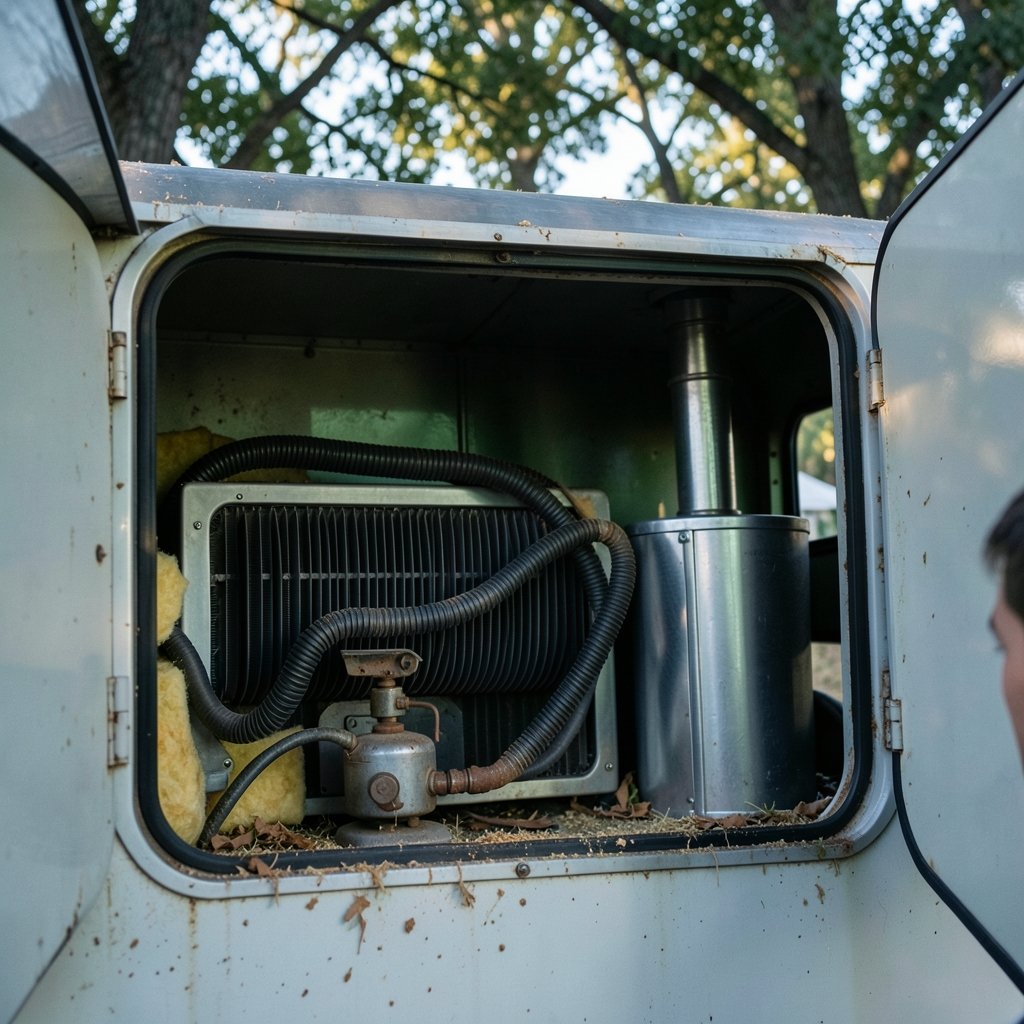
An absorption refrigerator uses heat, not a compressor, to move ammonia. A propane flame or electric heating element boils an ammonia-water mixture in the generator. The ammonia vapor rises, separates from the water, condenses back to liquid in the condenser coils, then evaporates into hydrogen gas in the evaporator, which is where the actual cooling happens. The cycle depends on gravity and convection; no pump pushes things along.
That design detail explains most repair realities. Because there is no compressor to wear out, the mechanical parts last a long time. But because the system relies on gravity, operating off-level for extended periods can cause the ammonia-water mixture to pool where it should not, overheating the cooling unit and permanently damaging it. Manufacturers generally advise keeping the fridge reasonably level whenever it runs on gas or electric, though exact tolerances vary by model and belong in the owner’s manual, not a forum post.
The Five Failures You Will Actually Encounter
1. No Cooling on Any Mode
If the fridge stays warm on propane and on shore power, the cooling unit is the prime suspect. This sealed assembly (the boiler, condenser, and evaporator) is the heart of the system. Once it leaks or crystallizes internally, no amount of cleaning or adjustment brings it back.
A classic tell is the yellow residue or ammonia smell near the back of the fridge. That means the sealed system has leaked and the unit is done. Stop using it, ventilate the area, and keep flames away.
2. Works on Electric but Not Gas
This points to the propane side: a dirty burner orifice, a clogged flue, a weak flame, or a thermocouple that fails to confirm ignition. Spiders love burner tubes, and a web the size of a thumbnail is enough to kill the flame. Cleaning the burner and flue is one of the cheapest fixes in RV ownership and one of the most commonly skipped.
3. Works on Gas but Not Electric
The heating element or its AC circuit has failed. The element is a simple resistive heater that eventually burns out. Testing it with a multimeter for continuity takes minutes; replacement is usually straightforward on units where the element is accessible from the rear.
4. Icing, Blocked Airflow, or a Bad Thermistor
If the fridge freezes food in the main compartment or cycles oddly, the thermistor (temperature sensor) may have slipped from its clip on the fin or failed outright. Poor airflow from a blocked vent, overpacked shelves, or added insulation around the cabinet causes similar symptoms. Absorption fridges need their roof or side vents clear and their installation clearances respected.
5. Control Board and 12V Power Problems
The eyebrow panel lights up but nothing happens? Check the 12V control power, fuses, and the board itself. Modern absorption fridges are controlled electronically, and a failed board can mimic a dead cooling unit. This is where diagnosis order matters: confirm power and level, then flame, then thermistor, then cooling unit.
A Practical Diagnostic Order That Saves Money
Technicians who work on these units follow a sequence because it moves from cheap and easy to expensive and invasive. Owners can follow the same path.
- Confirm the fridge is level and has been level while running. Off-level operation is the leading preventable cause of cooling unit death.
- Verify power on every mode. Check the AC breaker, the 12V fuse for the control circuit, and the propane supply at the stove to confirm gas is reaching the appliance.
- Look at the flame. A healthy propane flame is a steady blue with a slight roar. Yellow, lazy, or sputtering means the burner or orifice needs cleaning.
- Inspect the flue and vents. Debris, nests, and rust flakes in the flue reduce efficiency. Blocked roof vents trap heat and cripple performance.
- Test the thermistor against the manufacturer’s resistance values, and confirm it sits in the correct clip position on the fin.
- Check the heating element for continuity if electric mode fails.
- Only then suspect the cooling unit. Yellow stains, ammonia odor, or a boiler that gets hot without any cooling at the evaporator confirm the diagnosis.
Skipping steps costs money. Owners routinely replace control boards when the real problem was a five-dollar thermistor clip, or replace a cooling unit when the burner was simply clogged.
Safety Comes Before Curiosity
Absorption refrigerators contain ammonia and hydrogen under pressure, and the propane side involves a flammable gas train. Anything involving the sealed cooling circuit or gas piping belongs with a qualified technician. The same caution applies to any appliance with a known fire-risk history; checking the model and serial number against manufacturer recall notices is a smart first move for any older unit, and recalls for absorption fridges related to fire risk do exist.
For owners dealing with other household breakdowns in the same season, the same logic of diagnosing before replacing applies. A practical guide to fixing a refrigerator that stopped cooling walks through the residential version of this troubleshooting, and the reasoning transfers well.
Repair or Replace? The Math Owners Actually Face
For absorption fridges, the decision usually comes down to three options.
| Option | Typical situation | Pros | Cons |
|---|---|---|---|
| Repair the existing unit | Burner, element, thermistor, or board failure | Cheapest, keeps original fit | Does not fix an aging cooling unit |
| Replace the cooling unit | Confirmed sealed-system failure | Often far cheaper than a new fridge | Labor-intensive; unit still old |
| Swap to a compressor fridge | Owner wants reliability and fast cooling | No leveling, strong cooling, efficient | Needs 12V capacity planning and wiring |
Cooling-unit replacement is frequently the economical choice when the cabinet, controls, and doors are in good shape. A full swap to a compressor unit is a popular upgrade, but it demands honest math about battery capacity and charging, because a compressor fridge runs on 12V around the clock. Owners who boondock heavily often find the upgrade pays off; weekend hookup campers usually do not.
The broader lesson, familiar to anyone who has faced a laptop repair decision or weighed a motherboard repair on a dead board, is that repair economics hinge on what else is still healthy. A fridge with a solid cabinet and working controls is worth fixing. One with rust, cracked liners, and a failing board is not.
What Professional Repair Should Cost and How to Avoid Getting Burned
Diagnostic fees for RV refrigerators commonly run in the range of a service call, and the real cost sits in parts and labor. A burner cleaning is inexpensive; a cooling unit replacement is a significant line item; a full fridge swap is the largest. Prices vary widely by region and unit size, so treat any single number as a starting point, not gospel.
Three habits protect owners from bad outcomes:
- Get the diagnosis in writing before authorizing work, including which tests were run.
- Ask whether the tech checked level, flame, thermistor, and element first. A shop that jumps straight to “needs a cooling unit” without those checks deserves skepticism.
- Confirm parts availability and warranty terms on any cooling unit replacement.
The same due diligence applies when finding service providers for anything else on the rig. The approach described in this guide to finding a trustworthy garage door pro fast applies almost word for word to RV techs: verify credentials, ask for the diagnosis, and be wary of pressure to decide on the spot.
Preventive Maintenance That Genuinely Works
Most RV fridge failures trace back to a short list of preventable causes. A little seasonal attention goes a long way.
- Level before running. Set the rig level before switching the fridge on, and recheck after moving sites.
- Clean the burner and flue annually. A soft brush, compressed air, and a look for nests prevent a large share of no-cool calls.
- Keep vents clear. Do not stack gear against roof or side vents, and do not add insulation around the cabinet.
- Check the door seal. A dollar bill should drag when pulled out closed in the door. A failing gasket lets warm, humid air in and causes icing.
- Manage the thermistor. Confirm it stays clipped in the right spot on the fin.
- Run it periodically in the off-season so seals stay supple and the system does not sit idle for a year.
Conclusion
RV refrigerator repair is less mysterious than it looks once the technology is clear. Absorption fridges fail in predictable places: the burner, the heating element, the thermistor, the airflow path, and finally the sealed cooling unit. Diagnosing in that order, cheapest first, keeps most repairs small. The one rule that never bends is safety, because ammonia and propane are not DIY territory. Handle the simple maintenance, respect the sealed system, and know when the math favors replacement over repair. Do that, and the warm-fridge panic becomes a manageable checklist instead of a vacation-ending crisis.
FAQ
Why does my RV fridge work on propane but not electric?
The most likely culprit is the heating element or its AC circuit. The element is a resistive heater that burns out over time. A multimeter continuity test confirms it in minutes, and replacement is usually affordable when the element is reachable from the rear of the cabinet. Check the breaker and wiring first before condemning the element.
How level does an RV refrigerator need to be?
Level enough that the ammonia-water mixture can flow by gravity, which is why manufacturers specify a tolerance in the owner’s manual. A common rule of thumb among owners is that if walking inside the rig feels comfortable, the fridge is probably fine. Exact limits vary by model, so the manual beats forum folklore.
Can I repair an RV fridge cooling unit myself?
The sealed cooling circuit contains ammonia and hydrogen under pressure, so no. That work belongs to qualified technicians. Owners can safely handle burners, orifices, thermistors, elements, fuses, and vent cleaning. Anything involving the sealed system or the gas train should stop there.
What does yellow residue behind the fridge mean?
It usually means the sealed system has leaked. Yellow staining or an ammonia smell near the back of the unit is a sign the cooling unit has failed and needs replacement. Stop using the fridge, ventilate the area, and keep any flame or spark source away until it is serviced.
Is it cheaper to replace the cooling unit or buy a new fridge?
For a unit with a sound cabinet and working controls, cooling-unit replacement is typically far cheaper than a new refrigerator. A full replacement, especially a swap to a compressor model, only makes sense when the rest of the unit is also aging or when the owner wants the performance upgrade and can support the 12V load.
Why does my RV fridge freeze food in the main compartment?
A thermistor that has slipped off its fin clip or failed outright is the usual cause, since the control board loses accurate temperature feedback. Poor airflow from an overpacked fridge or blocked vent can produce similar symptoms. Testing the thermistor against the manufacturer’s resistance values is the first step.



