
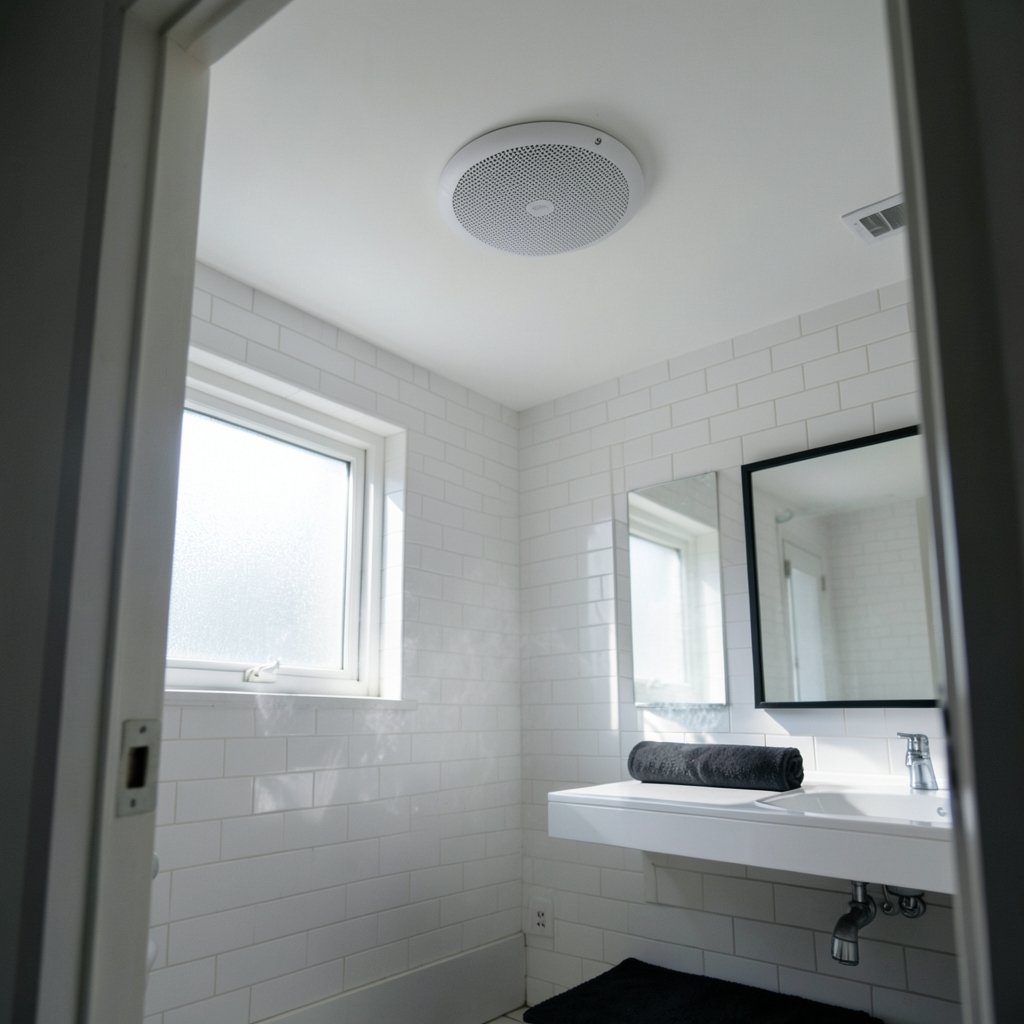
Does your bathroom mirror fog up the moment someone takes a shower, even though you installed a fan last year? Plenty of homes have the same result. Plenty of homeowners upgrade to a fan with a humidity sensor or a Wi-Fi chip, then discover the mirror still steams and the mould still creeps along the grout. The problem is rarely the fan itself. It is the mismatch between what the fan senses, how it is installed, and how much air the room actually needs to shift. (Extractor fan)
A smart extractor fan for bathroom use adds automatic humidity or motion sensing, adjustable overrun timers, and often app or voice control. That sounds like a small upgrade. In practice, it changes how the room dries out, how much noise you tolerate, and how often you think about ventilation at all. This guide walks through how these fans work, where they fall short, and how to choose one that earns its price.
What Makes a Bathroom Fan “Smart”?
A standard fan has one job: spin when the light switch flips and stop when a timer runs out. A smart fan adds at least one sensing or connectivity layer on top of that.
The most common features fall into four groups:
- Humidity sensing (hygrostat): the fan reads moisture in the air and boosts speed or starts running when levels climb past a set point.
- Motion or presence sensing (PIR): the fan triggers when someone enters the room, regardless of the light switch.
- Adjustable overrun timers: instead of a fixed 15-minute run-on, you set the cooldown period to match how long your bathroom actually stays damp.
- App, Wi-Fi, or smart-home integration: scheduling, remote control, and linking to platforms such as Alexa, Google Home, or Apple HomeKit.
Some models combine all four. Others offer only a hygrostat and a better timer. The label “smart” gets applied loosely, so check the spec sheet rather than the marketing copy. A fan with a genuinely adjustable hygrostat often beats a Wi-Fi fan with a crude on/off sensor, because moisture control is the whole point of bathroom ventilation.
Why Moisture Control Matters More Than Connectivity
Bathrooms generate a lot of water vapour in a short window. A single hot shower can push indoor humidity well above the level where condensation forms on cold surfaces. Intermittent extract ventilation is the long-standing approach to managing that moisture, and continuous low-rate extract is the alternative in very airtight homes. The principle is simple: remove damp air at the source before it spreads into walls, ceilings, and adjoining rooms. (Indoor Air Quality (IAQ))
When extraction falls short, the consequences show up slowly. Condensation on windows and mirrors is the visible sign. Less visible is moisture soaking into grout, sealant, and plasterboard, which creates the conditions for mould growth. That is why building guidance treats bathroom ventilation as a requirement rather than an optional extra.
This is also where smart features earn their keep. A fan tied only to the light switch stops running the moment someone leaves, even though the room is still saturated. A humidity-sensing fan keeps going until the air dries out. In a busy family bathroom with three showers before 8 a.m., that difference matters far more than an app icon on your phone.
Matching Fan Performance to the Room
Before comparing smart features, get the basics right. An underpowered fan with excellent sensors is still an underpowered fan.
In the UK, Approved Document F of the Building Regulations sets minimum extract rates for bathrooms, with higher rates required for rooms without windows. Widely cited figures sit around 15 litres per second for intermittent extract in a standard bathroom, rising for windowless rooms. Treat any specific number as something to confirm against the current edition of the guidance and, ideally, a qualified installer’s calculation. Rules and editions change, and the figure for your room depends on its size and layout.
Three practical checks matter more than the brochure:
- Duct route and length. A fan rated at 15 L/s may deliver far less once it pushes through two metres of flexible duct and a couple of bends. Rigid, short, straight ducting performs better than long, kinked runs.
- Air path. Extraction only works if replacement air can get in. A sealed, draught-proofed room with no trickle vent or door gap will starve the fan, and the motor will strain while moisture stays put.
- Noise at real speed. Fans are commonly rated in dB(A), with quiet models often quoted around 20 to 25 dB(A). Check the rating at the speed you will actually use, not the lowest setting.
If you are building out a broader connected home, it helps to think about how the fan fits with everything else. A hub such as the Home Center Lite can tie ventilation, lighting, and heating into one routine, so the fan runs when the shower does rather than when someone remembers to press a button.
Smart Fan Features Compared
Not every smart feature delivers the same value. Here is how the main options stack up in day-to-day use.
| Feature | What it does well | Where it falls short | Best for |
|---|---|---|---|
| Humidity sensor | Keeps running until air dries; catches showers the switch misses | Can lag before triggering; set point needs tuning | Most bathrooms, especially busy ones |
| PIR motion sensor | Starts instantly on entry; no switch habit needed | False triggers from passing traffic; stops too early without overrun | Guest bathrooms and rentals |
| Adjustable overrun timer | Simple, reliable, cheap to include | Fixed logic; does not react to actual moisture | Budget upgrades and simple retrofits |
| App and Wi-Fi control | Scheduling, remote checks, automation links | Adds cost, setup, and privacy questions; rarely used daily | Connected homes and landlords managing multiple units |
| Boost and trickle modes | Continuous background extract plus on-demand boost | Needs correct commissioning to be effective | Airtight, modern homes |
A pattern shows up again and again in owner forums and installer advice: the humidity sensor is the feature people value most after a year of use, and the app is the feature they stop opening. If budget is tight, spend it on a better hygrostat and quieter motor before spending it on connectivity.
Installation Rules You Cannot Skip
Bathroom fans sit in a wet zone, and the electrical rules reflect that. In the UK, fans are typically installed in Zone 2 or outside the zones defined by BS 7671, the IET Wiring Regulations, and need an appropriate IP rating plus RCD protection. Some work is notifiable. Getting this wrong is a safety issue, not a cosmetic one, so use a qualified electrician for anything beyond a straight like-for-like swap.
A few practical points that catch people out:
- Isolation and switching. A fan with a permanent live for overrun or sensing needs the right three-pole isolation; a light-switch feed alone is insufficient.
- Backdraught shutter. Required on external walls to stop cold air and insects coming back in.
- Access for cleaning. The fan needs to be reachable. A unit buried behind a sealed ceiling panel will clog with dust and lose performance within a couple of years.
- Condensation traps in ducting. Insulated duct or a fall toward the outside prevents moisture pooling and dripping back.
If you are also tightening up the rest of the house, coordinate the work. Draught-proofing without adding ventilation makes moisture problems worse, and it pays to plan smart thermostats to save energy alongside ventilation so the two systems do not fight each other.
Common Mistakes That Undermine a Good Fan
Most disappointing smart fans are not faulty. They are misapplied. These are the errors that come up repeatedly.
Choosing by price alone. A cheap fan with a humidity sensor often has a crude sensor and a noisy motor. The sensor triggers late, the fan runs loud, and the household starts switching it off at the wall, which defeats the entire purpose.
Ignoring the duct. Homeowners replace the fan but leave the old flexible duct with three bends and a crushed section behind it. Airflow collapses. The new fan gets blamed.
Setting the overrun too short. Fifteen minutes feels generous until you time how long a bathroom stays steamy after a hot shower. Twenty to thirty minutes is often more realistic, and adjustable timers exist precisely so you can tune this.
Skipping the trickle vent. Modern homes are airtight. Without a path for replacement air, extraction underperforms no matter how smart the fan is.
Forgetting the rest of the connected home. A bathroom fan is one node in a system. If you are starting from scratch, it is worth reviewing best smart home devices for beginners so the fan, lighting, and heating speak the same language rather than sitting on four separate apps.
Never cleaning it. Dust on the impeller and grille cuts airflow and makes the fan louder. A two-minute clean twice a year keeps performance close to spec.
Where Smart Fans Fit in a Connected Home
The strongest case for a connected fan is automation, not remote control. A routine that triggers extraction when a humidity sensor crosses a threshold, or that pairs the fan with a shower light, removes the human element entirely. That is genuinely useful in a busy household.
The weakest case is novelty. App control on a fan you touch twice a year adds little. Privacy is a fair question too: a device with a microphone or persistent cloud connection in a bathroom deserves scrutiny. Buy from brands with clear data policies, and prefer local control where the option exists.
For broader context on how these devices slot into a home, the best smart home devices for beginners guide covers the entry points, while best smart speakers for home automation explains which voice platforms actually support ventilation routines. If security integration matters to you, best smart locks for home security shows how the same hub can manage access alongside climate and air quality.
One more angle worth noting: if you enjoy tinkering with connected gadgets, the same instincts that make a smart fan appealing apply elsewhere. Fans of puzzle games often look for the same kind of satisfying, low-friction automation in their downtime, and a list of games like Wordle scratches a similar itch. It is a small reminder that “smart” should mean less effort, not more.
How to Choose: A Practical Buying Sequence
Work through these steps in order and the shortlist builds itself.
- Calculate the required extract rate for your room size and window situation, then add headroom for duct losses.
- Map the duct route. Short, rigid, and straight wins. If the route is long, buy a fan with a higher rated airflow.
- Decide on sensing. Humidity sensing is the priority for most bathrooms. Add PIR only if the switch habit is genuinely a problem.
- Check the noise rating at the speed you will use, and confirm the overrun timer is adjustable.
- Confirm electrical compliance with a qualified installer, including IP rating, zoning, and RCD protection.
- Only then consider app and smart-home features, and check they work with the platform you already use.
Conclusion
A smart extractor fan for bathroom use is worth the money when the intelligence serves moisture control. A well-tuned humidity sensor, a realistic overrun timer, and a quiet motor on a short, clean duct will outperform a Wi-Fi-enabled box with a weak sensor every time. Get the airflow and installation right first, then layer on connectivity if it genuinely simplifies your routines. Do that, and the mirror stops fogging, the grout stays clean, and you stop thinking about the fan at all, which is exactly how good ventilation should feel.
Frequently Asked Questions
Do smart bathroom fans really reduce mould?
They can, but only as part of a working system. A humidity-sensing fan that runs until the air dries removes moisture that a switch-timed fan would leave behind. If the duct is undersized or the room has no air path, even a good smart fan will struggle. Fix airflow first, then add sensing.
How long should a bathroom extractor fan run after a shower?
Long enough to clear the moisture, which is usually longer than people expect. Many households find 20 to 30 minutes works better than the common 15-minute default. Adjustable overrun timers exist so you can tune this to your bathroom rather than guessing.
Is a humidity sensor better than a motion sensor?
For most bathrooms, yes. Humidity sensing responds to the actual problem, which is moisture, and keeps the fan running until conditions improve. Motion sensing is useful for starting the fan quickly, but it stops when people leave, which is often too early.
Can I install a smart extractor fan myself?
A straight like-for-like replacement is within reach for a confident DIYer, but anything involving new wiring, a permanent live feed, or work inside the bathroom zones should go to a qualified electrician. The wiring regulations covering bathroom zones and RCD protection are there for good reason.
Why is my new fan still noisy?
Noise usually comes from three places: the motor at higher speeds, turbulence in a kinked or oversized duct run, and vibration through a poorly mounted ceiling. Check the duct route and mounting before blaming the fan, and compare the dB(A) rating at the speed you actually run.
Do smart fans need a hub or app to work?
No. Most humidity-sensing and timer-based fans work entirely standalone, with no app or hub involved. Connectivity is an optional layer for scheduling and automation. If you want voice control or routines, check compatibility with your existing platform before buying.



