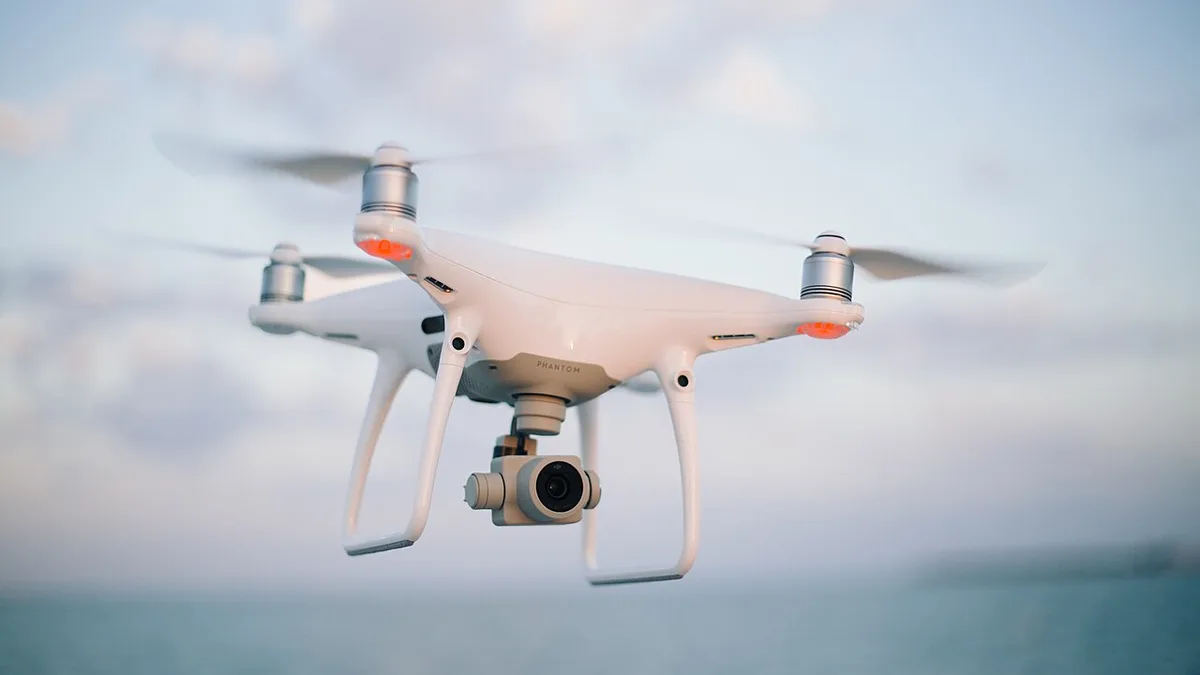
A drone is an aircraft that flies without a pilot on board. Most of the drones people buy are quadcopters: small machines with four spinning rotors, a battery, a camera, and a radio link to a controller held on the ground. The pilot steers from below while the aircraft balances itself dozens of times every second.
The modern drone only became practical when three things got cheap at the same time: small sensors that can tell which way is up, powerful batteries that can lift their own weight, and processors fast enough to adjust four motors in real time.
This guide explains how drones work in plain terms: how four rotors lift and steer, how the camera stays steady, how the controller talks to the aircraft, and what the different types are good for. No engineering background is needed.
Key takeaways
- Most consumer drones are quadcopters: four rotors provide lift, and changing their relative speeds steers the aircraft.
- A flight controller reads gyroscopes and accelerometers many times per second and adjusts each motor to keep the drone level.
- The camera hangs on a motorised gimbal that cancels out vibration and tilt, which is why drone footage looks smooth.
- Control and live video travel over a radio link; when that link breaks, a good drone flies home and lands by itself.
- Battery life is the main limit: most consumer drones fly for 20 to 45 minutes before they must land and recharge.
Drones at a glance
| Part | What it does |
|---|---|
| Rotors | Four spinning propellers that create lift and steer by changing speed |
| Flight controller | The onboard computer that balances the drone many times per second |
| Battery | A rechargeable lithium pack that powers motors, camera, and radio |
| Camera and gimbal | A stabilised camera that records smooth photo and video from the air |
| GPS and sensors | Satellite positioning plus obstacle sensors that hold position and avoid crashes |
| Radio link | The two-way connection carrying control signals up and live video down |
| Return-to-home | The automatic routine that flies the drone back and lands it if the link is lost |
What a drone actually is
A drone, formally called an unmanned aerial vehicle, is any aircraft flown without a person inside it. The word covers everything from a palm-sized toy to a military aircraft the size of a small plane. Most people mean consumer quadcopters weighing 250 grams to about a kilogram, built around a camera.
The 250-gram line matters because regulators in many countries treat drones below that weight more lightly: they often need no registration and face fewer restrictions. Heavier drones generally carry bigger cameras, fly longer, and handle wind better, but they also bring more paperwork.
Inside the body, the layout is simple. A central frame holds the battery, the flight controller, and the camera, with four arms reaching out to the motors. There are no wings, no tail, and no flaps. Everything the drone does in the air comes from speeding up or slowing down those four propellers.
How a drone stays in the air
A quadcopter flies because its four propellers push air downward, and the reaction pushes the aircraft upward. When all four rotors spin at the same speed, the drone hovers. Speed them all up together and it climbs; slow them all down and it sinks.
Steering works by unbalancing the rotors on purpose. To move forward, the rear rotors spin faster than the front ones, tilting the aircraft slightly forward so some of the lift points ahead. To turn, the clockwise rotors speed up and the anticlockwise ones slow down.
None of this would work without the flight controller, a small computer that reads motion sensors called gyroscopes and accelerometers. These sensors detect tilt and acceleration, and the controller corrects the motors many times per second. A gust of wind tips the drone a fraction of a degree; the controller compensates before the pilot ever sees a wobble. This constant correction is called stabilisation, and it is why a beginner can hover a drone on the first try. GPS adds a second layer of steadiness, letting the drone hold one spot or follow a programmed route, while obstacle sensors help it stop before hitting a wall or tree.
How the camera and gimbal work
The camera is the reason most people buy a drone, and it hangs below the body on a gimbal, a small motorised mount that moves in three directions. When the drone tilts forward to fly, the gimbal tilts the camera back so it stays level. When vibration from the motors shakes the frame, the gimbal absorbs it. The result is footage that looks as if it were shot from a crane, not from a buzzing machine.
Most consumer drone cameras record 4K video and take still photos of 12 to 48 megapixels, with a sensor about the size of a phone sensor, so quality is best in good daylight. The video on the pilot’s phone is a live feed with a delay of well under a second, while the full-quality footage is saved on a memory card inside the aircraft. Smart modes let a drone circle a subject or follow a moving person, using the same kind of machine learning that tags faces in photo apps.
How the controls and radio link work
The pilot flies with a controller that looks like a game pad with two sticks and a phone clipped on top. The left stick usually controls height and rotation, while the right stick controls forward, backward, and sideways movement. Dials and buttons handle the camera.
Commands travel to the drone over a radio link, most often in the 2.4 GHz or 5.8 GHz bands, the same frequencies used by home Wi-Fi. Modern drones use a digital link that carries both the control signals and the live video feed, with a range of several kilometres in open country. The link works in both directions: the drone sends back battery level, height, distance, and GPS position, and if the signal breaks entirely, the drone climbs to a safe height, flies back to its take-off point, and lands itself. This autonomy runs on the drone itself, using the kind of trial-and-error learning explained in our guide to what reinforcement learning is and how AI learns by doing.
Types of drones
Quadcopters dominate the consumer market because they are stable, easy to build, and good at hovering in one place, which is exactly what photography needs. Most have four rotors, but larger camera drones use six or eight for redundancy: if one motor fails, the others can still bring the aircraft down safely.
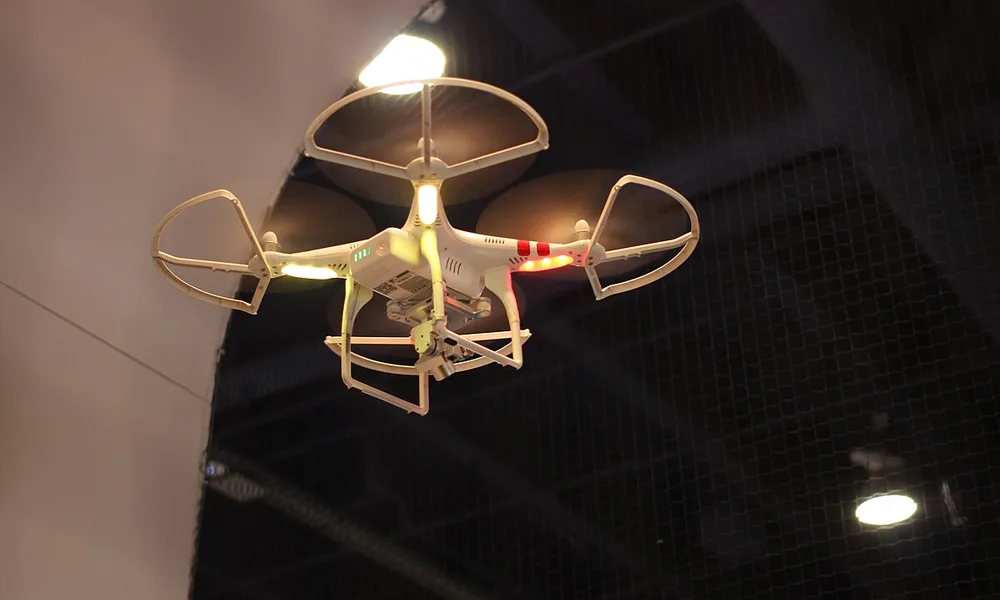
Fixed-wing drones look like small aeroplanes, with wings instead of rotors. They cannot hover, but they fly much farther and longer on the same battery because the wings do the lifting, so survey teams use them to map fields and coastlines. At the other end of the scale, tiny palm-sized drones with propeller guards are built for indoor flying and learning. If you are shopping for a first aircraft, our guide to the best drones for beginners in 2027 compares the models that are easiest to learn on.
Benefits and risks
The main benefit of a drone is a viewpoint that was once expensive or impossible. Aerial photos and video used to require a helicopter; now a machine that fits in a backpack does the job for a fraction of the cost. Surveyors map land faster, farmers check crop health field by field, and rescue teams search terrain that would take people hours to cover on foot.
The risks are real and mostly come from the same strengths. A spinning propeller can injure a person, a falling drone can damage property, and a lost radio link over a crowd is a serious hazard. That is why flying near airports, over crowds, and above certain heights is restricted, and heavier models often need registration and a basic test. Privacy matters too: do not film people where they expect privacy, or hover over private property without permission.
Real-world uses
Photography and video remain the biggest use. Travel creators shoot coastline and mountain footage and estate agents photograph houses from above. In surveying, a drone photographs a site from above and software stitches the images into a map or 3D model, so builders track progress week by week and farmers spot dry or diseased patches of crop. Energy companies fly drones along power lines and wind turbines to spot damage, and search and rescue teams use thermal cameras to find people at night.
Drones vs traditional aircraft and camera rigs
Against a helicopter, a drone wins on cost and access and loses on payload and range. A helicopter can carry people and heavy cameras for hours; a drone carries a small camera for under an hour, but it costs a few dollars per flight and launches from a garden instead of hundreds of dollars per hour. Against a fixed-wing survey plane, a quadcopter wins on precision and loses on coverage: a plane maps a whole county in one flight, while a quadcopter maps a single site in fine detail and can hover to inspect one spot.
Checklist: before you fly
- Charge the battery fully and check the propellers for cracks or chips before every flight.
- Confirm the area is legal to fly in, away from airports, crowds, and restricted zones.
- Wait for a strong GPS lock and confirm the home point is set before take-off.
- Check the wind: if small branches are moving strongly, a light drone will struggle.
- Keep the drone within sight and keep at least 30 percent battery in reserve for the return.
- Land, inspect the aircraft, and back up the footage before the next flight.
Frequently asked questions
How long can a drone fly on one battery?
Most consumer drones fly for 20 to 45 minutes on a full charge, depending on the model, the wind, and how much the camera is used. Real flight time is usually a few minutes less than the figure on the box, because manufacturers test in still air.
How far can a drone fly from its controller?
Modern digital links reach several kilometres in open country, but the practical limit is usually eyesight: pilots are expected to keep the drone where they can see it.
What happens if a drone loses signal?
It climbs to a preset safe height, flies back to its recorded take-off point using GPS, and lands itself. This return-to-home routine triggers automatically after a few seconds without a signal.
Do I need a licence to fly a drone?
It depends on the weight and the country. Drones under 250 grams often need no registration, while heavier drones usually require registration and a basic online test.
Can drones fly in rain or strong wind?
Most consumer drones are not waterproof and should not be flown in rain. Strong wind drains the battery fast and can push a light drone off course, so if the weather looks doubtful, wait for a calmer day.
Why does drone video look so smooth?
The camera sits on a motorised gimbal that counteracts the drone’s tilt and vibration in real time, keeping the lens level while the aircraft moves. The result looks as if it were filmed from a steady platform.
The bottom line
A drone is a simple idea executed with fast electronics: four rotors lift it, a flight controller balances it, a gimbal steadies the camera, and a radio link connects it to the pilot. Together they explain why a machine that fits in a backpack can take photographs that once needed a helicopter.
For anyone considering one, the sensible path is to start light, learn the controls in an open space, and respect the rules on where flying is allowed. The best footage comes from a pilot who understands the machine and plans each flight before take-off.