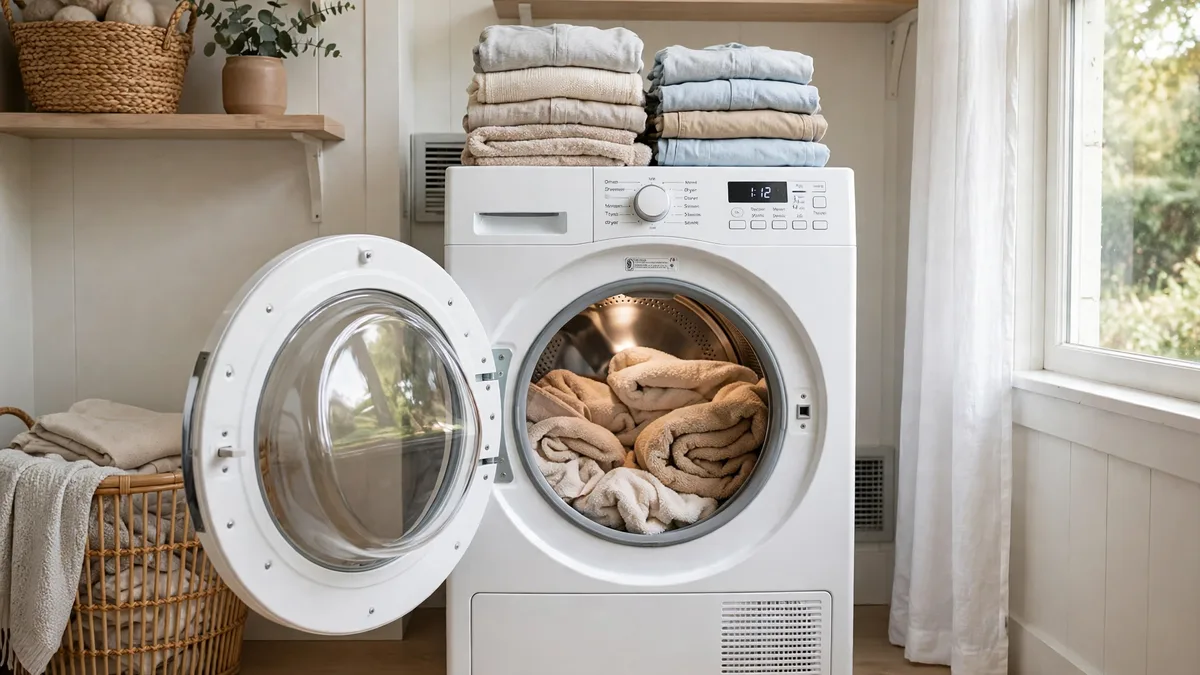
A dryer is a household appliance that dries wet laundry by tumbling it through heated air, so clothes come out warm, dry and ready to fold instead of hanging damp on a line for hours. It is the natural partner to the washing machine: the washer cleans the load, and the dryer finishes the job. For households without outdoor space, or in wet and cold weather, it turns laundry day from a two-day wait into a single afternoon.
A typical dryer handles the same load as a full-size washer — about 4.5 to 5.5 cubic feet — and finishes most loads in 30 to 60 minutes. It uses more energy than almost any other home appliance, which is why the type of dryer, the heat setting and the way it is loaded all matter for the electricity bill. A vented model blows hot, moist air outside through a duct, while a ventless model condenses the moisture or recycles the heat.
Used well, a dryer is safe, fast and gentle enough for most everyday fabrics. Used badly, it shrinks wool, melts elastic and wastes energy. This guide explains what a dryer is, how it dries clothes, the main types, the settings that matter, and how to use one safely and efficiently.
Key takeaways
- A dryer dries laundry by tumbling clothes through heated air and venting or condensing the moisture away.
- Vented dryers are cheaper and faster; ventless heat-pump dryers use far less energy but take longer.
- Match the heat to the fabric: low heat for delicates and synthetics, medium for everyday loads, high only for towels and heavy cotton.
- Clean the lint filter after every load — a clogged filter is the main cause of slow drying and dryer fires.
- Do not overload the drum; clothes need space to tumble freely or they come out damp and creased.
Dryer at a glance
| Detail | What to know |
|---|---|
| What it does | Dries wet laundry by tumbling it through heated air |
| Main types | Vented, condenser, heat-pump, gas, washer-dryer combo |
| Typical capacity | 4.5 to 5.5 cubic feet for a full-size dryer |
| Average cycle time | 30 to 60 minutes for a normal load |
| Energy use | One of the highest in the home; heat-pump models use about half the energy |
| Key safety rule | Clean the lint filter after every load |
| Typical lifespan | 10 to 13 years with regular cleaning and care |
| Best for | Towels, bedding, everyday cotton and homes without drying space |
What a dryer is
A dryer is an electric or gas appliance built around a large rotating drum that holds wet laundry. A fan draws in air, a heating element or gas burner warms it, and the hot air passes through the tumbling clothes, picking up moisture. The damp air is then either blown outside through a vent hose or passed over a condenser that turns the moisture into water, which drains away or collects in a tank. Sensors measure the humidity of the air leaving the drum and stop the cycle when the clothes reach the chosen dryness.
Clothes dryers became common in American homes in the 1950s and 1960s, as automatic washing machines spread. In Europe they arrived later and remain less universal, partly because many homes are smaller and energy costs are higher. Today the dryer is standard in most new homes in the United States, and it is the second half of the laundry pair, with the washer and dryer side by side or stacked. Like other home appliances, dryers have gained moisture sensors, quieter motors and more efficient designs, the same steady improvement seen across other home appliances, including the coffee maker explained in our guide to what a coffee maker does and how to pick one.
How a dryer works

Drying has three parts: heat, airflow and tumbling. The drum turns slowly, lifting clothes and dropping them through hot air so every item is exposed. Heat turns the water in the fabric into vapour, the airflow carries that vapour away, and the tumbling stops clothes clumping together, which would trap moisture in the middle of the load. A load that cannot tumble freely dries unevenly, with damp patches in the centre.
Moisture sensors make modern dryers far more efficient than older timed models. Instead of running for a fixed time, the dryer measures how damp the exhaust air is and stops when the load is dry, or switches to a short cool-down tumble that relaxes wrinkles. Clothes removed hot and left in a pile crease badly, while a cool-down and prompt folding keeps them smooth.
Types of dryers
Vented dryers are the simplest and cheapest type. They heat air, pass it through the drum and blow the moist air outside through a duct, so they need a vent to the outside wall. They dry quickly and cost less to buy, but they use the most energy. Gas vented dryers cost more upfront but are cheaper to run where gas is cheap.
Condenser and heat-pump dryers
Condenser dryers need no vent: they cool the moist air so the water condenses and drains away, then reheat the air. They can sit anywhere with a power socket, which suits flats. Heat-pump dryers are the most efficient type, recycling heat through a refrigeration loop and drying at lower temperatures, which is gentler on clothes. They use roughly half the energy of a vented dryer, but they take longer per load and cost more to buy. Washer-dryer combinations dry in the same drum as the wash, saving space but drying slowly.
Settings, capacity and care
Settings matter more than most owners realise. Low heat suits delicates, synthetics and anything with elastic, because high heat melts elastic and shrinks wool. Medium heat handles everyday cotton and mixed loads, while high heat is reserved for towels, jeans and heavy bedding. Timed drying runs for a set number of minutes, while sensor drying stops when the load is dry — sensor drying is almost always the better choice, because it prevents over-drying, which wears out fabric and wastes energy.
Capacity should match the washer: a dryer smaller than the washer cannot dry a full wash load in one go. A 4.5 to 5.5 cubic foot drum suits most families, and the drum should be filled about three-quarters full so clothes can tumble. For care, clean the lint filter after every load and vacuum the filter housing monthly. Check the vent hose once a year for kinks and lint build-up. A dryer that takes much longer than usual almost always has a clogged filter or vent, not a broken heater — and a machine that is not drying at all may need a repair, which is where appliance repair software that helps technicians track jobs comes in for the businesses that fix them.
Benefits and risks of a dryer
The main benefit is speed and independence from the weather. A load that takes a day on a washing line in winter dries in under an hour, and towels come out softer than line-dried ones because tumbling fluffs the fibres. For flats without outdoor space and families with children, a dryer removes a daily bottleneck. It also kills dust mites: ten minutes on high heat deals with mites in bedding and soft toys.
The risks are heat damage, energy use and fire. High heat shrinks wool, damages elastic and fades prints, and repeated over-drying thins fabric faster than line drying. A dryer is one of the most energy-hungry appliances in the home, and running half loads on high heat wastes electricity. The most serious risk is fire: lint is highly flammable, and a clogged filter or vent lets heat build up. Dryer fires are rare but real, and almost all trace back to lint that was not cleaned. Never dry items stained with oil or chemicals, and never dry rubber-backed mats or plastic items.
Real-world uses and comparisons
In homes, the dryer sits at the end of the laundry chain: wash, dry, fold. Families use it daily, while single-person households may use it only for towels and bedding. In laundromats, large commercial dryers serve customers who need a week’s laundry dried in half an hour, and the operators track machine use and maintenance carefully — the same software world covered in our roundup of the best laundromat management software.
The most common comparison is dryer versus line drying. Line drying costs nothing, uses no energy and is gentlest on fabric, but it needs space, time and dry weather. A dryer costs money to run and wears fabric faster, but it is fast, reliable and softens towels. The other common choice is vented versus heat-pump: vented dryers are cheaper and faster, while heat-pump dryers cost more but halve the energy bill and treat clothes more gently. For a household that dries five loads a week, the heat-pump model usually pays back its higher price within a few years.
Checklist: using a dryer safely
- Clean the lint filter after every load, and vacuum the filter housing monthly.
- Fill the drum about three-quarters full so clothes can tumble freely.
- Match the heat to the fabric — low for delicates and synthetics, high only for towels and heavy cotton.
- Use sensor drying instead of a fixed timer to avoid over-drying.
- Check the vent hose yearly for kinks, lint build-up and damage.
- Never dry items stained with oil or chemicals, and never leave a dryer running unattended for hours.
Frequently asked questions
How long does a dryer take?
Most loads take 30 to 60 minutes. A dryer that takes much longer than usual usually has a clogged lint filter or vent.
Does a dryer shrink clothes?
Heat shrinks natural fibres such as wool and cotton, especially on a high setting. Wash and dry wool on low heat or air-dry it, and check the care label before drying anything new. Synthetics are less likely to shrink but can melt or warp on high heat.
Is a heat-pump dryer worth it?
For households that dry several loads a week, yes. A heat-pump dryer uses roughly half the energy of a vented dryer and is gentler on clothes, though it takes longer and costs more to buy.
Why is my dryer not drying?
The most common cause is a clogged lint filter or vent, which blocks airflow. Clean the filter, check the vent hose for kinks and lint, and make sure the drum is not overloaded. If it still does not heat, the heating element or thermostat may need a repair.
Can I dry shoes in a dryer?
Most shoes should not go in a dryer: heat warps soles and damages glue. Some dryers have a shoe rack that holds trainers still while warm air circulates, but air-drying is safer for most footwear. Never dry leather shoes in a dryer.
Should I use dryer sheets or balls?
Dryer sheets reduce static and add scent, but they leave a coating on the lint filter and on towels that reduces absorbency. Wool dryer balls are a reusable alternative: they separate clothes, cut drying time slightly and reduce static without chemicals.
The bottom line
A dryer matters because it removes the last uncertainty from laundry day. The washer cleans the clothes, but without a dryer the load depends on the weather, the space and the time available. A dryer gives back that time, softens towels and kills dust mites. The trade-off is energy use and heat, both manageable with the right settings.
When buying, match the capacity to the washer, choose the type that fits the home — vented where a duct is easy, heat-pump where energy costs matter — and use sensor drying with the right heat for the fabric. Clean the lint filter every time, check the vent yearly, and the dryer will do its job quietly for a decade or more. The machine is simple; the habit of using it well is what makes it last.