A microwave is an electric kitchen appliance that heats food with microwave radiation, a form of energy that makes water, fat, and sugar molecules inside the food vibrate and produce heat. It does not heat food from the outside in the way a conventional oven does. Instead, the energy passes through the container and into the food itself, which is why a bowl of soup can be steaming hot in two minutes while the bowl stays only warm to the touch.
The first microwave ovens were large, expensive machines built for restaurants. The compact countertop microwave most homes have today arrived in the late 1960s and became common in the 1980s, when prices fell. Today, more than nine in ten households in the United States own one, and it has become the default tool for reheating leftovers and defrosting frozen food.
What makes the microwave worth understanding is that it is not a small oven. It works on a different principle, with different strengths and limits, and it demands different habits. Knowing how it heats and what should never go inside it is the difference between a fast, useful tool and a ruined meal.
Key takeaways
- A microwave heats food with 2.45 GHz microwave radiation, which excites water, fat, and sugar molecules and turns that motion into heat.
- It cooks unevenly by nature, so stirring, rotating, and resting food are part of using it well.
- Countertop, over-the-range, built-in, and drawer models differ mainly in size, power, and fit.
- Metal, sealed containers, and some plastics do not belong in a microwave, and foil can spark.
- A microwave is fastest at reheating, defrosting, and steaming, but it cannot brown or crisp food.
What a microwave actually is
A microwave oven is a metal box with a door, a turntable, a control panel, and a component called a magnetron. The magnetron is the heart of the machine: it converts electricity into microwaves, a type of non-ionising radiation with a frequency of about 2.45 gigahertz. That frequency is the one at which water molecules absorb energy efficiently, and it is shared with Wi-Fi routers, which is why a running microwave can briefly interfere with a weak Wi-Fi signal nearby.
The walls of the cooking cavity are metal, and metal reflects microwaves, so the energy bounces around inside until the food absorbs it. The door has a fine metal mesh built into the window that keeps the energy inside while letting the cook watch the food. Safety interlocks cut power to the magnetron the moment the door opens.
Most home microwaves sit between 600 and 1,200 watts. A 1,000-watt model heats roughly a third faster than a 700-watt one, which is why cooking times on ready-meal packaging usually assume an 800-watt oven. Shoppers comparing models can find the same trade-offs in our guide to affordable microwave ovens, where price and power are weighed against each other.
How a microwave heats food
When the magnetron fires, microwaves flood the cavity and pass into the food. Water molecules flip back and forth billions of times a second as the field alternates, and that rapid movement creates friction, which becomes heat. Fat and sugar molecules respond in the same way, though less strongly, which is why fatty foods heat faster than lean ones.
Microwaves only penetrate food to a depth of about 2.5 to 4 centimetres. In thick food, the outer layer heats directly and the centre warms by conduction. This is why a microwave heats a thin plate of leftovers evenly but leaves a dense casserole hot at the edges and cold in the middle, and why standing time matters.
The turntable fights this unevenness by rotating food through the hot and cold spots. Power levels work differently from what many assume: 50 percent power means full-power microwaves in bursts, which gives heat time to spread and is gentler on delicate food.
Covering a dish traps steam, speeds cooking, and stops splatters. A fully sealed container is the exception: it traps steam until pressure builds, and that pressure can burst the container.
Types of microwave ovens
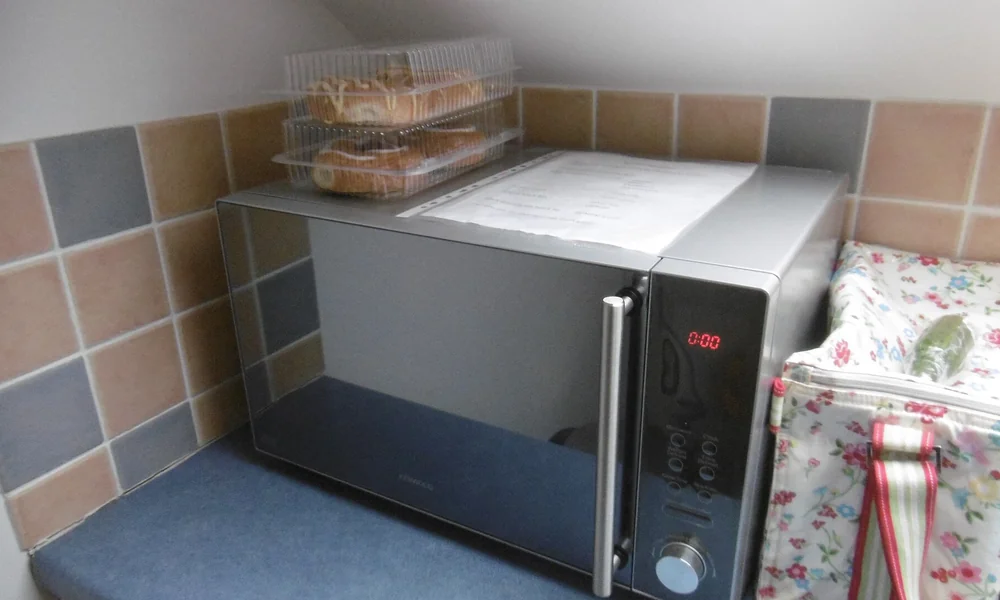
Countertop microwaves are the most common type. They sit on a worktop, plug into a standard socket, and cost the least, with capacities of 17 to 32 litres and power of 800 to 1,000 watts. Their weakness is the space they occupy, which is why they appear in our roundup of kitchen gadgets that actually earn their counter space.
Over-the-range microwaves are mounted above the hob and double as an extractor hood. They save worktop space but are harder to install and sit high enough that lifting hot soup down can be awkward. Built-in microwaves are fitted into a wall unit or tall cabinet, often paired with a wall oven, and give the cleanest look. They cost more, need professional installation, and are sized to the cabinet, so a replacement must fit the same opening.
Drawer microwaves slide out from under a worktop like a drawer and are loaded from above, which suits kitchen islands and accessible kitchens. Combination microwaves add a convection oven or a grill element, letting one appliance bake and crisp as well as microwave, though they cost considerably more.
Microwave ovens at a glance
| Detail | What is known |
|---|---|
| Heating method | 2.45 GHz microwave radiation exciting water, fat, and sugar molecules |
| Typical home power | 600 to 1,200 watts; 800 watts is the common baseline for cooking times |
| Penetration depth | About 2.5 to 4 centimetres; thicker food heats by conduction from the outside in |
| Main types | Countertop, over-the-range, built-in, drawer, combination, and commercial |
| Typical capacity | 17 to 32 litres for countertop models; larger for built-in and combination units |
| Best at | Reheating, defrosting, steaming vegetables, melting butter and chocolate |
| Cannot do | Brown, crisp, or roast food without a convection or grill element |
| Key safety rule | No metal, no sealed containers, and no superheated liquids left unstirred |
Benefits and risks
The microwave’s main benefit is speed. Reheating a plate of food takes two or three minutes instead of fifteen in an oven, and defrosting takes minutes rather than hours in the fridge. It is also energy efficient for small jobs: heating one portion uses far less electricity than heating a whole oven. For vegetables, short cooking times and little added water also preserve more vitamins than boiling does.
The risks are real but manageable. Uneven heating is the most common problem, and it is also a food-safety issue: cold spots in reheated meat or rice can harbour bacteria. Stirring halfway, cutting food into even pieces, and letting it stand for a minute after cooking address most of this. Superheated water is a subtler hazard: water in a very smooth cup can pass boiling point without bubbling, then erupt when the cup is moved. Stirring before heating prevents it.
Microwave radiation itself is not a health risk when the oven is used correctly. The energy is non-ionising, which means it cannot damage DNA the way X-rays can, and it disappears the moment the magnetron stops. An oven with a damaged door seal should be repaired or replaced rather than used. What does cause damage is misuse: metal objects can arc and spark, and some plastics soften at high temperatures, so containers should be labelled microwave-safe.
Real-world uses
Reheating is the microwave’s home territory. Leftovers and takeaway reheat faster and with less washing up than any other method. Spread food in a thin, even layer, cover it loosely to hold in steam, and stir halfway. Rice deserves care: reheat it until steaming hot throughout and only once, because the spores that cause food poisoning in rice survive cooking.
Defrosting is the second everyday job. Most microwaves have a defrost setting that cycles low power to thaw food without cooking the edges. It works well for meat, fish, and bread, but food defrosted this way should be cooked immediately, because the outer layers will have entered the temperature range where bacteria multiply. Steaming vegetables is the third: a splash of water, a lid, and two to four minutes produce crisp vegetables.
Beyond the obvious, a microwave melts butter and chocolate more evenly than a pan, softens ice cream in seconds, and pops popcorn. It also warms baby bottles, though bottles should always be shaken and tested on the wrist afterwards, because hot spots can scald.
Microwave vs oven vs hob
A microwave and a conventional oven solve different problems. An oven heats with hot air and radiant heat, which browns, crisps, and roasts. A microwave heats fast and only where water is present, which makes it useless for browning but unbeatable for reheating. The two are complements: the oven handles roasts and bakes, while the microwave handles the quick jobs.
A hob sits between the two. It gives direct, controllable heat for frying, boiling, and simmering, and it can brown food, but it is slower than a microwave for reheating and uses more energy for a single portion. Buying all three does not have to be expensive, as our guide to finding cheap kitchen appliances that offer real value explains.
Checklist: using a microwave well
- Use microwave-safe containers only, and check the label on any plastic before it goes in.
- Spread food in a thin, even layer and cut thick pieces into similar sizes.
- Cover dishes loosely to trap steam, but never seal a container shut.
- Stir or rotate food halfway through, and let it stand for one to two minutes after the beep so heat evens out.
- Keep metal, foil, and gold-trimmed crockery out of the cavity.
- Stir drinks before and after heating, and test baby food on your wrist before serving.
Frequently asked questions
Is microwave radiation dangerous?
No, when the oven is used correctly. Microwave radiation is non-ionising, so it cannot damage DNA, and it stops the instant the magnetron switches off. The door mesh and safety interlocks keep the energy inside, and no radiation remains in the food.
Why does food heat unevenly in a microwave?
Microwaves only penetrate a few centimetres into food, and the energy is not distributed evenly inside the cavity. The outer layers heat directly while the centre warms by conduction. Stirring, rotating, and resting the food evens the temperature out.
Can you put metal in a microwave?
No. Metal reflects microwaves, which can cause arcing and sparks, damage the magnetron, and start a fire. Thin metal such as foil and gold trim is the most likely to arc, and no metal should be used in a home microwave.
Does microwaving destroy nutrients?
Microwaving preserves nutrients well compared with boiling, because cooking times are short and little water is used. Vitamin C and B vitamins are sensitive to heat and water in any cooking method, and microwaving loses less of them.
What wattage microwave should I buy?
For most households, 800 to 1,000 watts is the right range. Below 700 watts, cooking is noticeably slow and ready-meal times need extending. Above 1,200 watts, food cooks very fast and delicate dishes are easier to overcook.
Why does my microwave make food rubbery?
Rubbery food usually means overcooking at full power for too long. High power drives water out of proteins quickly, which toughens meat, bread, and eggs. Use a lower power setting, shorter bursts, and a loose cover to hold steam in.
The bottom line
A microwave is a fast, efficient appliance that heats food with microwave radiation, and it does that one job better than any other tool in the kitchen. It is at its best reheating, defrosting, and steaming, and at its worst when asked to brown, crisp, or cook thick food evenly. Used with a few simple habits, it is a reliable everyday workhorse rather than a compromise.
Choosing one comes down to space, power, and fit. A countertop model suits most homes, an over-the-range or built-in model suits a kitchen short on worktop space, and a combination model suits anyone who wants one appliance to do more. Whichever type you pick, the fundamentals stay the same: microwave-safe containers, no metal, and even portions.