
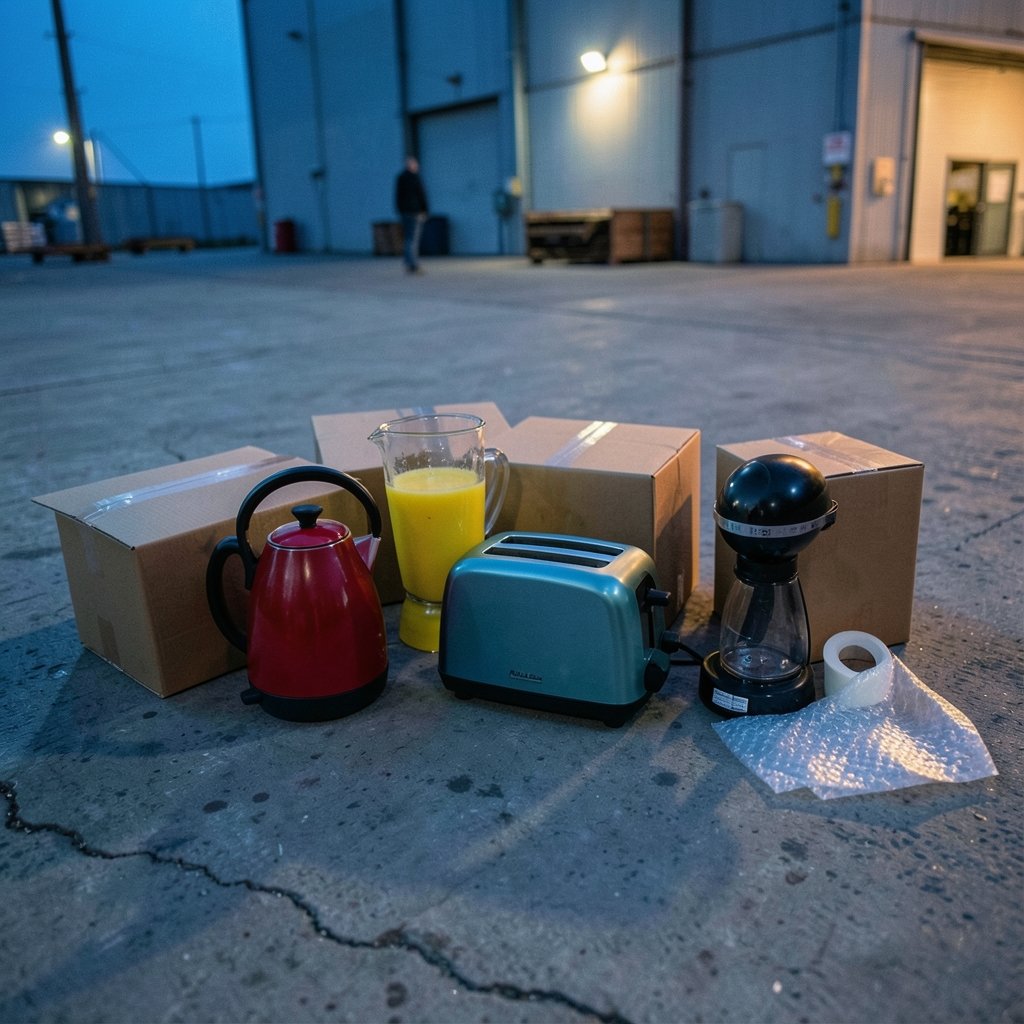
Can a €40 blender from a website nobody has heard of really be the same machine as the €120 one in a high-street shop? Sometimes yes. Often no. The gap between a genuine bargain and an expensive mistake is usually not the price tag but the homework done before clicking “buy.”
Buying cheap kitchen appliances online has never been easier, and that is exactly the problem. Search results overflow with listings that look identical but hide different motors, different warranties and different safety paperwork. This guide walks through what actually separates a smart buy from a false economy, using the rules and labels that manufacturers must follow. It covers energy labels, return windows, certification marks and the small practical checks that catch problems before a parcel arrives.
Why online prices for kitchen appliances vary so much

The same 1,500-watt kettle can sell for wildly different amounts across three websites on the same afternoon. Several forces drive that spread.
Old and new energy classes. Since March 2021, EU energy labels for dishwashers, fridges, washing machines and TVs use a rescaled A–G scale with no A+ or A++ classes, and each label carries a QR code linking to the product’s registration in the EPREL database. A model that was “A+++” under the old system might now sit at D or E. Retailers clearing older stock often discount heavily, which is fine, but shoppers should read the new label rather than trust a badge printed on the box years ago.
Model churn. Manufacturers refresh lines constantly. When a successor model launches, the previous version drops in price fast. That is one of the few situations where cheap does not mean compromised: the machine is new, boxed and certified, just no longer the newest number.
Regional sourcing. Sellers buy stock across borders and pass part of the saving on. This explains odd plug types, foreign-language manuals and model codes that do not match the local catalogue. None of that is automatically bad, but it changes what support a buyer can expect.
Refurbished and open-box stock. Returns, ex-display units and repaired items sell at deep discounts. A graded refurbishment from a reputable seller can be excellent value. The key word is “graded”: the listing should state the condition class and what was checked.
Hidden costs. A cheap headline price can balloon once delivery, installation, old-appliance removal and extended warranty are added. Comparing basket totals, not sticker prices, is the single most effective habit in this category.
The labels and marks that tell you what you are buying


Cheap appliances still have to meet the same legal requirements as expensive ones. Knowing which marks matter turns a wall of small print into a quick filter.
| Region | Energy label | What it shows | Buyer action |
|---|---|---|---|
| EU | Rescaled A–G label with QR code | Energy use, plus a link to the EPREL product registration | Scan the code; confirm the model matches the listing |
| UK | Rescaled A–G label | Energy use, registered in the UK product database rather than EPREL | Check the label matches the model number |
| US | Yellow EnergyGuide label | Estimated yearly energy use or cost | Compare yearly running cost alongside purchase price |
For electrical safety, plug-in appliances sold in the UK should carry UKCA marking, or CE during the transition period, while the CE mark applies across the EU. A listing with no visible certification, no manufacturer address and no model number is a red flag regardless of price. Counterfeit electrical goods circulate in e-commerce, and the safety risks are real: undersized wiring, missing fuses and plastics that soften under heat.
A practical check that costs nothing: search the exact model number plus the word “manual.” If the manufacturer’s own documentation appears, the product is likely genuine. If only marketplace listings appear, treat it with caution.
Where the money actually goes in a cheap appliance
Two appliances can look the same on a product photo and differ enormously inside. Understanding where manufacturers cut costs helps predict which corners were trimmed.
Motor and heating elements. Cheaper motors are noisier and shorter-lived. In blenders and food processors, a lower-power motor struggles with ice and tough ingredients, which shortens its life further.
Housing materials. Thin plastic and lightweight metal reduce durability and can affect heat retention in kettles and toasters.
Controls. Mechanical dials cost less than digital controls and often last longer, so cheap is not always worse here. Touch panels on budget models are a common failure point.
Spare parts and repairability. This is the big one. Under the EU right-to-repair rules adopted in 2024, with member states required to transpose them by 31 July 2026, repair obligations are expanding. Even before those rules bite, a seller who stocks spare parts and publishes repair guides is signalling that the product is meant to last.
Warranty length. A two-year warranty on a €50 appliance often says more about build confidence than a one-year warranty on a €150 one. In the EU, consumer law already provides a minimum legal guarantee period, so check whether the advertised warranty is extra or just the legal minimum relabelled.
The return window is part of the product
Here is a fact that changes how boldly a shopper can buy online: in the EU, buyers in distance contracts generally have 14 days to withdraw without giving a reason under the Consumer Rights Directive. In the UK, the Consumer Contracts Regulations 2013 give online shoppers a 14-day cancellation right from delivery. In the US, by contrast, the FTC’s three-day cooling-off rule applies to sales of $25 or more made at the buyer’s home or a temporary location, not to ordinary online orders. American shoppers therefore depend far more on each retailer’s own published return policy. (Image search techniques for finding images online)
That asymmetry matters when hunting for cheap appliances. A generous, clearly written return policy effectively lets a buyer test a machine in their own kitchen. A policy buried in vague terms does not.
Practical tips that work in practice:
- Screenshot the return policy at the moment of purchase, including any restocking fee.
- Check who pays return shipping for a heavy item such as a microwave.
- Confirm whether “unused” means the box must be unopened, since a kettle cannot really be assessed without boiling water in it.
- Note the delivery date, because cancellation clocks usually start then, not at order date.
A common mistake is assuming a marketplace seller follows the platform’s return policy. Often the platform sets a baseline, and the seller sets the actual terms. Reading the seller’s own page takes two minutes and prevents most disputes.
Small appliances versus large ones: different rules of thumb
Budget strategy should shift with the size of the appliance.
For small appliances such as kettles, toasters, blenders and air fryers, the risk of a bad purchase is low because the sums are small and replacement is easy. This is where aggressive bargain hunting pays off. A cheap kettle that lasts three years is a fine outcome.
For large appliances such as fridges, ovens and dishwashers, the maths flips. Running costs dominate. An inefficient fridge can quietly cost more in electricity over its life than the price difference between models. Delivery, installation and disposal add fixed costs that make returning a large item painful. Here, spending slightly more on a well-documented, repairable model is usually the cheaper path overall.
A useful middle route for large items is buying a previous-generation model from a mainstream brand. The certification, spare-parts network and manual are all in place; only the model number is dated.
Reading listings like a sceptic
Product pages are marketing documents. A few habits cut through the noise quickly.
Ignore the “was” price. Reference prices are frequently inflated to make a discount look larger. Compare across several retailers instead.
Check the model number against the manufacturer’s site. If the brand does not list the model, ask why before buying.
Look for the weight and dimensions. Suspiciously light appliances often mean thinner materials. For anything that fits into a cabinet, measure the gap twice; this is the most common cause of returns for large appliances.
Read the one-star and three-star reviews, not the five-star ones. Complaints about noise, lids that leak or elements that fail after months repeat across cheap models and are far more informative than praise.
Watch for subscription traps and bundles. A cheap appliance bundled with filters or pods can lock a buyer into ongoing costs that erase the saving.
For anyone also furnishing the room around a new appliance, small-space planning overlaps heavily with budget shopping, and guides on small kitchen remodeling ideas with budget-smart upgrades pair naturally with appliance decisions. Lighting is a good example: strip lights under cabinets are cheap to buy but often produce visible dots and glare, a problem explained in this piece on fixing LED strip dots and hotspots in kitchen cabinets. The same principle applies to appliances: the cheapest component often needs one extra accessory to work well.
Selling, reselling and the second-hand market
The cheapest kitchen appliance is often the one already in the kitchen. Before buying anything, a quick assessment of what is broken is worth doing. A fridge that is not cold may need a thermostat, not replacement. A dishwasher that leaves residue may need a filter clean.
When buying second-hand online, the same listing scepticism applies, plus a few extras. Ask for a photo of the rating plate, which shows the model and serial number. Ask how old the item is and whether it has been repaired. For anything with a heating element, ask to see it running before money changes hands.
Resale value is also part of the true cost. Mainstream brands hold value; unknown brands often do not. A buyer who may move house in two years should factor that in.
Warranty, repairs and the right to repair
Warranty terms on cheap appliances vary from excellent to meaningless. The difference usually comes down to who honours it: the manufacturer, the retailer or a third party.
A warranty that requires shipping a 15 kg microwave to another country at the buyer’s expense is not much of a warranty. Check the claim process before buying, not after something breaks. In practice, the practical questions are simple: where does the item go, who pays postage, and how long does it take?
Repairability is becoming a formal consideration rather than a nice-to-have. The EU right-to-repair directive, adopted in 2024 with transposition due by 31 July 2026, pushes manufacturers toward providing spare parts and repair information. Buyers who plan to keep appliances for years should favour brands that already publish parts lists.
Disposal matters too. The EU WEEE Directive makes producers responsible for taking back and recycling electrical equipment, including small kitchen appliances. Retailers often offer take-back when delivering a replacement, which is both convenient and usually free.
Conclusion
Cheap kitchen appliances online are neither a trap nor a shortcut. They are a category where the buyer’s diligence does most of the work. The pattern that holds up in practice is unglamorous: scan the energy label and its QR code, confirm the certification mark, search the model number, read the one-star reviews, and check the return window before paying. Small appliances reward bold bargain hunting; large ones reward patience and a slightly bigger budget. Get those basics right, and the low price on the screen becomes a genuine saving rather than a down payment on a replacement.
Frequently asked questions
Are cheap kitchen appliances online safe to use?
Generally yes, if they carry the required certification mark and come from a traceable seller. In the UK, plug-in appliances should show UKCA marking, or CE during the transition, and in the EU the CE mark applies. The risk rises with listings that show no manufacturer details, no model number and no certification. Counterfeit electrical goods do circulate in e-commerce, so a quick check of the manufacturer’s own site is worthwhile.
How can I tell if an energy label is genuine?
Scan the QR code on the label. In the EU, it links to the product’s registration in the EPREL database, which lists the model’s details. If the code does not resolve, or the registered model does not match the listing, treat the claim as unverified. Since March 2021, EU labels use a rescaled A–G scale with no A+ or A++ classes, so older-style badges are a sign of outdated stock or a misleading listing.
Can I return a cheap appliance if I do not like it?
In the EU, online buyers generally have 14 days to withdraw from a distance contract without giving a reason. In the UK, the Consumer Contracts Regulations 2013 give a 14-day cancellation right from delivery. In the US, the FTC’s three-day cooling-off rule generally does not cover ordinary online orders, so the retailer’s own policy governs. Always check who pays return shipping for heavy items.
Is it worth buying refurbished kitchen appliances?
Often, yes, provided the listing states the condition grade and what was checked. Refurbished units from reputable sellers can offer large savings on models that are otherwise well built and repairable. The main things to confirm are the warranty length, the return window and whether accessories such as jugs, blades or shelves are included.
Why is the same appliance so much cheaper on one website?
Common reasons include end-of-line stock, cross-border sourcing, refurbished or open-box units, and different warranty terms. Sometimes the saving is real; sometimes the cheap listing excludes delivery, installation or old-appliance removal. Comparing the full basket total, rather than the headline price, shows which offers are genuinely cheaper.
Do cheap appliances cost more to run?
They can. Running cost depends on efficiency, not purchase price, which is why the energy label matters more than the discount. A low-priced fridge with a poor efficiency class can cost more in electricity over several years than the price gap between models. For small appliances used briefly, the difference is minor; for fridges and dishwashers, check the label first.



