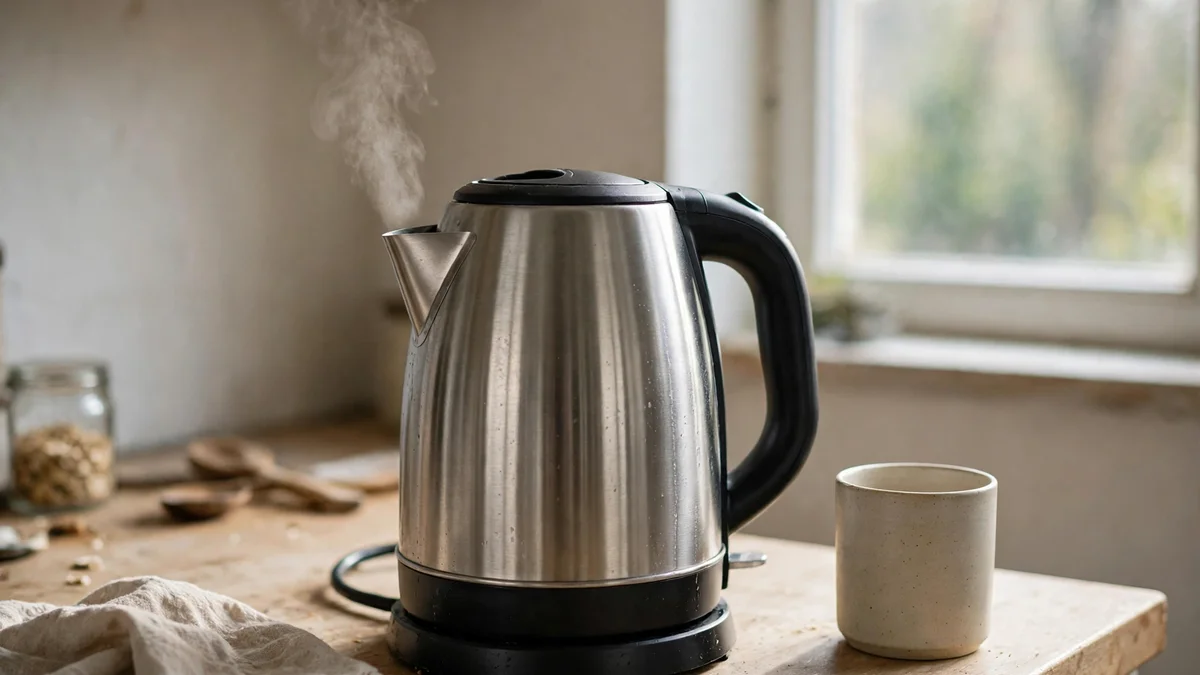
A kettle is a vessel built for one job: heating water fast. Most electric kettles boil a litre of water in two to four minutes using a concealed heating element of 1,500 to 3,000 watts, then switch themselves off the moment the water reaches a rolling boil. It is one of the most-used appliances in any kitchen, yet most people never think about how it works until it slows down.
The basic idea has barely changed in a century: heat water in a metal container from below, and let the hot water rise while cooler water sinks. What has changed is the heat source, the safety cut-outs, and the control: a modern electric kettle is a sealed system with a thermostat, a boil-dry protector, and a spout made to pour without splashing.
This guide explains how a kettle heats water, the main types, how fast each one really is, and the care habits that keep one working for years.
Key takeaways
- An electric kettle boils water by passing current through a heating element, and a steam-sensitive thermostat switches it off at boiling point.
- A 1.7-litre electric kettle typically boils a litre of water in two to four minutes, faster than a hob or a microwave.
- Electric jug, stovetop, gooseneck and variable-temperature kettles suit different jobs, from a quick cup of tea to precise pour-over coffee.
- Descaling every one to three months matters more than brand: limescale slows boiling and shortens the element’s life.
- Never fill a kettle past its maximum line, never switch it on empty, and keep the base and plug dry at all times.
At a glance: kettle types
| Type | How it heats | Time for 1 litre | Best for |
|---|---|---|---|
| Electric jug | Concealed element, mains power | About 2 to 4 minutes | Everyday tea and coffee |
| Stovetop | Hob or gas flame under the base | About 4 to 7 minutes | Gas hobs and power cuts |
| Gooseneck | Electric element, narrow spout | About 3 to 5 minutes | Pour-over coffee |
| Variable temperature | Electric element with thermostat settings | About 2 to 5 minutes | Tea and coffee at set temperatures |
| Travel kettle | Small electric element, low wattage | About 4 to 6 minutes | Hotel rooms |
| Induction stovetop | Magnetic base on an induction hob | About 3 to 5 minutes | Induction hobs |
What a kettle is
A kettle is a container designed to heat water to boiling point and pour it safely. The shape is not decorative: a wide base takes in heat quickly, a narrow neck and lid keep the heat in, and a spout controls the pour so boiling water lands in the cup and not on the hand holding it. Most hold 0.5 to 1.7 litres, and the useful capacity is always less than the printed maximum, because water expands as it boils.
Electric kettles dominate modern kitchens because they are self-contained: element, thermostat and switch sit inside the base, so the user handles only water and a handle. Stovetop kettles are the older form, a metal body on a hob with a whistle that sounds when steam escapes. The electric version controls itself; the stovetop version depends on someone listening.
How a kettle heats water
An electric kettle works by resistance heating. When it is switched on, mains current flows through a metal heating element, usually a coil or a flat plate hidden under the jug floor. The element resists the current and gets hot, and that heat passes directly into the water touching it. Because the element sits at the bottom, heated water rises and cooler water sinks, a circulation called convection that brings the whole jug to the boil evenly.
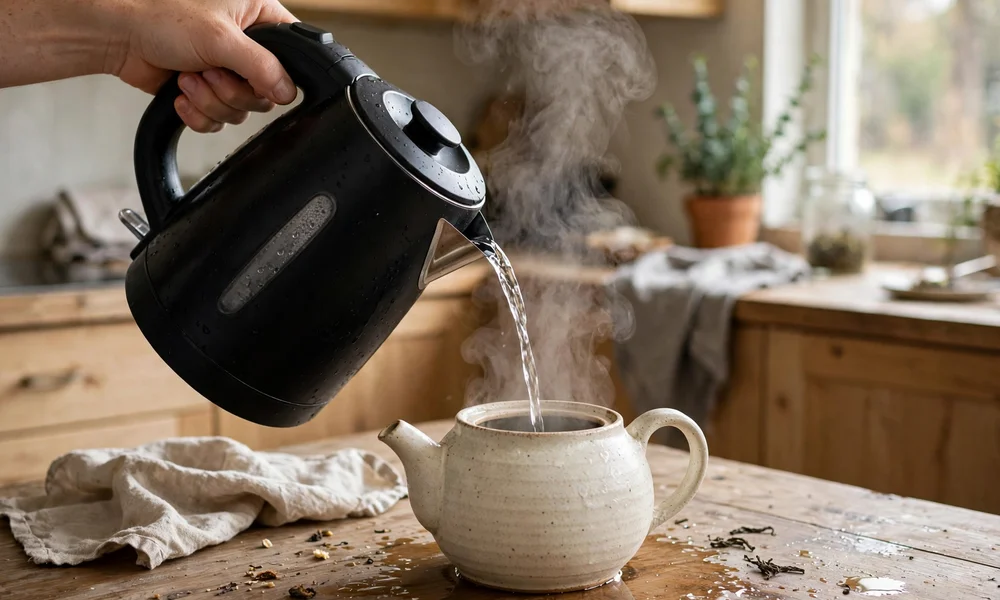
The switch-off is the clever part. A small bimetallic thermostat sits near the top of the kettle, where steam collects as the water boils. Steam reaches it through a small tube, and the two metals bend at different rates, snapping the switch open. That is why a kettle clicks off seconds after the boil starts, and why it will not switch off properly if the lid is left open.
A second protector guards against boiling dry: if the kettle is switched on with too little water, a thermal cut-out trips and stops the element overheating. Speed depends on power and volume. A 3,000-watt kettle can boil a litre in about two minutes, and filling only the water you need is the single biggest speed and energy saving available.
Types of kettle
Electric jug kettle
The electric jug is the default kettle in most homes. It sits on a powered base, boils quickly, switches itself off, and lifts off the base for pouring. Concealed-element models are easier to clean than older exposed-coil models. A 1.5 to 1.7-litre jug suits a family; a 1-litre jug suits one or two people and boils faster.
Stovetop kettle
A stovetop kettle is a metal jug heated on a hob. It has no plug and no thermostat, so it keeps boiling until someone takes it off the heat, and the whistle is the only warning. It works on gas, on a camping stove, and during a power cut, but it is slower and needs attention.
Gooseneck kettle
A gooseneck kettle has a long, thin, curved spout that gives a slow, precise pour. It is the standard tool for pour-over coffee, where water must be added in a thin, steady stream to wet the grounds evenly. Most are electric and slower than a standard jug: the narrow spout trades speed for control.
Variable-temperature kettle
A variable-temperature kettle lets the user pick a target temperature instead of always boiling. Green tea tastes best at 70 to 80 degrees, coffee at 92 to 96, and baby formula is made with water cooled to about 70 degrees. These kettles hold the chosen temperature and often keep the water warm for half an hour.
Travel and low-wattage kettles
Travel kettles are small, usually 0.5 litres, and run at 600 to 1,000 watts so they do not trip the circuits in hotel rooms or older houses. They boil slowly and hold little water, but they pack small. On a dual-voltage model, check the voltage setting first: the wrong setting can destroy the element in seconds.
Benefits and risks
The main benefit of a kettle is speed with very little waste. An electric kettle puts nearly all its energy into the water, unlike a hob, which loses heat around the pan, or a microwave, which heats unevenly. It also switches itself off at boiling point, so the water waits ready rather than boiling away on the stove.
The risks are all about boiling water and electricity in the same object. Scalds are the most common injury, usually from overfilling, from a spout that dribbles, or from a kettle knocked over on a worktop. The handle should stay cool, the lid should fit tightly, and the kettle should sit well back from the counter edge with the cord tucked away, especially with small children in the house.
Limescale is the slow risk. In hard-water areas, calcium carbonate settles on the element and the inside walls as a white crust. A scaled kettle boils more slowly, uses more electricity, and can develop hot spots that damage the element. Descaling with citric acid or white vinegar every one to three months is the single most useful maintenance habit a kettle owner can have.
Kettle in everyday use
The everyday jobs are tea and coffee, and they are also where temperature matters most. Black tea wants fully boiling water, while green tea and delicate white teas want cooler water, which is why a variable-temperature kettle earns its place in a tea drinker’s kitchen. Coffee from a French press or pour-over dripper wants water just off the boil, around 92 to 96 degrees; water at a rolling boil can scorch the grounds and make the cup bitter.
Beyond drinks, a kettle is the fastest way to start cooking. Boiling water for pasta, rice, vegetables or stock in the kettle, then pouring it into the pan, saves several minutes over heating a pan from cold. In a small kitchen, the kettle also decides the layout: it needs a socket, a stable surface, and space for steam to escape without hitting a cupboard above it. The same kitchen-planning logic applies to the other appliances on the counter, and the guide to the kitchen microwave guide and how it works covers the same kind of placement and ventilation thinking for the microwave that usually sits beside the kettle.
Kettle versus microwave: which heats water faster
For a single mug, a kettle and a microwave are close. For a litre, the kettle wins clearly. A 3,000-watt kettle boils a litre in about two to three minutes, while a 1,000-watt microwave takes about four to five minutes for the same litre, and heats the water unevenly, in patches. The kettle also switches itself off at boiling point, while a microwave keeps heating until the timer ends.
The microwave has one advantage: it heats the water in the vessel it will be drunk from, so there is nothing to pour. There is also a safety difference. Water heated in a microwave can superheat, passing boiling point without bubbling, then erupt when the cup is moved. A kettle cannot superheat, because its convection currents keep the water moving. The buying guide to a microwave oven that fits your kitchen explains the power ratings that decide this comparison. The roundup of the best side-by-side refrigerator is a useful companion read when planning the cold side of the same kitchen.
Checklist: buying and using a kettle safely
- Choose the capacity for your household: 1 litre for one or two people, 1.5 to 1.7 litres for a family.
- Fill between the minimum and maximum lines every time, and boil only the water you will use.
- Look for a concealed element, automatic switch-off, boil-dry cut-out and cool-touch handle.
- Keep it back from the counter edge, the cord tucked away, and steam clear of the cupboard above.
- Descale every one to three months in a hard-water area, and rinse well after descaling.
- Replace a kettle with a cracked body, loose lid, damaged cord or a plug that keeps tripping.
Frequently asked questions
How long does a kettle take to boil?
A 3,000-watt electric kettle boils a litre of water in about two to three minutes, and a full 1.7 litres in about three to four minutes. A 1,500-watt kettle takes roughly twice as long.
Why does my kettle switch off before the water boils?
Usually the lid is open or not seated, so steam escapes before reaching the thermostat, or limescale blocks the steam tube. Close the lid firmly and descale the kettle. If the problem continues, the thermostat may be faulty.
Is it safe to reboil water in a kettle?
Yes, reboiling water is safe. The idea that it concentrates harmful minerals is a myth at household scale: the amounts involved are tiny. The cost is energy and taste: boiled water loses dissolved oxygen and can taste flat.
How do I descale a kettle?
Fill to the minimum line with equal parts water and white vinegar, or water with a tablespoon of citric acid, boil, leave fifteen minutes, then rinse twice and boil plain water.
Can I put milk or soup in a kettle?
No. A kettle is designed for water only. Milk and soup scorch onto the element and clog the spout. Heat milk in a pan or a microwave instead.
Why is my kettle so noisy?
It is the element and tiny steam bubbles collapsing as the water heats, and it gets louder as limescale builds up, so descaling is the first fix.
The bottom line
A kettle is a simple machine doing a simple job well: a heating element, convection, and a steam thermostat that switches it off at exactly the right moment. An electric jug suits most homes, a gooseneck suits pour-over coffee, a variable-temperature model suits tea drinkers, and a stovetop kettle suits anyone who needs hot water without electricity.
Buy for the capacity you actually use, fill only what you need, and descale regularly. Those three habits decide almost everything about speed, cost and lifespan.