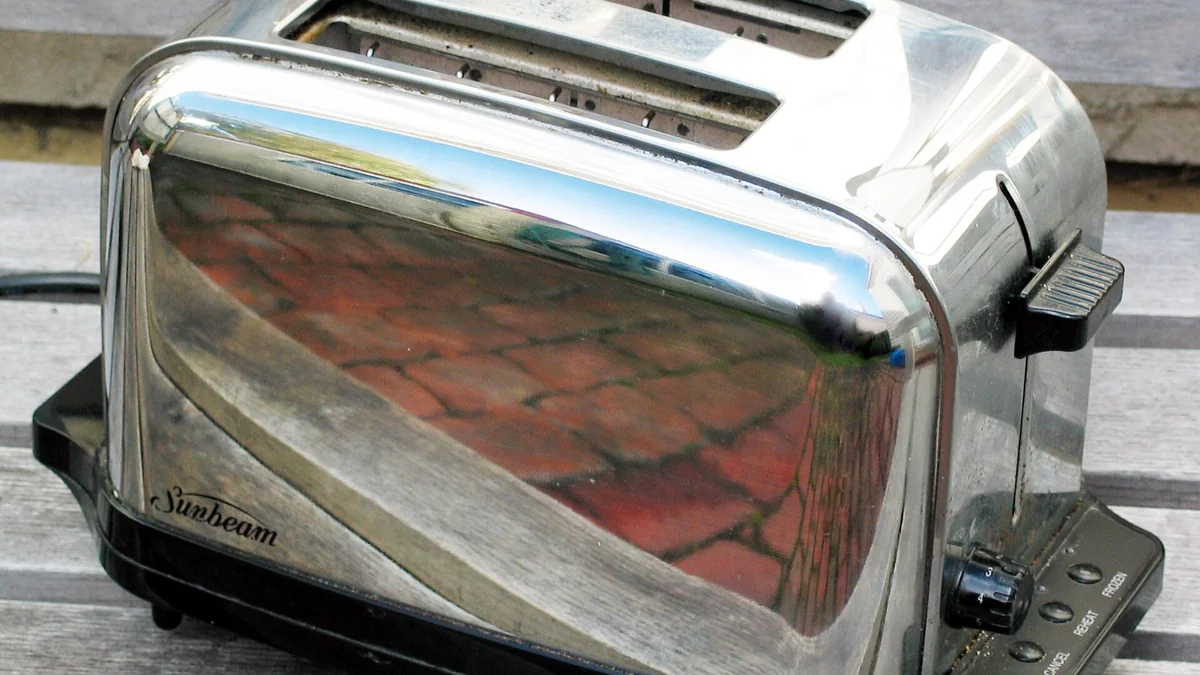
A toaster is a small electric appliance that browns bread by exposing it to radiant heat from hot wire elements. A toaster does one job, and it does it in about two minutes: it turns pale, soft bread into crisp, golden toast. Unlike an oven, which heats a whole cavity of air, a toaster heats only the surface of the bread, which is why it is fast, cheap to run, and found in almost every kitchen.
The first electric toasters appeared in the early 1900s, and they were manual: bread sat on a wire rack, and the cook flipped it by hand. The pop-up toaster, which lowers the bread, times the browning, and lifts it out when done, arrived in 1919 with Charles Strite’s design. A century later, the basic design has barely changed, because it works.
That simplicity is deceptive. A good toaster balances heat, time, and airflow to brown both sides evenly without drying the bread out, while a poor one burns the edges and leaves the middle pale.
Key takeaways
- A toaster browns bread with radiant heat from nichrome wire elements, not with hot air.
- Pop-up toasters are the standard type; toaster ovens are a different appliance that bakes and broils as well as toasting.
- Slot count, slot width, and a browning dial matter more than presets and extra buttons.
- Uneven browning usually comes from cold bread, uneven slices, or crumbs blocking the elements, not from a broken toaster.
- A toaster is cheap to run and easy to clean, but it needs a crumb tray emptied and should never be used near water or curtains.
What a toaster actually is
A pop-up toaster is a metal or plastic box containing two or four vertical slots. Inside each slot, bread sits between two heating elements made of nichrome wire, an alloy that glows red-hot when electricity passes through it. A lever lowers the bread and starts a timer. When the timer ends, a spring lifts the bread back up, and the elements switch off.
The browning dial does not change the temperature of the elements. It changes the time: on a low setting, the bread pops up after a minute, lightly coloured; on a high setting, it stays down for two to three minutes and comes up dark. Thick, moist bread needs more time than thin, dry bread, and frozen bread needs more time still, which is why many toasters have a defrost button.
Most toasters draw between 800 and 1,500 watts, but they only run for a few minutes at a time, so a two-slice toaster costs very little electricity per week. It earns its place on the worktop the same way other small appliances do, and it regularly appears in our roundup of kitchen gadgets that actually earn their counter space.
How a toaster browns bread
Browning in a toaster is the Maillard reaction, the same process that browns seared meat and bread crusts. When bread is heated above about 140 degrees Celsius, sugars and amino acids react and create hundreds of new flavour compounds, along with the golden colour. The reaction needs dry heat and a dry surface.
The elements sit a few millimetres from the bread on each side, so the heat is intense and direct. The wire is wound in a zigzag across a mica sheet, which spreads the heat across the whole face of the slice. Even so, most toasters brown slightly unevenly: the top of the slice gets more airflow and stays a shade paler. Good toasters minimise this with evenly wound elements and a slot that centres the bread.
Timing is controlled by a thermostat or a timer. Older toasters use a bimetallic strip that bends as it heats and releases the spring. Newer ones use an electronic timer. The pop-up mechanism is mechanical: a latch holds the bread carriage down against a spring, and the timer releases the latch. When a toaster stops popping up, the fault is usually crumbs jamming the carriage, which is why cleaning matters.
Steam is the enemy of good toast. As bread heats, its water turns to steam and escapes through the top of the slot. If toast sits in the slot after popping up, the steam condenses on the cooling bread and softens it, which is why the best toast is buttered and eaten straight away.
Types of toasters
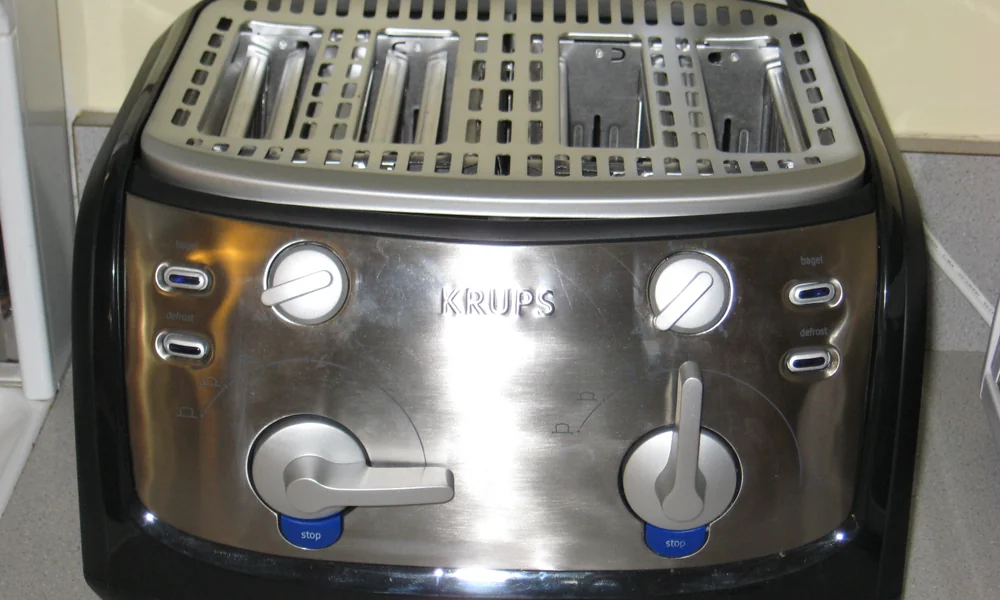
Two-slice pop-up toasters are the standard: compact, cheap, and suited to one or two people. Four-slice models have two pairs of slots with separate controls, so two people can toast at different settings at once. They take up more worktop and cost more, but for a family they are worth it. Long-slot toasters have extra-long slots that fit artisan bread and sourdough, which a standard slot would only half cover.
Toaster ovens are a different appliance entirely: small ovens with a glass door, a rack, and elements top and bottom, which can bake, broil, reheat pizza, and toast bread. They are more versatile than a pop-up toaster but slower at toasting, larger, and harder to clean, and they are often compared with other countertop appliances in buying guides such as our look at affordable microwave ovens.
Other types fill niches. Conveyor toasters, common in cafes and hotels, carry bread through on a belt and produce dozens of slices an hour. Transparent toasters have glass sides so the cook can watch the bread brown, though the glass clouds with use. Retro-styled toasters cost more for their looks, and smart toasters with touchscreens exist at the premium end, where the extra electronics add cost without changing the physics of browning bread.
Toasters at a glance
| Detail | What is known |
|---|---|
| Heating method | Radiant heat from nichrome wire elements, browning by the Maillard reaction |
| Typical power | 800 to 1,500 watts; four-slice models draw more than two-slice models |
| Toasting time | About two minutes per cycle at a medium setting |
| Main types | Two-slice, four-slice, long-slot, toaster oven, conveyor, and smart toasters |
| Browning control | A dial that changes time, not temperature; frozen and bagel settings add time |
| Best at | Sliced bread, bagels, waffles, and English muffins |
| Cannot do | Heat unevenly shaped food, cook raw food, or brown very thick items evenly |
| Key safety rule | Empty the crumb tray, keep it away from water and curtains, never force stuck bread with a metal knife |
Benefits and risks
The toaster’s main benefit is speed and simplicity. It produces toast in about two minutes with no preheating, no supervision, and almost no washing up. It uses little electricity per use, it is cheap to buy, and it lasts for years with minimal care.
The risks are mostly about fire and crumbs. Crumbs build up on the crumb tray, and if it is never emptied, they can scorch and smoke, and in rare cases catch fire. A toaster should always sit on a clear, heat-resistant surface, away from curtains and paper, and never under a low cupboard where heat can build up. Stuck bread should be removed with a wooden utensil after unplugging, never a metal knife while it is plugged in.
There is also a food-safety point worth knowing. Very dark toast contains higher levels of acrylamide, a chemical that forms when starchy food is cooked at high temperatures. The risk from normal toast is low, but the practical advice is simple: aim for golden brown rather than dark brown. Buying a toaster does not have to cost much, as our guide to finding cheap kitchen appliances that offer real value explains.
Real-world uses
Breakfast is the toaster’s main job. Sliced bread, bagels, English muffins, and frozen waffles all toast well, and the bagel setting is worth using: it toasts the cut side and only warms the crust side. Frozen bread goes straight in with the defrost setting, which adds time so the centre thaws before the outside burns.
Beyond breakfast, a toaster warms pitta bread, crisps up stale bread, and toasts sandwich bread before it is filled, which stops fillings from making the bread soggy. What a toaster cannot do is cook raw food or heat food that is not flat and dry: anything with a filling that can drip will make a mess and a fire risk.
In offices and cafes, toasters run all day, and the pattern there shows what matters in a busy setting: wide slots that fit real bread, a crumb tray that slides out easily, and a body that stays cool enough to touch.
Toaster vs toaster oven vs grill
A pop-up toaster and a toaster oven solve different problems. The pop-up toaster is faster, smaller, and better at the single job of toasting bread. The toaster oven is slower at toasting but far more versatile: it bakes, reheats, and broils. If the household eats toast every day, the pop-up toaster wins. If it wants a small second oven, the toaster oven wins.
A grill can also make toast, and it browns well. It is slower, needs watching, and toasts one side at a time, which is why the pop-up toaster replaced it in most kitchens. The grill still has its place for cheese on toast and for bread too thick or irregular for a slot.
Checklist: choosing and using a toaster
- Count the slots you need: two for one or two people, four for a family or a busy household.
- Check the slot width: wide slots fit bagels, sourdough, and thick artisan bread.
- Look for a crumb tray that slides out easily and a body that stays cool to the touch.
- Test the browning dial across its range, and prefer even browning over extra presets.
- Empty the crumb tray weekly, and wipe the outside with a damp cloth when the toaster is cool and unplugged.
- Never put buttered bread, pastries with filling, or metal utensils into a toaster, and never leave it running unattended.
Frequently asked questions
Why does my toaster brown one side more than the other?
Most toasters brown slightly unevenly because the elements are not perfectly matched and airflow differs on each side. Cold bread, uneven slices, and crumbs near the elements make it worse. Using evenly sliced bread usually fixes it.
Can you put frozen bread in a toaster?
Yes. Use the defrost or frozen setting, which adds time so the centre thaws before the outside burns. Without it, frozen bread usually comes out pale in the middle and dark at the edges.
Is a toaster oven better than a pop-up toaster?
It depends on the job. A toaster oven is more versatile: it bakes, reheats, and broils. A pop-up toaster is faster, smaller, and better at toasting bread. For toast alone, the pop-up toaster wins.
How do I clean a toaster?
Unplug it, let it cool, and slide out the crumb tray to empty it. Shake it gently upside down over a bin to dislodge loose crumbs, then wipe the outside with a damp cloth. Never put water inside a toaster.
Why does toast go soggy after popping up?
Toast goes soggy when steam from the hot bread condenses on its surface as it cools. Leaving toast in the slot makes it worse. Butter and eat toast straight away, or stand slices upright in a rack.
How long should a toaster last?
A well-made toaster lasts five to ten years with normal household use. The parts that fail first are usually the timer, the pop-up spring, and the browning dial. Regular crumb-tray cleaning extends its life.
The bottom line
A toaster is a simple appliance that does one job well: it browns bread quickly, cheaply, and with almost no effort. Its design has barely changed in a century because the physics of browning bread has not changed. What separates a good toaster from a poor one is even heat, honest slot width, and a crumb tray that is easy to empty.
Choosing one comes down to household size and bread habits. Two slots suit one or two people, four slots suit a family, and wide or long slots suit anyone who eats bagels or sourdough. Whichever type you pick, keep the crumb tray empty, aim for golden brown rather than dark, and butter the toast while it is still hot.