
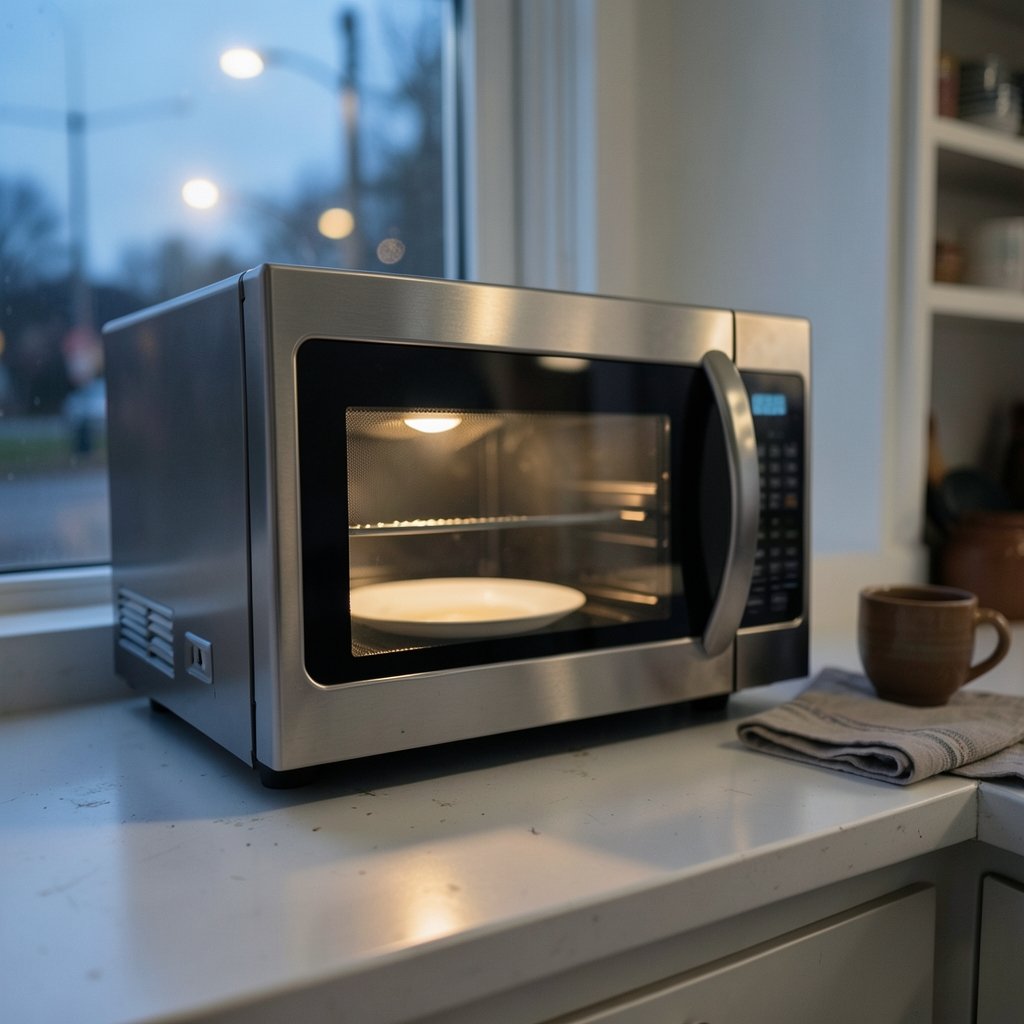
Ever stood in front of your kitchen microwave, watching that plate spin, and wondered what is actually happening inside that humming box? You press a button, walk away, and thirty seconds later your coffee is hot. It feels like magic, but it is physics, engineering, and a surprising amount of food science all packed into a countertop appliance. And like any appliance, it rewards people who understand it and punishes those who treat it like a mystery.
This guide walks through how a kitchen microwave works, how to use it well, what to cook in it, what to keep out of it, and the safety questions people ask most. No hype, no scare stories, just what holds up.
What Actually Happens Inside a Kitchen Microwave

A kitchen microwave produces electromagnetic waves at roughly 2.45 GHz, a frequency that sits comfortably in the “microwave” band. Those waves interact with polar molecules, and water is the star of the show. Water molecules have a slight electrical imbalance, so they twist and rotate to follow the alternating field. That rotation creates friction and collisions at the molecular level, and friction produces heat.
The important detail is that this heating is not uniform. Waves create pockets of high and low intensity inside the cavity, which is exactly why turntables, stirrers, and “let it stand for two minutes” instructions exist. Those are not decorative. They are the difference between a lukewarm center and a scalding edge.
The history is fun too. An engineer working at Raytheon, Percy Spencer, is widely credited with noticing in 1945 that a candy bar in his pocket softened near an active magnetron. Raytheon filed a patent that year, and the first commercial unit, the Radarange, showed up in 1947. The melting candy bar story has been retold so many times that it is best treated as anecdote rather than documented fact, but the timeline itself is solid.
Why the Standing Time Matters More Than You Think


Most people pull food out the instant the beep sounds. That is a mistake. During microwaving, heat builds unevenly, and the outside of a portion can be much hotter than the middle. Standing time lets heat conduct from hot zones into cool ones, evening out the temperature.
In practice, this means:
- Follow the recipe’s rest time, even when it feels unnecessary.
- Stir halfway through whenever the dish allows it.
- Arrange food in a ring shape rather than a solid mound so waves reach more surface.
- Cover the dish with a microwave-safe lid or vented wrap to trap steam, which also speeds cooking.
People who skip these steps usually conclude that “microwaves heat badly.” They do not. They heat unevenly, and the fix is technique, not a new appliance.
Picking a Kitchen Microwave That Fits Your Counter and Habits
The market splits into a few clear types, and the right pick depends on space, budget, and how you actually cook. Here is how they compare.
| Type | Best for | Trade-offs |
|---|---|---|
| Countertop | Most kitchens, tight budgets | Takes counter space, usually lower output |
| Over-the-range | Small kitchens needing ventilation | Installation cost, often lower output |
| Built-in or drawer | Clean lines, integrated look | Expensive, requires cabinet work |
| Convection combo | Browning, baking, roasting | Higher price, longer learning curve |
| Inverter models | Even heating at low wattage | Costs more than standard units |
Wattage is the number shoppers fixate on, and it does matter. Higher wattage means faster, more even cooking, but the practical difference between mid and high ranges is smaller than marketing suggests. A unit that fits your space and that you will actually keep clean beats a higher-wattage one crammed into a corner.
If your kitchen is tight, the same space-planning logic that applies to compact layouts applies here: measure the counter, the door swing, and the clearance above before you fall in love with a model. A few budget-smart upgrade ideas for cramped kitchens translate well to appliance choices, and it helps to think about the whole zone rather than one box. Good task lighting makes a real difference too, though strip lights under cabinets often need diffusion to avoid harsh dots and glare, a problem worth solving before you blame the microwave for a gloomy corner. (Small kitchen remodeling ideas budget smart upgrades that)
What a Kitchen Microwave Does Genuinely Well
Some jobs suit a microwave better than any other appliance. These are the ones worth building habits around.
Reheating leftovers. Nothing else gets a plate of rice and vegetables back to edible in ninety seconds with so little cleanup.
Steaming vegetables. A splash of water, a covered bowl, and a few minutes produces crisp-tender vegetables that retain water-soluble nutrients well. Because cooking times are short and little water is used, microwaving generally preserves those nutrients comparably to or better than boiling.
Melting and softening. Butter, chocolate, cream cheese, and honey all soften quickly at low power. Use short bursts and stir between them.
Cooking grains and oats. Oatmeal and quick-cooking rice are practically designed for it.
Defrosting. The defrost setting cycles power on and off to give heat time to spread. It is imperfect but far faster than waiting on the counter.
Sanitizing sponges and cloths. A damp sponge heated on high for about a minute is a well-known kitchen trick, though it should be soaking wet to avoid fire risk.
What It Does Poorly, and Why That Is Fine
A kitchen microwave is a bad tool for anything that needs browning or crisping. Microwaves heat water, not surfaces, so you never get a Maillard reaction. Bread goes rubbery, chicken skin stays pale, and pizza turns to leather.
It is also poor at cooking large dense items evenly. A whole chicken or a thick roast will cook unevenly and is better handled by an oven. And it is not a sterilizer for anything metal, sealed, or dry.
Energy claims deserve nuance. Microwaves are often described as more efficient than conventional ovens for small portions because they heat the food rather than the cavity and the surrounding air. That is broadly true, but it depends heavily on portion size and the appliance. Heating one mug of water: microwave wins easily. Cooking a full casserole: the comparison gets murky.
Containers, Metal, and the Rules That Actually Matter
Metal is the classic warning, and it is real. Thin metal, foil edges, and metallic trim can cause arcing, which looks like tiny lightning and can damage the oven. Some modern units tolerate small amounts of smooth foil, but the safe default is to avoid metal entirely.
For plastics, look for a microwave-safe label. Some plastics are formulated for microwave use; others, including some polystyrene foam containers, are not designed for it and can warp or leach. When in doubt, transfer the food to glass or ceramic.
Other practical rules that prevent most accidents:
- Never heat sealed containers, whole eggs in the shell, or anything with a tight lid. Steam needs an escape route.
- Pierce potatoes and squash skins before cooking.
- Do not run the oven empty for long periods.
- Do not operate a unit with a damaged door, latch, or seal.
That last point is the one safety officials emphasize. Consumer ovens use multiple door interlocks that cut power to the magnetron the moment the door opens, and those interlocks are the primary safeguard. A damaged door or seal undermines the whole system.
The Leakage Question, Answered Without Panic
Radiation fears around microwaves are persistent and mostly misplaced, but the standards behind them are worth knowing.
In the United States, federal rules limit microwave leakage to 5 mW/cm² measured 5 cm from the oven surface, and that limit applies both before sale and over the oven’s lifetime. International standards for household microwave safety, used in many markets, apply comparable requirements. Regulators describe radiation injuries from microwave ovens as rare, precisely because of the redundant interlock design.
What does that mean for you? A kitchen microwave in good repair with an intact door and seal is not a radiation hazard in practice. The realistic risks are mundane: steam burns, scalding from unevenly heated food, and fires from metal or dry materials. Those cause far more injuries than leakage ever has.
If your door does not close flush, if the latch feels loose, or if the seal is torn, stop using it and get it serviced or replaced. That is the one scenario where caution is genuinely warranted.
Measurement Mistakes That Ruin Microwave Recipes
Microwave cooking is less forgiving of eyeballed quantities than stovetop cooking, because timing scales directly with volume and water content. A recipe written for one cup of liquid will not behave the same at one and a half cups.
Two conversions trip people up constantly. First, liquid volume: knowing how many ounces are in a cup settles a surprising number of recipe disputes, and it matters when you are scaling a mug cake or a sauce. Second, spoon measures: the tablespoons-to-cup conversion catches people out when they are halving or doubling a small batch, and the teaspoons-to-tablespoon relationship is the one home cooks second-guess most often. Get those straight and microwave baking stops being a gamble. (Many oz cup answer that actually works kitchen)
Cleaning and Maintenance That Extends Life
A kitchen microwave is easy to neglect, and neglect shortens its life. Food splatter absorbs energy, creates hot spots, and eventually burns, which is why an unclean oven smells like regret.
The easiest routine:
- Fill a microwave-safe bowl with water and a slice of lemon.
- Heat on high for three to five minutes until the window steams up.
- Leave the door closed for five minutes so the steam loosens residue.
- Wipe the interior with a damp cloth, including the ceiling and door seal.
- Leave the door open for a few minutes to dry out.
Do this weekly and deep-clean monthly. Avoid abrasive pads on the interior coating, and never spray cleaner directly into the vents. Check the door seal for cracks each time you wipe it, since that seal is doing real safety work.
For anyone building out a connected kitchen, appliance order matters in ways that surprise people. Pairing smart devices, including hubs and sensors, follows its own sequence, and treating inclusion versus exclusion order as an afterthought on every device tends to produce headaches. The same is true of range expectations: long-range and mesh-based smart home radios behave differently, and knowing which one your kitchen devices use prevents a lot of dead spots. If gaming or media gear shares the same network corner, workflow differences between storefronts are a separate rabbit hole entirely, but the underlying lesson is identical: plan the setup before you plug things in. (Led strip diffuser kitchen cabinets fix dots glare hotspots)
Conclusion
A kitchen microwave is one of the most misunderstood appliances in the home. It is not a magic box, and it is not a radiation villain. It is a fast, efficient tool for reheating, steaming, melting, and defrosting, with real limits around browning and even cooking. Learn its quirks, respect the standing time, keep metal and sealed containers out, wipe it down regularly, and check the door seal now and then. Do those things and it will quietly earn its counter space for a decade or more.
Frequently Asked Questions
Is a kitchen microwave dangerous to stand near while it runs?
No appreciable risk exists with an oven in good repair. Federal rules cap leakage at 5 mW/cm² measured 5 cm from the surface, and that limit applies across the oven’s lifetime. Multiple door interlocks cut power to the magnetron when the door opens. The realistic hazards are steam burns and fires from metal, not radiation.
Why does my microwave heat unevenly?
Microwaves create pockets of high and low wave intensity inside the cavity, so some spots absorb far more energy than others. Turntables, stirrers, stirring halfway, ring-shaped arrangement, and standing time all exist to even out that distribution. Skipping them is the usual cause of cold centers.
Can I put metal in a kitchen microwave?
Generally no. Thin metal, foil edges, and metallic trim can arc, which looks like tiny lightning and can damage the interior. Some newer ovens tolerate small amounts of smooth foil, but avoiding metal entirely is the safe habit. Use glass, ceramic, or labeled microwave-safe plastic instead.
Does microwaving destroy nutrients in food?
It usually does the opposite. Because cooking times are short and little water is used, microwaving generally preserves water-soluble nutrients comparably to or better than boiling. The bigger nutritional risk in any cooking method is overcooking, not the heat source itself.
How often should I clean my microwave?
Wipe the interior weekly and deep-clean monthly. Steam from a bowl of water and lemon for a few minutes loosens stuck-on residue, then a damp cloth handles the rest. Check the door seal for cracks each time, since a damaged seal is the one condition that genuinely compromises safety.
What should I do if my microwave door does not close properly?
Stop using it. A damaged door, latch, or seal undermines the interlock system that keeps the magnetron from running while the door is open. Get it serviced or replaced rather than working around it. This is the one scenario where genuine caution is warranted.



