
Pinterest is owned by its shareholders, with founders and major investment firms among the holders rather than one person owning the whole platform. For investors, the key is separating ownership of shares from control of the company. A dual-class share structure is a share arrangement with two classes that carry different voting rights.
The public can buy shares, while people who use the app do not gain ownership just by saving ideas. Founders can still have influence through their shares, board roles, or both. This overview explains the owners, voting rules, leaders, and business facts that help make sense of that structure.
Key Takeaways
- Shareholders own the company, not app users as a group.
- Institutional investors hold many shares, alongside insiders and retail investors.
- Class A and Class B shares carry different voting rights.
- Bill Ready leads daily operations as CEO.
- Using the app does not create an ownership stake.
A person who saves ideas on Pinterest does not become a shareholder just by using the app.
Who Owns Pinterest Today?
Institutional investors hold the largest collective share of Pinterest, but no single institutional firm owns the company. Public shareholders include investment firms, insiders, and people who buy shares through brokerage accounts.
Institutional investors collectively hold a majority, while insiders and retail investors also own shares. Published estimates of total ownership differ, so a single overall percentage would suggest more certainty than the figures allow.

Institutional and public shareholders
Institutional investors manage money for clients or funds, and their filings show reported positions at set dates. Nasdaq’s institutional holdings data tracks reported positions by filing period.
- Institutional investors hold shares through funds, trusts, or investment firms.
- Insiders include company executives, directors, and other people with access to internal information.
- Retail investors are individuals who buy shares for their own accounts.
These groups can own the same class of shares, but their roles and reporting rules differ.
The largest disclosed holders
As of early 2026, the Vanguard Group held about 57.7 million shares, or 9.6% of the company. Elliott Management held about 28 million shares, or 4.7%, while BlackRock held about 24.2 million, or 4.0%.
| Holder | Shares | Approximate share of company |
|---|---|---|
| The Vanguard Group | 57.7 million | 9.6% |
| Elliott Management | 28 million | 4.7% |
| BlackRock | 24.2 million | 4.0% |
Ben Silbermann held about 50.84 million shares, or 7.64%, making him the largest individual shareholder. His disclosed Pinterest stake is not the same as his personal net worth, which includes more than those shares.
The largest institutional holder and the largest individual shareholder are different categories of owner.
The table names institutional firms, while Silbermann’s position belongs to an individual holder. Treat a shareholder’s percentage of the company as an equity figure, not as a measure of that holder’s voting power.
Who Founded Pinterest, and Why Was It Created?
Pinterest began with a practical observation from Tote: people were more interested in collecting products than completing purchases in the app. The founders saw that saving images could be useful even when a shopping transaction did not happen.
Ben Silbermann, Paul Sciarra, and Evan Sharp founded Pinterest in December 2009. It was not founded by a woman; the three founders were men.

From Tote to a pinboard for ideas
Tote was a mobile shopping app, but mobile payment tools were still underdeveloped. That made it harder for users to complete purchases inside the app.
Silbermann and Sciarra noticed that users saved and collected products more often than they bought them. That behavior pointed to a broader use: people could gather images and ideas in one place, then return to them later.
The early app let users build visual collections, rather than treating every image as a step toward checkout. The idea grew beyond shopping as people saved recipes, style ideas, and home inspiration.
The founders and Pinterest’s early growth
Development began in December 2009, and the service launched as a closed beta in March 2010. Nine months after launch, it had 10,000 users.
By December 2011, the site recorded 11 million visits per week, a strong sign that it had become popular. Early investors helped fund the private startup, but that does not mean every early investor still holds shares.
In April 2012, the company changed its name from Cold Brew Labs Inc. to Pinterest, Inc. The IPO on April 18, 2019, was priced at $19 per share, closed its first trading day at $24.40, and raised about $1.4 billion.
EBSCO’s history of Pinterest also describes the move from Tote’s shopping focus to saved product images and business tools.
The March 2010 closed beta was the launch of the service, while December 2009 marks the start of development.
How Does Pinterest’s Share Structure Affect Control?
A smaller economic stake can carry greater influence when its shares have more votes per share. Pinterest’s Class A shares carry one vote each, while Class B shares carry 20 votes each.
The number of votes attached to a share can outweigh its share of the company’s economic value. This difference matters when shareholders vote on board matters or other company decisions.
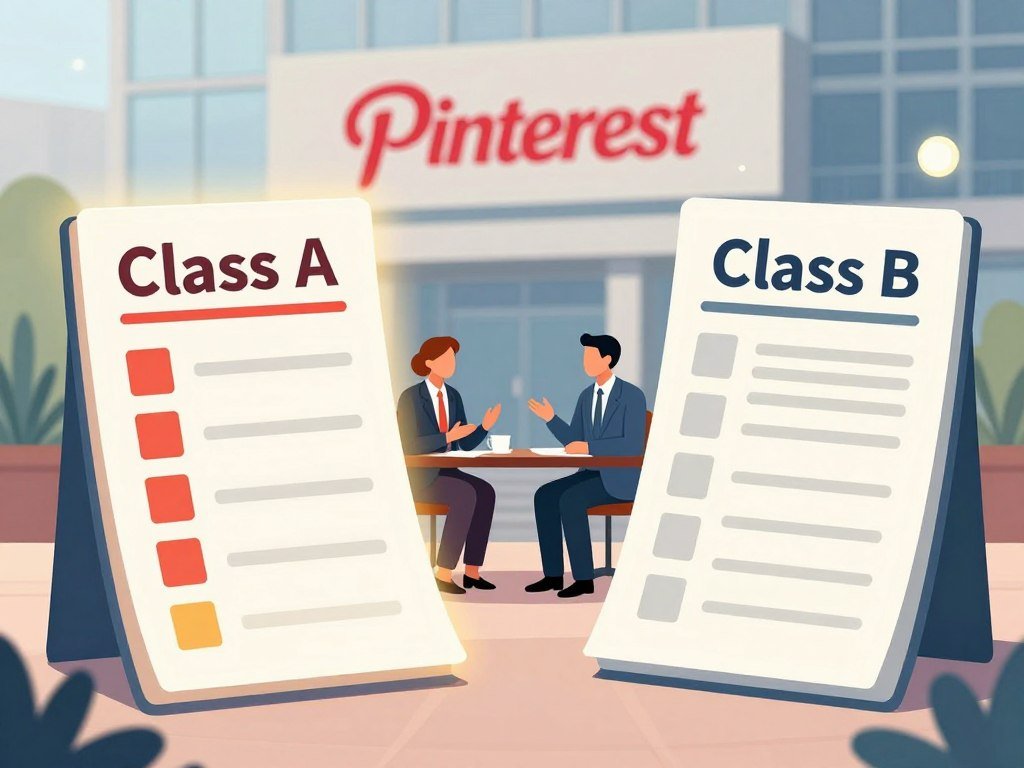
Class A and Class B voting rights
Class A shares are the publicly traded shares most investors can buy. Class B shares give their holders more voting power, so a holder’s voting influence may differ from the size of that person’s economic stake.
At the June 2022 CEO transition, Silbermann’s Class B holdings gave him about 37% of total voting power. That figure describes the situation at that time, not a current voting share.
Share class is one reason a simple ownership percentage cannot explain who may shape a vote. A company’s board can also affect governance, while daily operations remain a separate job.
The conditional conversion provision
Class B shares also convert to Class A shares when transferred. Pinterest’s IPO terms added a specific automatic conversion rule seven years after the April 2019 IPO for certain holders.
The rule applies to a holder who has sold more than half of that holder’s original stake. For those holders, the remaining Class B shares automatically convert to Class A shares after the seven-year period.
That condition ties the change to both time and how much of the original stake a holder sold. An explanation of company ownership and control can help show why an economic stake and voting influence are separate measures.
Read the conversion condition alongside the share class before drawing conclusions about who could control a vote.
Who Leads Pinterest Now?
Bill Ready is Pinterest’s CEO, while co-founder Ben Silbermann serves as Executive Chairman. The CEO handles day-to-day leadership, and the Executive Chairman remains a leader of the board.
Ready became CEO on June 28, 2022, when Silbermann moved into the Executive Chairman role. That shift placed a new leader in charge of daily operations while keeping Silbermann in a board leadership role.

Ready brought commerce experience from Google and Braintree. That background fit a platform where users discover ideas and businesses try to reach people planning purchases.
- Before June 2022, Ben Silbermann served as CEO.
- On June 28, 2022, Silbermann became Executive Chairman and Ready became CEO.
- After the transition, Bill Ready served as CEO, including in March 2026.
The titles describe different jobs, not different companies. The CEO directs staff and business plans, while the Executive Chairman focuses on board leadership.
Silbermann’s change in role did not mean he left the company or stopped serving as a board leader. Ready took on the operating role that involves guiding the company’s daily work.
The change was a leadership transition, not a change in the company’s name or its public listing.
How Does Pinterest Make Money?
Pinterest makes almost all its revenue from digital advertising, rather than charging people to save ideas. The platform uses visual search and saved ideas to help match paid messages with users who may be interested.
Advertisers pay to reach users through Pinterest’s advertising products and ad auction. The auction helps decide which ads appear at relevant moments, based on the ad and the person’s activity.
Advertising and the ad auction
People use search and visual search to find images and ideas. Searches, saved Pins, and clicks can show what someone may want to buy, giving advertisers a chance to reach that user with a related ad.
The auction weighs competing ads and chooses which ones can appear. The process lets Pinterest sell ad space without charging users to create boards or save Pins.
Business accounts and shopping intent
Pinterest launched business accounts in 2012. These accounts give companies a way to share products and connect their posts with advertising tools.
The model has three linked parts:
- Advertising products let companies pay to promote content to users.
- The ad auction selects which paid ads can appear to a user.
- Business accounts give companies a presence and tools for their activity.
People may use the app for recipes, home ideas, or style inspiration, but those activities can also signal shopping intent. A search for a product or a saved Pin can help advertisers reach a person who is already exploring that topic.
A business account gives a company a Pinterest presence, while the ad auction determines when its paid ads can reach users.
What Do Pinterest’s Latest Business Numbers Show?
Pinterest reported $4.22 billion in revenue for 2025, followed by $1.17 billion in revenue for the third quarter of 2026. Its 2025 net income was $417 million, while the latest quarter showed continued revenue growth.
Market capitalization measures the public-market value of outstanding shares, not revenue or net income. Pinterest’s market capitalization was $10.964 billion on October 30, 2026, and its share price ranged from $13.84 to $34.12 over the prior 52 weeks.
Revenue, earnings, and market value
Pinterest’s net worth is not the same measure as market capitalization. Market capitalization values its outstanding shares, while revenue tracks money brought in from business activity.
In Q2 2025, revenue reached $998 million, up 17% from the same quarter one year earlier. The company reported $39 million in GAAP net income and $251 million in adjusted EBITDA.
As of October 30, 2026, trailing-twelve-month revenue was $4.56 billion. Pinterest’s market value and share price are distinct measures, and the company’s quarterly financial reports present results by reporting period.
Users and regional monetization
Pinterest reported 619 million monthly active users in Q4 2025, with Gen Z making up over half of its user base. In Q2 2025, global monthly active users totaled 578 million, up 11% year over year.
| Region | Q2 2025 monthly active users | Q2 2025 revenue | Q2 2025 average revenue per user |
|---|---|---|---|
| United States and Canada | 102 million | $745 million | $7.29 |
| Europe | 146 million | $191 million | $1.30 |
| Rest of the world | 329 million | $63 million | $0.19 |
The regions show different results: the rest of the world had the most users, while the United States and Canada brought in the most revenue. The regional figures show why user totals alone do not describe how effectively Pinterest monetizes its audience.
Is Pinterest Owned by Meta?
Pinterest is not owned by Meta: Pinterest, Inc. trades separately on the New York Stock Exchange under PINS. Pinterest and Meta are separate companies, and Instagram is a Meta platform.
Public investors can buy Pinterest shares, but using the app does not create an ownership stake. Instagram competes with Pinterest for advertising dollars, but competition does not mean one company owns the other.
A ticker is the short symbol used to identify a company’s listed stock. PINS refers to Pinterest’s publicly traded Class A stock on the New York Stock Exchange.
People who want to invest can buy shares through a brokerage account. That purchase creates an ownership stake, unlike making a board, saving Pins, or browsing the platform.
Meta does not own Pinterest, and Instagram remains a competing platform rather than a parent company.
Those relationships matter when someone compares the companies’ business models or considers buying stock. Each public company has its own shareholders, listing, and business results.
A Pinterest account gives someone access to the platform, while owning part of the company requires owning its stock.
Conclusion
Pinterest is owned by its shareholders, while its share classes determine how much voting influence particular holdings can carry. A share’s economic value and its voting power are related, but they are not always equal.
For current ownership and voting details, check Pinterest’s latest proxy filing. The filing offers a practical way to see who holds shares and how the voting rules apply.
Before relying on an older voting figure, check the latest proxy filing for the current share and voting disclosures.
FAQ
Why was Pinterest created?
Pinterest grew from a shift in focus after users saved and collected products in Tote more often than they completed purchases. Ben Silbermann and Paul Sciarra saw that collecting images could serve a wider purpose than shopping. The idea became a place to gather visual inspiration, return to saved items, and share collections with others.
Is there a way to see Pinterest history?
Yes, key milestones trace the company from development to its public listing. Development began in December 2009, and the service launched as a closed beta in March 2010. Pinterest later changed its company name in April 2012. Its IPO took place on April 18, 2019, marking its entry into public markets.
Is Pinterest publicly owned?
Yes, Pinterest is publicly owned through shares held by investors, and it trades on the New York Stock Exchange under ticker PINS. Public investors can buy its listed Class A stock through a brokerage account. Shareholders own the company, while people who simply use the app do not gain an ownership stake.
How does Pinterest make money?
Pinterest makes almost all its revenue from digital advertising. Companies use its advertising products to reach users, and an ad auction helps choose which paid ads appear at relevant moments. Search activity and saved ideas can help signal what users may want, which can make the platform useful to advertisers.
Do Pinterest users own part of the company?
Only users who own shares are shareholders; using the platform or saving Pins does not confer equity. A person can create boards, search for ideas, and save content without owning stock. An ownership stake comes from buying shares, not from having an account or taking part in the app’s features.



