

Mild nausea may ease with small, gentle steps, but the best choice depends on what is causing it. For many people, a few changes can make a queasy morning or unsettled stomach easier to manage. The right approach can differ with pregnancy, stress, motion sickness, a recent meal, or a medicine you take.
This article offers 15 practical approaches for mild symptoms, along with guidance on when home care may not be enough. An antiemetic is a medicine used to prevent or treat nausea and vomiting. Some remedies may feel soothing, but they cannot treat every cause or replace needed medical care.
A new, severe, or persistent problem deserves more attention than another home remedy.
Key Takeaways
- Choose a gentle approach that fits the likely cause.
- Try small portions and slow sips when eating feels difficult.
- Pregnancy nausea has its own care tips and warning signs.
- Medicine choice depends on the cause and your health needs.
- Contact a clinician when symptoms persist or limit food and fluids.
Why Might You Feel Nauseous After Eating?
Nausea immediately after eating can accompany reflux or another digestive problem, though timing alone cannot pinpoint the cause. Meal timing can offer a clue, but it cannot prove what is wrong. Nausea means you feel as if you may vomit, even when vomiting never happens.
A queasy throat can happen without vomiting, and that sensation alone cannot diagnose the cause. Acid reflux may bring a sour taste, burning, or a feeling that rises into your throat. Other digestive conditions can also cause nausea after a meal.
A throat-level nausea feeling may accompany reflux, but the sensation by itself does not identify its cause.
Motion sickness and vertigo can unsettle the body, while migraine may bring nausea with head pain or light sensitivity. Pregnancy, stomach infections, stress, and anxiety can also contribute. Some medicines cause nausea as a side effect, so note any new drug or dose change.
Overeating, food poisoning, and digestive problems such as irritable bowel syndrome can also lead to an upset stomach. A Cleveland Clinic explanation of nausea after eating describes several possible triggers, including reflux, infection, stress, and medication effects.
If you take probiotics, they may cause mild gas or stomach upset in some people. A guide to comparing probiotic products notes that medicine use, immune health, and illness can affect whether a product is a good fit. Ask a clinician or pharmacist if symptoms persist or worsen.
Record the timing, recent meals, and medicines if the pattern keeps returning.
Which Home Remedies for Nausea Can You Try First?
Ginger is a practical first option for mild nausea, while peppermint or lemon scent may suit someone who prefers not to eat. Start gently, since no flavor or scent works for every cause. Ginger tea, candies, and fresh root are familiar ways to try it.
Choose ginger ale made with real ginger if you want to try that drink for this purpose. Many ginger ales have little or no real ginger. Ginger options include tea made with fresh-grated root, capsules, candies, and ginger snaps.

Try ginger in a form you can tolerate
1. Try ginger in a form that feels easy to take. Fresh ginger root, ginger tea, or a small ginger snap may suit you better than a capsule. A drink made with real ginger is another option, but it is not a promise of fast relief.
A cup of tea can offer fluid and a mild flavor when food sounds unappealing. For another view of warm drink choices, see these ginger and peppermint tea options. Peppermint tea may feel cooling, but it can trigger reflux in some people.
Use gentle flavors or scents
2. Try peppermint tea or the scent of peppermint if you would rather not eat. 3. Try lemon scent as another gentle option. A scent may also help some people feel more settled, though it is not proven to work for every cause.
| Option | How to try it | Practical caveat |
|---|---|---|
| Ginger tea | Steep fresh-grated ginger in hot water, or use a tea bag. | Let it cool if heat or strong smells bother you. |
| Ginger candy or snaps | Try one small piece and see how it feels. | Check the label; some products contain little ginger. |
| Peppermint tea or scent | Sip tea slowly or breathe in the scent from a cup. | Peppermint can worsen reflux for some people. |
| Lemon scent | Smell a cut lemon or a cup with lemon nearby. | A scent may not help if smells trigger your nausea. |
Stop any flavor or scent that makes the queasiness worse.
What Foods and Drinks Are Easiest on an Upset Stomach?
Small portions of plain foods and slow sips are usually easier to manage than a large meal or drink. Keep portions modest, and pause if eating makes your stomach feel worse. Simple foods high in carbohydrates and low in fat may feel easier during mild nausea.
Try a few bites at a time rather than pushing through a full meal. Plain bread, rice, crackers, pasta, and applesauce are common bland choices. A short-term BRAT-style diet uses bananas, rice, applesauce, and toast, but it is not meant to last more than a couple of days.
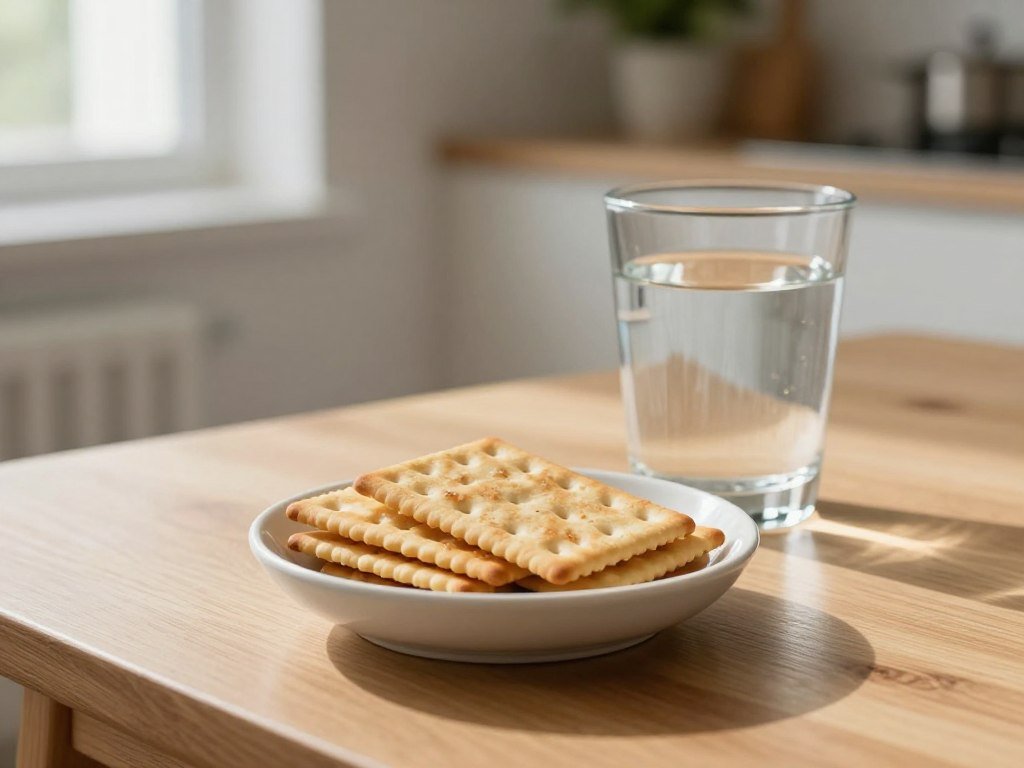
Choose simple foods in small amounts
4. Choose simple, bland foods such as these:
- Plain bread or toast
- Rice
- Crackers
- Pasta without a heavy sauce
- Applesauce
5. Sip fluids slowly, taking small amounts instead of drinking a full glass at once. 6. Try cool foods if the smell of a hot meal brings on nausea. Cold or room-temperature food may have less cooking odor.
Sip fluids and lower food odors
7. Use ice chips or a popsicle when even small drinks feel like too much. Let each piece melt slowly, and take a break if it increases your symptoms. These small steps may help you take in fluid without a large swallow.
A patient guide from Massey Cancer Center also recommends small meals, slow sips, and cooler foods when cooking smells trigger nausea. The drinks below offer different tastes and ways to take fluids:
| Drink | Why it may be manageable | How to take it |
|---|---|---|
| Water | It is mild and has no strong flavor. | Take small sips every few minutes. |
| Broth | A clear broth offers a savory taste and fluid. | Try a few spoonfuls, warm or cool. |
| Apple juice | Its mild sweetness may appeal when water does not. | Sip a small amount; dilute it if it tastes too strong. |
| Ginger ale | Bubbles and sweetness may feel easier for some people. | Choose one with real ginger if using it for ginger. |
Choose the foods that sound tolerable, and stop before a small portion feels like too much.
How Can You Manage Morning Sickness at Home?
For pregnancy nausea, eating something dry before getting out of bed and avoiding an empty stomach are useful starting points. A little food early may be easier than waiting for a full meal. Pregnancy nausea and vomiting usually starts before nine weeks and eases by 14 weeks for most pregnant women.
Contact a maternity-care professional promptly if you cannot keep fluids down or show signs of dehydration. Hyperemesis gravidarum is a severe form of pregnancy nausea and vomiting. It may be diagnosed when someone has lost 5 percent of prepregnancy weight and has other problems related to dehydration.

Make the morning and meals easier
8. Keep dry toast or crackers near the bed, and eat a little before standing. 9. Plan five or six mini meals through the day rather than three larger meals. 10. Include a protein choice with each meal, such as dairy, nuts, seeds, or a protein shake.
These smaller meals can help you avoid an empty stomach without requiring a large serving. The American College of Obstetricians and Gynecologists recommends 8 to 12 cups of water daily during pregnancy. Follow your maternity-care professional’s advice if you have been given a different fluid goal.
After frequent vomiting, rinse your mouth with 1 teaspoon of baking soda dissolved in 1 cup of water. The mixture helps neutralize stomach acid on your teeth. Rinse and spit it out; do not drink the solution.
Watch for dehydration and severe symptoms
Pregnancy nausea and vomiting often improve by 14 weeks, but severe symptoms need care. Hyperemesis gravidarum affects up to 3 percent of pregnancies. Weight loss and dehydration can make it hard to keep up with daily needs.
Seek medical advice if any of these warning signs occur:
- Very dark urine or no urination for more than 8 hours
- Inability to keep food or fluids down for 24 hours
- Weakness, dizziness, or fainting
- Abdominal pain, a high temperature, or blood in vomit
- Weight loss
Contact a maternity-care professional promptly if you cannot keep fluids down or show signs of dehydration.
Where Is the P6 Pressure Point for Nausea?
The P6 point sits on the inner wrist between two tendons, a few finger widths below the crease. Find the tendons first by turning your palm upward and bending your wrist slightly. The point lies about two or three finger widths from the wrist crease.
Press firmly on both wrists without causing pain. Some people feel relief in 10 to 30 seconds, while others may need up to five minutes. A wristband must sit over the P6 point to apply pressure there.

Locate and press the inner-wrist point
12. Place two or three fingers below the wrist crease, between the two tendons. Use your thumb to press the spot, then repeat on the other wrist. You can hold steady pressure or rub in a small circle for a few minutes.
A Memorial Sloan Kettering guide to P6 acupressure describes the same inner-wrist location and recommends firm pressure without pain. Avoid pressing skin that is damaged, irritated, or infected.
Understand what the evidence does and does not show
A review of 40 trials involving 4,858 patients found that P6 stimulation reduced postoperative nausea, vomiting, and the need for rescue antiemetics compared with sham treatment. That result concerns nausea after surgery. It does not guarantee relief from migraine, reflux, pregnancy, or other causes.
Ease off if pressing causes pain, numbness, or skin irritation.
What Can Ease Nausea at Night or in Bed?
At night, sit up or raise your torso rather than lying completely flat, especially if reflux may be contributing. Prop up your upper body with pillows or an adjustable bed, and give your stomach time to settle. Sitting upright quietly for at least an hour after a meal can help avoid worsening symptoms.
Slow breathing, meditation, or another calming activity may help when stress adds to nausea. Try a few minutes of steady breathing, progressive muscle relaxation, or guided imagery. A quiet room and fresh air may also feel easier than a warm, stuffy space.
13. Get fresh air if you can do so safely, such as by opening a window or sitting outside briefly. 14. Try slow breathing, meditation, or another relaxation technique. 15. Distract yourself with gentle music, a familiar show, or the company of someone you trust.
Choose a calm activity that does not ask much of you. Dim lights and low sound may help if bright screens or noise make you feel worse. You do not need to force sleep while your stomach is unsettled.
If vomiting starts while you are in bed, turn onto your side to reduce the chance of inhaling it.
What Should You Do When Food Poisoning Causes Nausea?
With suspected food poisoning, take small, frequent sips because a large drink may make vomiting worse. Slow sips can help replace fluid without filling your stomach too quickly. Food poisoning may cause nausea, vomiting, belly pain, diarrhea, dehydration, and sometimes a low-grade fever.
Replace lost fluid with small amounts of water or a sports drink. The National Institute of Diabetes and Digestive and Kidney Diseases explains that replacing fluids and electrolytes is a key part of food poisoning care. Children and people at higher risk may need medical advice about oral rehydration solutions.
Separate urgent warning signs from symptoms that call for a healthcare professional:
- Get urgent help for severe belly pain.
- Get urgent help if watery diarrhea becomes very bloody within 24 hours.
- Call a healthcare professional if vomiting lasts more than 2 days.
- Call if diarrhea lasts more than several days.
- Call if fever reaches 101 F (38.3 C) or higher.
- Call for lightheadedness, fainting, confusion, or worrisome belly pain.
Fever, diarrhea, and vomiting can all add to fluid loss, so take small sips often instead of trying to drink quickly. If symptoms make it hard to keep fluids down, do not wait for a large amount of fluid loss before seeking advice.
Seek urgent help for severe belly pain or rapidly bloody watery diarrhea.
Which Medicines Help With Nausea From Motion or Treatment?
The best medicine depends on the cause: pregnancy nausea, motion sickness, and treatment-related nausea use different options. Match the treatment to the likely trigger, your health history, and other medicines. An antiemetic is a medicine used to prevent or treat nausea and vomiting.
Ask a clinician or pharmacist before using an over-the-counter antiemetic often or combining medicines. For motion sickness, dimenhydrinate, meclizine, or a scopolamine patch may help prevent symptoms. A clinician or pharmacist can help you choose safely.
Match the medicine to the cause
For pregnancy nausea, vitamin B6 may be tried first, with doxylamine added if B6 alone does not help. Vitamin B6 and doxylamine, alone or together, have been found safe during pregnancy, with no harmful fetal effects. Ondansetron is used for nausea from chemotherapy, radiation, and surgery, and sometimes for pregnancy-related nausea.
Nausea that starts after a prescribed medicine may be a side effect. Talk with the prescriber before stopping or changing that medicine. A dose change or another treatment may be safer than stopping suddenly.
| Medicine or group | Common use | Key safety point |
|---|---|---|
| Dimenhydrinate or meclizine | Prevention or treatment of motion sickness | Ask about drowsiness and whether it is safe with your other medicines. |
| Vitamin B6 with doxylamine | Pregnancy nausea when B6 alone does not help | Check dosing with a maternity-care professional. |
| Ondansetron | Nausea from chemotherapy, radiation, or surgery | Pregnancy safety research is unclear; it can affect heart rhythm. |
| Scopolamine patch | Prevention of motion sickness or surgery-related nausea | Heat effects, drowsiness, and age-related risks need attention. |
Know the medication-specific risks
Research on ondansetron safety in pregnancy remains unclear. The medicine has also been linked to heart-rhythm problems, especially in people with certain underlying conditions. Common side effects include headache and constipation.
Get immediate medical attention for chest pain, shortness of breath, fainting, or a fast, slow, or irregular heartbeat while taking ondansetron. Do not treat those symptoms as routine nausea or wait for them to pass.
For motion sickness, apply a scopolamine patch at least four hours before it is needed, and leave it in place for up to three days. The FDA warned in 2025 that scopolamine can cause hyperthermia and heat-related problems. Most reported cases involved children under 17 or adults older than 60.
Remove the patch right away if body temperature rises or sweating decreases. Avoid heating blankets and heating pads while wearing it. Do not drive or operate machinery until you know how its drowsy effects affect you.
Check with a clinician or pharmacist before using an OTC antiemetic often or combining medicines.
When Should You Call a Doctor About Nausea?
Call a healthcare professional when nausea keeps returning, disrupts daily life, or prevents adequate food and fluids. Persistent symptoms deserve attention, even if you have not vomited. A clinician can help look for causes and decide whether you need treatment.
Seek emergency care or call 911 for blood in vomit, coffee-ground-like vomit, confusion, or possible inhalation of vomit. Weakness or dizziness with these symptoms also needs urgent care. Do not try to manage a possible emergency with another home remedy.
Blood or coffee-ground-like material in vomit, confusion, or possible inhalation of vomit calls for emergency care or 911.
For people receiving cancer treatment, contact the care team if vomiting lasts 2-3 days, you cannot take more than 4 cups of liquid or ice chips in a day, or you have eaten no food for more than 2 days.
Also contact the cancer care team for a loss of 2 or more pounds in 1-2 days or dark urine. These thresholds apply during cancer care; follow the team’s own instructions when they give you a plan.
Frequent symptoms can make it harder to stay hydrated or get enough food, even when they seem mild at first. Keep a note of what you can eat and drink, how often nausea returns, and how it affects your day.
During cancer treatment, use the care team’s stated thresholds for calling rather than waiting for symptoms to become severe.
Conclusion
A gentle first step can help mild nausea, but persistent or severe symptoms deserve professional guidance. Choose one mild approach that fits the likely cause, then give yourself time to see how your body responds. You do not need to try every remedy at once.
Do not delay care if symptoms are severe or keep returning. Before contacting a clinician, note when nausea began, what you ate, and any medicines you took. Those details can help make the conversation more useful.
If you contact a clinician, bring your symptom timeline and a list of medicines you take.
FAQ
How to stop nausea with a home remedy?
A small sip of fluid, a tolerated ginger option, or a cool, quiet setting may ease mild nausea. No home remedy works instantly for everyone, and the cause matters. Try one gentle change at a time so you can tell whether it helps. Stop if a taste, scent, or drink makes the queasiness worse.
What foods should I eat if I have morning sickness?
Dry toast or crackers before getting out of bed can be a useful first bite. Then try small meals with protein choices such as dairy, nuts, or seeds. Keep portions modest, and eat what sounds tolerable. If you cannot keep food or fluids down, contact a maternity-care professional rather than relying on food changes alone.
What could be causing me to feel nauseous immediately after eating?
Reflux or another digestive problem can cause nausea after a meal, but timing alone does not establish the cause. Infection, stress, medication effects, and other digestive conditions may also contribute. Note what you ate, when the feeling began, and any medicines you took. A repeated pattern is useful to share with a healthcare professional.
Does laying down help nausea?
Lying flat can worsen nausea when reflux is involved, so raising your torso may feel better. Try sitting up or resting with your upper body propped on pillows. If you vomit while in bed, turn onto your side to reduce the chance of inhaling vomit. Choose a position that feels safe and does not increase symptoms.
What relieves nausea immediately in bed?
Sitting up, raising your torso, and taking slow breaths are gentle options to try in bed. Ice chips may help you take in small amounts of fluid if you can tolerate them. These steps do not work immediately for everyone. If you cannot keep fluids down, contact a healthcare professional for advice.
Where to rub to help with nausea?
Press between the two tendons on the inner wrist, about two or three finger widths from the wrist crease. You can try the same spot on both wrists with firm, comfortable pressure. Relief may begin in 10 to 30 seconds, or take up to five minutes. Ease off if your skin hurts or feels numb.
Why do I feel really nauseous but can’t throw up?
Nausea can happen without vomiting, and the sensation alone does not identify its cause. Reflux, motion sickness, migraine, stress, pregnancy, infection, and medicines can all contribute. Notice when the feeling starts and whether other symptoms appear. If nausea keeps returning or disrupts eating and drinking, talk with a healthcare professional.
What is fast acting for nausea?
Small sips, P6 pressure, or a medicine suited to the cause may help, but no option is fastest or safest for everyone. Some people feel a change from wrist pressure within seconds, while others need minutes or no relief. A medicine choice depends on the cause and your health needs, so ask a clinician or pharmacist about frequent use.



