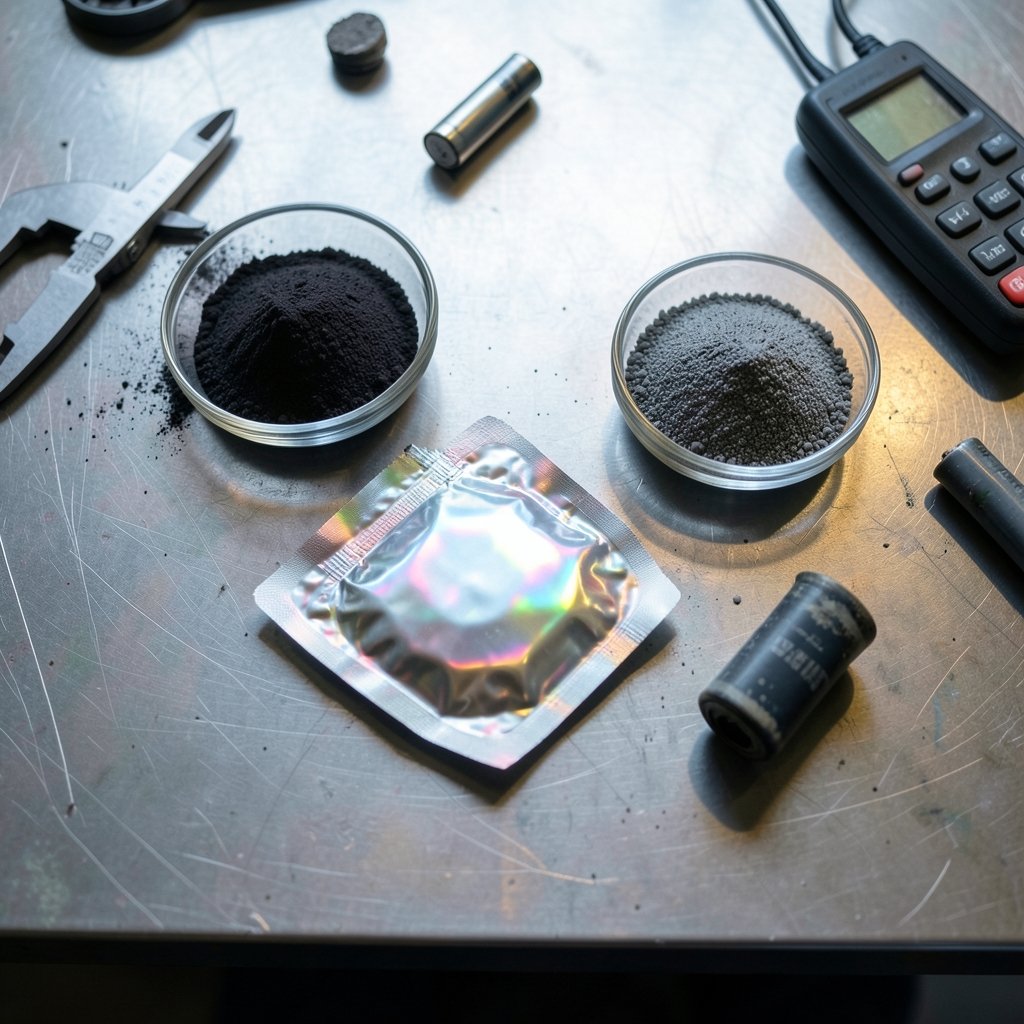
Quick Answer: How does silicon carbon batteries work step by step for beginners?
Silicon carbon batteries store and release energy by pulling lithium ions into tiny silicon particles mixed with carbon, then letting them flow back out. Carbon holds the structure together while silicon soaks up far more lithium than plain graphite, which is why these anodes promise more capacity in the same space. You will see the idea applied in phone batteries, power tools, and electric vehicles, though most “silicon” cells today are blends rather than pure silicon. Before judging any product, compare its silicon percentage, cycle life, swelling behavior, first-cycle efficiency, charging speed, and warranty terms.
The numbers are genuinely wild. Graphite, the material that has anchored almost every lithium-ion battery since the 1990s, can hold roughly 372 milliampere-hours per gram of charge. Silicon can theoretically hold several thousand. That gap is why researchers have chased silicon anodes for decades, and why the phrase “silicon carbon battery” now shows up in marketing for everything from earbuds to electric sedans. But a battery is not a single material, and the step-by-step story of how silicon carbon actually works is where the interesting engineering lives.
What “Silicon Carbon” Actually Means

A silicon carbon anode is a composite. It blends nano-scale silicon with carbon in some form: graphite particles, a carbon coating, a carbon matrix, or a blend of all three. The carbon does several jobs at once. It conducts electricity, it holds the silicon in place, and it cushions the mechanical shock of a material that changes size dramatically as it charges.
It helps to know the parts of a lithium-ion cell first. There is a cathode (often a metal oxide), an anode (the negative side), an electrolyte that carries ions, and a separator that keeps the two electrodes apart. During charging, lithium ions travel from the cathode to the anode. During discharge, they travel back. The anode’s job is to host those ions safely and reversibly, thousands of times.
Graphite does this well because it stacks lithium between layers without changing shape much. Silicon behaves differently. It hosts lithium and also alloys with it, forming chemical compounds. That is a fundamentally more aggressive process, and it explains both the promise and the problems.
Step 1: Lithium Ions Arrive at the Anode
When a cell charges, an external voltage pushes lithium ions out of the cathode and through the electrolyte. They cross the separator and reach the anode surface. In a silicon carbon anode, they meet a landscape of silicon particles embedded in carbon.
The carbon network matters here. Silicon on its own is a poor conductor, so electrons need a path to reach the reaction sites. Carbon provides that path. Without it, large portions of the silicon would sit idle, and the extra capacity would never show up in real use.
This is the first place beginners get confused. The carbon is not a minor additive. In most commercial designs, it is the majority of the anode by mass, with silicon making up a modest fraction. The silicon is the star, but the carbon is the stage.
Step 2: Silicon Absorbs Lithium and Swells
As lithium enters the silicon, the atoms rearrange into alloy phases. At full lithiation, the material approaches a composition often written as Li₁₅Si₄, and the silicon particles expand enormously. Published figures commonly cite volume expansion in the range of roughly 300 percent, though the exact number depends on the phase and the measurement method.
Three hundred percent is not a rounding error. Imagine a grape turning into a golf ball, then shrinking back, then doing it again on every cycle. That is the mechanical reality inside a silicon anode.
Engineers tame this in several ways. They shrink the silicon to nanoscale particles or wires so the strain is distributed and cracks stay small. They wrap silicon in carbon shells. They use porous structures that leave room to expand. They also blend silicon carbon composite into graphite, so the graphite carries most of the load while the silicon adds extra capacity. That blending strategy is the workhorse of the industry, and it is why many so-called silicon batteries are really graphite batteries with a silicon boost.
Step 3: The SEI Layer Forms on the Surface
Here is the step most beginners never hear about, and it is arguably the most important. The electrolyte is not stable against a charged anode. It decomposes on contact, forming a thin film called the solid electrolyte interphase, or SEI.
A good SEI is essential. It passivates the surface, stops further electrolyte breakdown, and allows lithium ions through while blocking electrons. Every lithium-ion battery builds one on its first charge, and a portion of the cell’s lithium gets consumed in the process. That is part of why new batteries lose a bit of capacity early on.
With silicon, the SEI is a moving target. When the particle expands, the film stretches and can crack. Fresh silicon gets exposed, more electrolyte decomposes, and a new layer forms on top of the old one. Repeat this over hundreds of cycles and you get two problems at once: the electrolyte dries up, and lithium gets locked into inactive compounds. This continuous SEI growth is a leading cause of silicon anode degradation, and much of the research in this field is essentially a fight to keep the SEI stable.
Step 4: Discharge Releases the Lithium
On discharge, the process reverses. Lithium leaves the silicon alloy, the particles contract, and ions travel back through the electrolyte to the cathode. Electrons flow through the external circuit, powering your device.
The contraction is where mechanical damage accumulates. Particles that expanded into a carbon shell may pull away from it. Electrical contact can be lost, stranding silicon that can no longer participate. Over many cycles, this shows up as gradual capacity fade.
This is also why the first cycle is special. Some lithium goes into building the SEI and never comes back out. The ratio of what you get out to what you put in is called first-cycle Coulombic efficiency, and silicon anodes historically struggled with it. Nanostructuring, carbon coatings, and pre-lithiation techniques have improved the numbers considerably, but it remains a specification worth checking.
Step 5: Carbon Keeps the Whole System Together
It is worth restating carbon’s role in plain terms, because it explains why the composite exists at all. Carbon provides electrical conductivity, mechanical buffering, and a stable surface for SEI formation. Graphite in particular is cheap, well understood, and dimensionally stable.
The trade-off is capacity. Every gram of carbon you add is a gram not doing silicon’s high-capacity work. So designers tune the ratio. A small silicon percentage gives modest gains with familiar reliability. A large percentage gives bigger gains but harder engineering problems. Most shipping products sit somewhere in the conservative middle, and manufacturers rarely publish exact blend numbers.
If you are the kind of person who likes understanding the machinery behind everyday tech, the same curiosity pays off when you look at how does AI image generation work or what is an IP address and how does it work. Different fields, same lesson: the visible result hides a layered process.
Silicon Carbon vs. Graphite: A Side-by-Side Look
| Feature | Graphite anode | Silicon carbon anode |
|---|---|---|
| Theoretical capacity | About 372 mAh/g | Several thousand mAh/g for silicon |
| Volume change on cycling | Small | Very large (often cited near 300%) |
| Cycle life maturity | Excellent | Improving, still challenging |
| Cost and supply | Mature, scaled | Higher, still scaling |
| Typical commercial form | Pure graphite | Silicon blended into graphite |
| Main degradation path | Lithium plating, SEI growth | Particle cracking, SEI regrowth |
The table tells the story in one glance. Silicon wins on capacity and loses on stability. The entire engineering effort around silicon carbon is about closing that stability gap without giving up too much of the capacity advantage.
Why the Industry Cares So Much
Energy density is the currency of battery progress. More capacity per gram means lighter devices, longer range, or smaller packs. Silicon is one of the few anode materials that can deliver a meaningful step change without abandoning the lithium-ion architecture that factories already know how to build.
There is a broader economic angle too. As AI tools spread through workplaces, power demand from data centers keeps climbing, and efficient storage matters more than ever. Reporting on AI creating more work has highlighted how technology shifts reshape energy and labor expectations in ways few predicted. Better batteries are part of that same story.
For hobbyists and makers, the practical version of this trend shows up in smaller gadgets. If you have ever compared the best ukulele for beginners or the best 3D printer for beginners, you already know how spec sheets can mislead. Battery marketing works the same way: the headline number rarely tells the whole story.
Common Mistakes Beginners Make
The first mistake is assuming “silicon carbon battery” means a pure silicon anode. In practice, almost every commercial cell is a blend, and the silicon fraction may be small. The second is treating capacity as the only metric. A cell that holds more charge but fades quickly is not automatically better. The third is ignoring swelling. Silicon anodes expand at the cell level too, and pack designers must leave room for it; a swollen pouch is a real engineering constraint, not a cosmetic issue.
The fourth mistake is expecting instant ubiquity. Silicon carbon has been “two years away” for a long time, and adoption has been gradual for good reason. Manufacturing nano-silicon at scale, controlling SEI behavior, and validating cycle life takes years. Patience is part of understanding the technology.
The fifth mistake is conflating lab results with products. A paper showing impressive numbers in a coin cell does not guarantee performance in a large format cell with real-world thermal and mechanical stresses. Scale changes everything.
What to Check Before Buying Anything Marketed as Silicon
Start with the silicon content if it is disclosed, and be skeptical if it is not. Look at cycle life claims and the conditions behind them, since a rating at gentle charging rates may not reflect fast-charge use. Check the warranty, which often reveals more about the manufacturer’s confidence than the spec sheet does. Consider charging speed and thermal behavior, especially in compact devices. Finally, compare against a well-reviewed graphite alternative, because a mature design sometimes beats a newer one in real use.
Conclusion
Silicon carbon batteries work through a repeating cycle: lithium ions enter silicon, the particles swell dramatically, an SEI film forms and reforms, and the ions exit again on discharge while carbon holds the structure together. Each step is simple on its own. Together they create a material with enormous capacity and stubborn durability challenges that engineers are steadily solving. For beginners, the takeaway is straightforward. Silicon carbon is a real improvement in energy density, most cells are blends rather than pure silicon, and the metrics that matter are cycle life, swelling, efficiency, and warranty rather than capacity alone. Understanding the steps makes it much easier to separate genuine progress from enthusiastic marketing.
Frequently Asked Questions
Are silicon carbon batteries the same as solid-state batteries?
No. Silicon carbon anodes are a change to one component inside a conventional lithium-ion cell that still uses a liquid electrolyte. Solid-state batteries replace the liquid electrolyte with a solid material, which is a much larger architectural shift. The two ideas can eventually combine, but they are separate developments with different timelines.
Why does silicon expand so much when it charges?
Silicon does not merely host lithium between layers the way graphite does. It chemically alloys with lithium, forming new compounds with a different structure and a much larger volume. That alloying reaction is what gives silicon its huge capacity, and the expansion is the unavoidable price of that capacity.
Do silicon carbon batteries last as long as graphite batteries?
Not usually, though the gap is narrowing. The repeated expansion and contraction cracks the protective SEI layer, consuming lithium and electrolyte over time. Nanostructured silicon, carbon coatings, and blended designs have improved cycle life substantially, but buyers should still compare published cycle ratings carefully rather than assuming parity with graphite.
What is first-cycle efficiency and why does it matter?
It is the share of the charge put into a new cell on its first cycle that can be taken back out. Some lithium is consumed building the SEI layer and is never recovered. Silicon anodes have historically lost more in that first cycle than graphite, which reduces usable capacity. Pre-lithiation and surface treatments help close the gap.
Can silicon carbon batteries charge faster?
They can support high charge rates in principle because silicon accepts lithium readily, but fast charging accelerates the mechanical and chemical stresses that shorten life. The practical limit usually comes from thermal management and SEI stability rather than from silicon’s intrinsic ability to absorb ions.
Is silicon carbon better for the environment?
It depends on how you measure. Silicon is one of the most abundant elements on Earth, which is favorable for supply security compared with graphite sourcing concerns. But nano-silicon production is energy intensive, and recycling streams for silicon-blended anodes are still maturing. The honest answer is that the benefits are real but conditional on manufacturing and end-of-life handling.