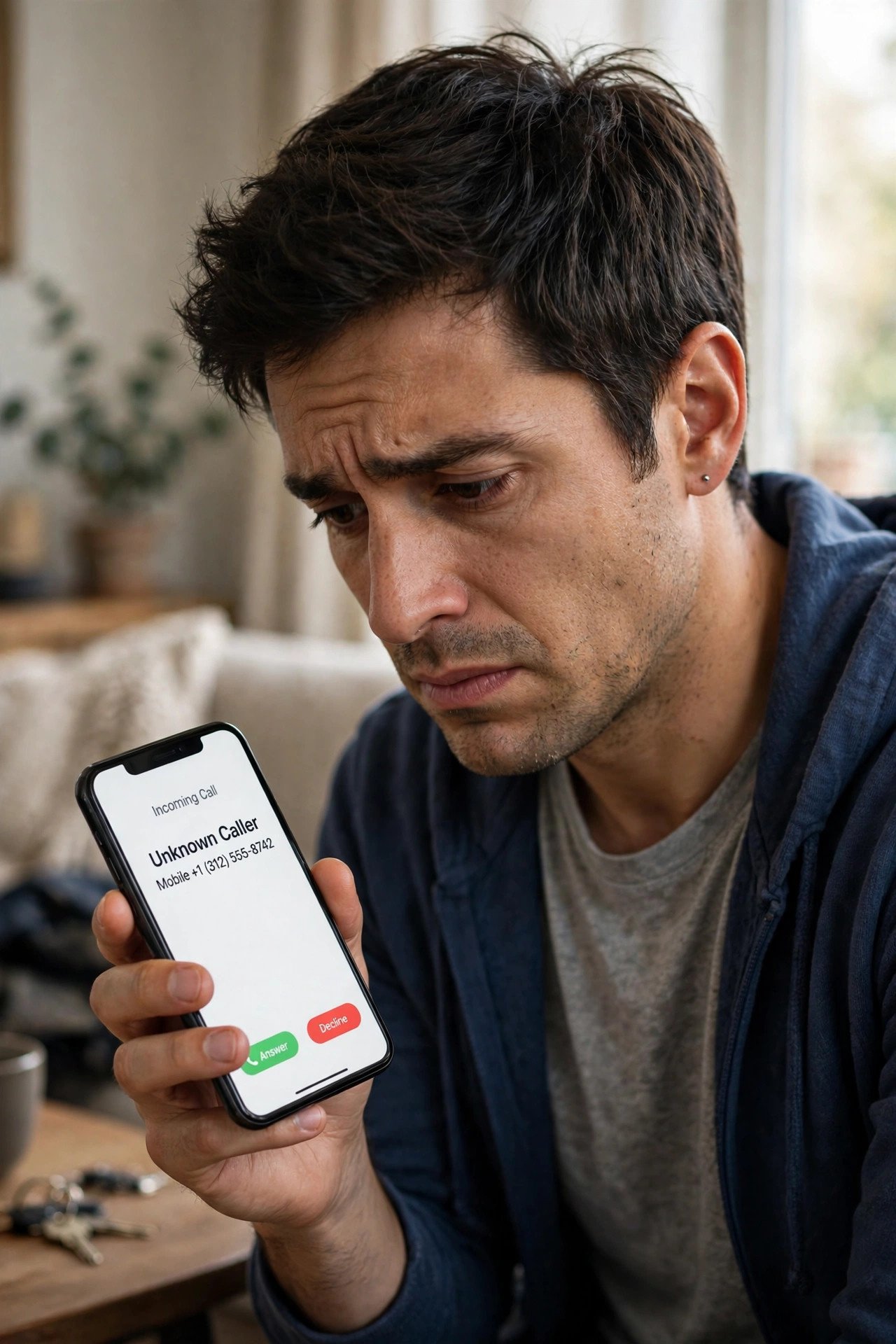
How to spot an AI voice clone scam call is a question that now matters to almost every family. Imagine your phone rings, and the voice sounds exactly like your daughter, your son, or your grandchild. They are in trouble. They need money, right now, and they need you not to tell anyone. Would you pause, or would you pay? That is the trap, and it is designed to work in seconds.
The direct answer is simple: do not trust the voice. Hang up, and call the person back yourself on a number you already know is theirs. If the emergency is real, it will survive that pause. If it is a scam, the pause is what breaks it.
Key takeaways
- The voice is no longer proof of identity. AI can clone a voice from a short audio clip, often taken from content posted online.
- Hang up and call back on a saved number. That one step stops most voice clone scams, whatever the voice sounds like.
- Agree a family safe word today. A word or question only your family knows is a fast, private test.
- Urgency plus secrecy plus an unusual payment is the pattern. Wire transfers, cryptocurrency and gift cards are classic scam payment methods.
- If money has already left, act fast. Call your bank’s fraud team immediately, then report the call to the FBI’s Internet Crime Complaint Center and the FTC.
What is an AI voice clone scam?
An AI voice clone scam uses artificial intelligence to copy a real person’s voice, then uses that copy in a phone call to impersonate them. The scammer usually needs only a short audio clip, often lifted from a video, a social media post, a voicemail greeting, or a podcast. That clip is fed into a voice-cloning program, which can then generate new speech in that voice — words the person never said.
The Federal Trade Commission (FTC) warned in March 2023 that a scammer can clone a relative’s voice using a short audio clip taken from content posted online plus a voice-cloning program. The FBI issued a public service announcement in December 2024 warning that criminals generate short audio clips of a loved one’s voice to pose as a relative in a crisis and ask for urgent money or a ransom.
The call that follows is usually a family emergency scam, also known as a grandparent scam. The caller claims to be a child, grandchild or partner who has been in an accident, arrested, or kidnapped, and needs bail money, hospital fees, or a lawyer now. A second voice may pose as a police officer or lawyer.
The scam works because it uses love and panic. Modern cloning tools need only a few seconds of source audio, and human listeners can no longer reliably tell a real voice from a cloned one in normal conversation. That is why this article focuses on the pattern of the call, not only on the sound — see AI-generated images and deepfakes.
The scale of the problem, in verified numbers
The FBI’s Internet Crime Complaint Center received 22,364 complaints with an AI component in 2025, with reported losses of $893 million, according to the FBI’s 2025 Internet Crime Report. Grandparent or “distress” scams accounted for losses of more than $5 million in 2025. Adults aged 60 and over filed 3,143 AI-related complaints, with losses of $352,496,231.
The FTC reported that people lost $3.5 billion to imposter scams in 2025, nearly three times the 2020 level. McAfee found in 2023 that one in four adults in seven countries had experienced an AI voice scam or knew someone who had, and that 77% of victims lost money.
The 7 red flags of a voice clone scam call
Learn these as a pattern, not as a checklist to tick off while you are panicking. If two or three appear together, hang up and verify.
- An unexpected call from a relative in sudden crisis. The caller is a child, grandchild or partner you were not expecting to hear from, and they are in an accident, in jail, or in danger.
- Intense pressure to act immediately. You must pay now, stay on the line, and not hang up. The caller says there is no time to check. Real emergencies allow a pause. Scams do not.
- Secrecy. You are told not to contact anyone else, or that telling anyone will make the situation worse. Secrecy is not a feature of a real emergency. It is a feature of a scam.
- A request to pay by wire, cryptocurrency or gift cards. The FTC is direct on this point: if the caller says to wire money, send cryptocurrency, or buy gift cards, those are signs of a scam. Those payment methods are hard to reverse, and that is why scammers choose them.
- A refusal to let you call back. The caller gives a reason why you cannot ring the person back on their usual number. A genuine caller has no reason to object to a callback on a number you already have.
- Details that do not quite fit. Facts are slightly out of date, or the caller’s knowledge stops where public information stops.
- A story that relies entirely on the voice sounding right. A familiar voice should start a verification process, not end it.
What a cloned voice can sound like
Cloned voices can sound right. Treat these audio signs as hints, not as tests. A clean recording can still be synthetic.
Listen for a metronome-like rhythm, with no genuine pauses for breath. Real distressed speech is messy: people stumble and take ragged breaths. Cloned voices often deliver clean sentences even when the script says they are crying.
Listen for flat emotion and for background noise that does not match the claimed location. Ask a question only the real person would know.
The hang-up-and-call-back check: your best defence
This is the most important section in this article, because it works even when the voice is perfect.
Best for every unexpected emergency call, whatever the voice sounds like: hang up and call back.
Here is the protocol. First, say you will call back, then hang up. Second, call the person on a number saved in your phone, not a number the caller gives you. If you cannot reach them, call another family member. Third, ask for the safe word. If the caller cannot give it, stop. Fourth, do not ring back on the number that called you. Fifth, wait for confirmation before you pay anything.
The FTC’s advice is the same: do not trust the voice. Call the person back yourself, on a number you know is theirs.
The family safe word: set it up today
Best for families with children, older parents, or relatives who travel: a family safe word.
Agree a simple word or question with the people closest to you, something a stranger could not know and would not find online. Practise it once, in a calm moment. Tell children that a real family member will always give the safe word when asked. The FBI recommends a family code word for voice-clone emergencies and virtual kidnapping scams.
Keep the safe word private. If you think it has been shared too widely, change it.

Comparison table: real emergency call vs voice clone scam call
| Signal | Real emergency call | Voice clone scam call |
|---|---|---|
| How it starts | Usually follows a message or a known event | Unexpected, with no warning |
| Pressure | Urgent, but allows a callback | Must act now, stay on the line |
| Secrecy | No reason to hide it from family | Told not to tell anyone |
| Payment | Hospital, police or lawyer through official channels | Wire, cryptocurrency or gift cards |
| Callback | Welcomes a call back on a known number | Resists or gives a new number |
| Details | Knows private, current details | Knowledge stops at public information |
| Voice | Messy, breathless, uneven under stress | Often too clean and even-paced |
| Second voice | A named official you can verify | A vague “officer” who cannot be checked |
How to protect your voice and your family
You cannot stop a scammer from trying, but you can make your voice harder to clone. Lock down your social media, because voice samples are usually pulled from public videos and voicemails. Set voicemail greetings to a short, generic message. Teach older relatives the same habits, kindly: adults aged 60 and over filed 3,143 AI-related complaints with the FBI in 2025, with losses of $352,496,231. At work, agree a rule now — see how to use AI safely at work: no payment, no bank detail change, and no password reset on the basis of a voice call alone. Every change needs a callback on a known number and a second person to approve it.
If you have already paid: act in the next hour
If money has already left, do not wait. Best for a wire or bank transfer: call your bank’s fraud department immediately and ask for a recall. Best for a gift card payment: contact the card company and report the card numbers. Best for a cryptocurrency payment: report it to the exchange and to law enforcement, even though recovery is unlikely. Then report the call to the FBI’s Internet Crime Complaint Center at ic3.gov and the FTC at ReportFraud.ftc.gov in the US, or Action Fraud in the UK. Keep the number, time, and how you paid.
FAQs
How can I tell if a voice on the phone is AI-cloned?
You often cannot tell by listening alone. Look for urgency, secrecy, a request to pay by wire, cryptocurrency or gift cards, and resistance to a callback. Hang up and call back on a saved number.
How much audio does a scammer need to clone a voice?
Only a short clip is needed, often a few seconds from a video or voicemail greeting. The FTC warned in 2023 that a scammer needs only a short audio clip taken from content posted online.
What is a family safe word, and how does it help?
A safe word is a word or question only your family knows, agreed in advance. If a relative calls in distress, ask for it. A real relative will give it. A scammer will not know it, and will usually deflect or become more urgent.
What should I do if a caller says my grandchild is in jail?
Hang up, then call your grandchild on their usual number, or call another family member. Do not pay on the basis of a single call, and do not pay by wire, cryptocurrency or gift cards.
Can I report a voice clone scam call?
Yes. In the US, report it to ic3.gov and ReportFraud.ftc.gov. In the UK, report it to Action Fraud. Keep the number and time.
Are voice cloning tools illegal?
Voice cloning tools themselves are not illegal. Using a cloned voice to deceive someone and take their money is fraud. In February 2024, the FCC ruled that AI-generated voices in robocalls fall under the Telephone Consumer Protection Act.
The bottom line
A familiar voice used to be enough. It is not anymore. Trust a process that protects your family: hang up, call back on a number you already have, and ask for the safe word. Set that safe word today. The next call may be real, and if it is, it will survive the pause. If it is a scam, the pause is what saves you. More in the AI Atlas.