What if the difference between a mediocre shot and a café-quality one isn’t your skill, but the machine sitting on your counter? That question drives most espresso shopping, and it’s the right one to ask. The market has settled into a few clear winners, and the good news is that you don’t need to spend four figures to pull a genuinely good shot.
This roundup covers six specific machines worth considering for a 2027 purchase. Each entry explains who it suits, what it does well, where it falls short, and what it costs when a published price exists. A comparison table comes first so you can scan the field, then the details, then a short guide to choosing between them.
Comparison Table: Best Home Espresso Machines at a Glance
| Machine | Best for | Grinder built in | Standout feature | Published price |
|---|---|---|---|---|
| Breville Barista Express Impress | All-in-one buyers who want assisted tamping | Yes, 25 settings | Assisted tamp at about 10kg with a 7-degree barista twist | Not stated |
| Breville Bambino Plus | Small kitchens and beginners | No | Three-second ThermoJet heater, automatic milk texturing | Under $150 in one tested listing |
| Breville Barista Pro | People chasing full shot control | Yes, 30 settings | Three-second heater plus LCD | Not stated |
| De’Longhi La Specialista Arte Evo | Beginners who want guidance | Yes | Gentle learning curve for new users | Not stated |
| Gaggia Classic Pro | Entry-level buyers wanting commercial-grade parts | No | Faster brew time, commercial-grade components | Not stated |
| Lelit Mara X3 | Buyers wanting Italian heat-exchanger craft | No | E61 group with dual-probe temperature control and flow-control paddle | $1,999.95 |
1. Breville Barista Express Impress: The Best All-in-One for Most People
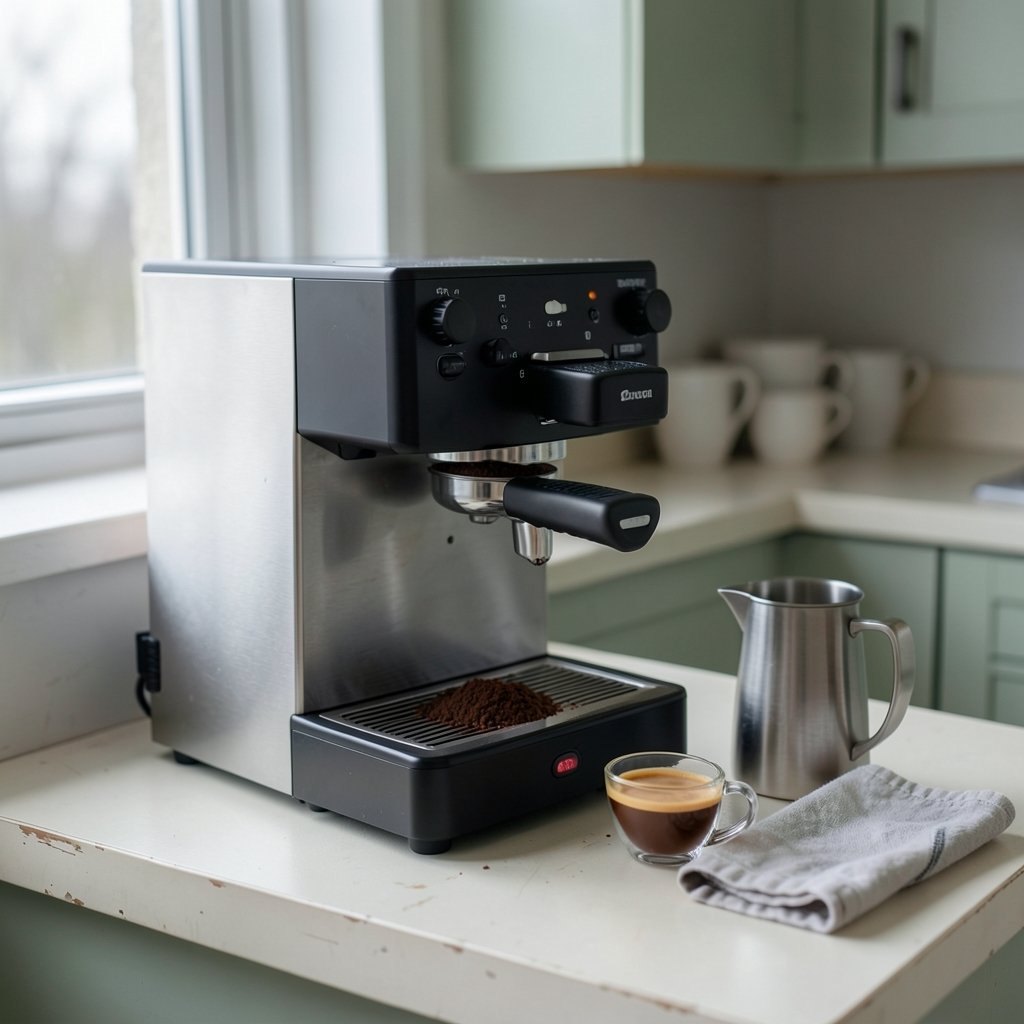
If someone says “espresso machine” and pictures one box that grinds, doses, tamps, and brews, this is the machine they mean. The Barista Express line is the most-reviewed object in this niche by a wide margin, and the Impress version adds the feature that matters most to newcomers: an assisted tamp that applies about 10kg of pressure and finishes with a 7-degree “barista twist.” That removes the single most common beginner error, which is tamping unevenly and wondering why the shot runs fast on one side.
The integrated conical-burr grinder offers 25 grind settings and feeds directly into the impress system. A thermo-coil heating system keeps brew temperatures accurate and extraction consistent, which is the quiet reason shots from this machine taste repeatable rather than random.
The limitation is speed and feedback. There’s no screen, and the design dates back years, so you’re buying proven rather than cutting-edge. If you want a display and a faster heater, the Pro below is the upgrade. For anyone assembling a first serious setup, this is the safest recommendation in the category, and it pairs naturally with the guidance in this roundup of the best espresso machine for home use.
2. Breville Bambino Plus: Best for Small Counters
The Bambino Plus is the compact star of Breville’s range. It packs a PID controller, a three-second ThermoJet heater, and, uniquely at its size, automatic hands-free milk texturing into a body narrow enough for a cramped kitchen. Testers who have run dozens of machines through lab protocols single it out as the space-saving option that doesn’t skimp on performance.
One real limitation: there’s no grinder. You’ll need to budget for one separately, and a bad grinder will undo everything the machine does well. That’s the mistake people make most often with compact machines. They spend the whole budget on the espresso maker and then buy pre-ground coffee, which goes stale within days.
On price, one tested listing placed a compact machine at under $150, though that figure should be verified against current listings before you buy, since pricing on this model moves. If you’re weighing compact against full-size, this comparison of the best home espresso machine options is a useful second opinion.
3. Breville Barista Pro: Best for Tinkerers
The Barista Pro is essentially the Barista Express with a three-second heater, an LCD, and a finer 30-setting grinder. That’s the whole pitch, and it’s a good one for anyone who wants to dial in a light roast and taste the difference between grind setting 14 and 16.
What it does well is give you full control over every shot’s flavor and texture without asking you to buy a separate grinder. The LCD shows you what’s happening, and the faster heater means less waiting between the first shot and the second.
The limitation is price positioning. The Express still outsells its own replacements, which tells you most buyers decide the screen and the extra grind settings aren’t worth the premium. Buy the Pro if you genuinely enjoy adjusting variables. Skip it if you just want coffee before work. For a broader look at how the two compare across the range, see this guide to the best home espresso machine 2.
4. De’Longhi La Specialista Arte Evo: Best for Nervous Beginners
De’Longhi’s pitch is different from Breville’s. Where Breville sells control, De’Longhi sells hand-holding, and the La Specialista Arte Evo is the clearest expression of that. It’s the pick for beginners in more than one roundup, and the reason is the learning curve: it guides you toward a drinkable shot instead of leaving you to diagnose a sour, gushing mess on your own.
It does the fundamentals well, with a built-in grinder that keeps the setup to one machine. The limitation is ceiling. Machines in this class tend to cap how far you can push a difficult bean, and buyers who get hooked on the hobby often outgrow them within a year or two.
Head-to-head testing has put Breville and De’Longhi against each other directly, and the coffee from the Breville came out on top in at least one comparison. That doesn’t make the De’Longhi a bad machine. It makes it the right machine for a different buyer: someone who wants a good cup with minimal fuss, not a project.
5. Gaggia Classic Pro: Best Entry Point to Real Espresso Gear
The Gaggia Classic Pro is the machine that experienced home baristas recommend to friends who want to learn properly. It uses commercial-grade components, brews faster than the entry-level competition, and has a frothing wand that’s easy to use. It’s also the machine most likely to still be repairable in a decade.
The limitation is that it demands more from you. There’s no grinder, no screen, and no automation. You’ll need a decent burr grinder, a scale, and patience. The payoff is that you learn the actual craft rather than watching a machine do it.
If you want the shortest path to good espresso with the least equipment, this isn’t it. If you want to understand why your shot tastes the way it does, it’s the best value in the category. This breakdown of the best at home espresso machine picks covers where it fits against the automatics.
6. Lelit Mara X3: Best for Italian Craftsmanship Under $2,000
For buyers who care about how a machine is built as much as how the coffee tastes, the Lelit Mara X3 is the standout at $1,999.95. It’s Italian-built, pairs an E61 group with dual-probe temperature control, and adds a flow-control paddle. That paddle lets one machine pull a light-roast shot slow and long and a dark roast fast and short.
The limitation is lifestyle. Heat-exchanger machines with real boilers take much longer to reach temperature than thermoblocks, so this is a machine you switch on before the kettle and leave on. It also rewards good technique and a good grinder, which means the true cost is higher than the sticker.
Above this price point you’re paying for paddle-actuated flow control, direct plumbing, and larger boilers for entertaining. Below roughly $1,400, buyers are almost always compromising on boiler construction, build materials, or both. The $1,400 to $3,500 band is where dual boilers or thermally stable heat-exchange systems with PID control, brass and stainless internals, and rebuildable brew groups converge reliably.
How to Choose Between Them
Work backward from your mornings, not from spec sheets.
- Decide whether you want a grinder in the machine. If counter space is tight or you want one plug, buy the Barista Express Impress. If you already own a good grinder, the Bambino Plus or Gaggia Classic Pro is the smarter spend.
- Be honest about temperament. The De’Longhi suits people who want a good cup with minimal fuss. The Barista Pro and Gaggia suit people who enjoy adjusting variables.
- Check the heating system. A three-second thermoblock gets you coffee fast. A boiler takes longer to heat but holds temperature across a run of shots.
- Budget for the grinder and the scale as well as the machine. This is the most common mistake in the category.
- Look for a descaling alert and rebuildable parts. A machine you can service outlasts one you can’t.
If you’re still narrowing the field, this comparison of the best home espresso machine options and this review of a cold brew espresso machine that really delivers cover two very different ends of the market. And if you’re outfitting a whole kitchen rather than just a coffee corner, it’s worth reading how to find the best washing machine for your home habits with the same logic: match the appliance to how you actually live, not to the spec sheet.
Conclusion
The best home espresso machine for 2027 isn’t the most expensive one. It’s the one that matches your patience, your counter, and your willingness to learn. For most people, the Breville Barista Express Impress is the answer because it removes the beginner’s biggest failure point while keeping the grinder, dose, tamp, and brew in one body. Small kitchens should look at the Bambino Plus. Tinkerers should look at the Barista Pro. Beginners who want guidance should look at the De’Longhi. Anyone who wants to learn the craft properly should start with the Gaggia Classic Pro, and anyone who wants Italian engineering under $2,000 should look hard at the Lelit Mara X3.
Buy the machine that fits your mornings. The coffee will follow.
Frequently Asked Questions
Do I need a separate grinder if my machine has one built in?
Not necessarily. Machines like the Barista Express Impress and Barista Pro include conical burr grinders with 25 and 30 settings respectively, which is enough for most home use. If you choose a machine without a grinder, such as the Bambino Plus or Gaggia Classic Pro, budget for a burr grinder. A blade grinder will produce uneven particles and ruin your shots.
Is a more expensive espresso machine worth it for a beginner?
Usually not at first. The $1,400 to $3,500 range is where dual boilers, PID temperature control, and rebuildable brew groups converge, but those features reward good technique. A beginner is better served by a mid-range machine with a built-in grinder and an assisted tamp, then upgrading once their palate and skills develop.
How long does a home espresso machine last?
It depends heavily on construction and serviceability. Machines with brass and stainless steel internals, E61-style or saturated group heads, and rebuildable brew groups are designed to be repaired rather than replaced, and parts availability can stretch decades. Entry-level machines with aluminum internals typically have shorter lives.
What is the difference between a thermoblock and a boiler?
A thermoblock heats water on demand, which is why machines like the Bambino Plus reach brewing temperature in about three seconds. A boiler stores heated water and heat, which keeps a run of shots consistent but takes much longer to reach temperature. Boiler machines are typically switched on well before you plan to brew.
Can one machine handle both espresso and milk drinks?
Yes, but check how. The Bambino Plus offers automatic hands-free milk texturing, which is unusual at its size. The Gaggia Classic Pro has an easy-to-use frothing wand that requires manual technique. Dual-boiler machines let you steam milk and pull a shot at the same time, which matters if you’re making several drinks in a row.
Should I buy a super-automatic instead?
A super-automatic grinds, doses, tamps, brews, and froths on its own, which suits households where convenience outranks control. The trade-off is less ability to dial in a specific bean and generally higher cost of repair. Buy one if nobody in the house wants to learn technique. Otherwise, a semi-automatic with a built-in grinder gives you better coffee for similar money.