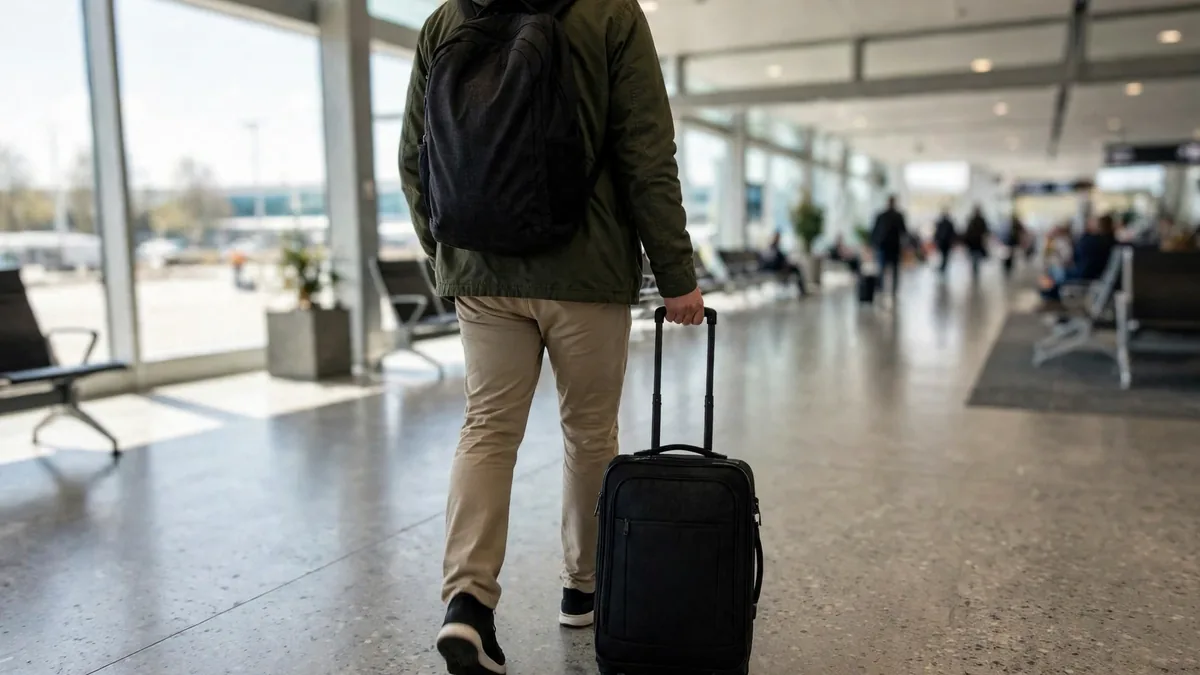
Flying light used to be a personal preference. In 2026 it has become a business opportunity. As airlines raise baggage fees and tighten carry-on rules, a wave of entrepreneurs is building companies around a simple idea: help travellers fit everything into one small bag, and charge for the privilege. The Forbes article that prompted this report, “Entrepreneurs Find Opportunity In Helping Fliers Travel Light,” frames the trend as a small-business story, and the numbers behind it explain why founders are paying attention.
The economics are hard to ignore. United States airlines collected a record $7.4 billion in baggage fees in 2025, according to Bureau of Transportation Statistics data, and about $79.7 billion between 2009 and 2025. Southwest Airlines, which let passengers check two bags free for half a century, started charging in May 2025. When the cost of checking a bag keeps rising, the value of travelling with only a carry-on keeps rising with it, and entrepreneurs are selling the tools, the bags, and the know-how to do it.
This article looks at the startups helping fliers travel light, the business model behind them, and the market they are chasing. The Forbes article itself is not freely available in full, so the companies and figures below come from corroborating coverage cited throughout, and anything that could not be confirmed from an accessible source is flagged as unconfirmed. This is a business story, not a product recommendation, and no specific startup named in the Forbes piece is confirmed here beyond the headline framing.
Key takeaways
- US airlines collected a record $7.4 billion in baggage fees in 2025, and about $79.7 billion from 2009 to 2025, according to Bureau of Transportation Statistics data.
- Southwest ended five decades of free checked bags in May 2025, charging $35 for the first bag and $45 for the second, and the fees generated about $350 million in one quarter.
- Travellers are responding by going carry-on only: 52 percent of global passengers prefer it, according to a 2024 IATA survey, and 57 percent of Americans try to avoid checking bags.
- Startups are selling the shift through direct-to-consumer luggage, vacuum-sealed packing, personal-item-sized bags, and smart suitcase features.
- The model works only if the bag genuinely fits airline rules, since gate fees and stricter enforcement can wipe out the savings in a single trip.
| Measure | Figure | Source |
|---|---|---|
| US baggage fees, 2025 | $7.4 billion, a record | Bureau of Transportation Statistics |
| US baggage fees, 2009-2025 | About $79.7 billion | Bureau of Transportation Statistics |
| Southwest bag fees, Q2 2025 | About $350 million in one quarter | Southwest earnings, via Ziddu |
| First checked bag, major US carriers | $35 to $50 one way, depending on carrier | US PIRG tracking, May 2026 |
| Passengers preferring carry-on only | 52 percent globally; 57 percent in the US | IATA 2024; Cheapflights |
| Bags mishandled globally, 2024 | 36.2 million, 6.3 per 1,000 passengers | SITA Baggage IT Insights 2025 |
| Global airline ancillary revenue, 2024 | $148.4 billion, 15.7 percent of revenue | IdeaWorksCompany |
Why flying light suddenly pays
The change is recent, and Southwest is the clearest marker. After 50 years of letting customers check two bags free, the airline started charging $35 for the first bag and $45 for the second in May 2025. Its second-quarter 2025 earnings showed the new fees generated roughly $350 million in a single quarter, with projections of $1.5 billion a year going forward. Other carriers moved the same way: American Airlines raised its first checked bag fee to $40 in early 2026, and later listings put it at $45 online or $50 at the airport.
The startups selling a lighter trip
The first wave of travel-light startups sold a better suitcase. Away, founded by Steph Korey and Jen Rubio, interviewed 800 frequent fliers before launching a polycarbonate carry-on with an internal compression system and a built-in USB charger for $225, far below the $500-plus price of comparable luggage at the time, according to PYMNTS. The direct-to-consumer model cut out the retail markup, and by 2016 the company had raised $11 million in venture funding. The lesson stuck: solve a real packing problem, sell direct, and price below the legacy brands.

The newest entrants design around the airline rulebook itself. The Personal Bag, created by entrepreneur Alexander Coverdale, is a backpack built to fit as a free personal item on most US airlines, with a vacuum-sealed main compartment that compresses clothing so more fits inside the size limit, according to MarketersMedia. Coverdale said he spent nearly two years perfecting the design, went through five prototypes, and sold his car and most of his possessions to fund it. The first 1,000 units arrived in February 2025, with shipments beginning in March. The pitch is not luxury or technology. It is the absence of a fee.
The business model: fees, not just bags
The model works because the airlines created the demand. Baggage fees are no longer a side business: global airline ancillary revenue hit $148.4 billion in 2024, according to IdeaWorksCompany, representing 15.7 percent of total airline revenue. US airlines collected $7.27 billion in checked-bag fees in 2024, up from $7.07 billion the year before and more than double the $2.84 billion pandemic low in 2020, according to the Bureau of Transportation Statistics. Every fee increase makes a $225 carry-on or a vacuum-sealed backpack easier to justify.
What the numbers say about baggage fees
The fee trend has only one direction. Baggage fee revenue hit a record $7.4 billion in 2025, compared with $2.7 billion in 2009, the first full year after first-bag fees became widespread, according to Bureau of Transportation Statistics data cited by The Travel. In 2026 the increases continued: American raised fees again, United introduced higher charges on US and Canadian routes, and JetBlue added increases in November. A comparison of the cheapest and most expensive fees in 2026 shows why comparing baggage policies can matter as much as comparing ticket prices.
The rules are also getting stricter, not just pricier. Airlines are converging on a standard maximum of 22 by 14 by 9 inches for overhead-bin bags, with less tolerance for bags that mostly fit, according to Ziddu. United’s Basic Economy fare does not include overhead-bin access at all, so those passengers can only bring a personal item that fits under the seat. Budget carriers are stricter still, with some enforcing 7-kilogram carry-on weight limits and weighing bags at the gate, where fees of €50 to €75 are common, according to Traveler Codex. A bag that worked last year can fail this year.
Where the model strains
Carry-on only is not the right call for every trip, and forcing it leads to miserable packing. Trips that need bulky gear, like ski layers, hiking boots, or a suit and dress shoes for a wedding, often will not fit into a 22 by 14 by 9 inch bag. Liquids are another constraint, since the TSA’s 3-1-1 rule caps each container at 3.4 ounces, and a two-week trip with gifts on the return leg is a much harder fit than a long weekend in a warm city, according to Bazar Travels. The startups’ marketing rarely dwells on these limits.
What to watch next
The trend to watch is whether airlines keep raising fees or start competing on them. Southwest’s move showed that even the last free-bag holdout could be converted, and its $1.5 billion annual projection shows why others will follow. If fees keep rising, the travel-light market keeps growing with them. If one major carrier breaks ranks and brings back a free bag to win customers, the arithmetic changes overnight, and the startups’ pitch gets weaker.
Checklist: travelling light without paying at the gate
The savings are real, but only when the bag fits the rules. A short checklist covers the mistakes that cost travellers the most.
- Measure your bag against your airline’s published limits, not the generic 22 by 14 by 9 inch standard, since low-cost carriers often allow less.
- Weigh the packed bag at home, because some carriers enforce 7 to 10 kilogram carry-on limits and weigh bags at the gate.
- Check your fare class: basic economy on some carriers includes only a personal item, with no overhead-bin access at all.
- Pack liquids to the 3-1-1 rule and keep them accessible, since a repack at security slows everyone down.
- Roll soft clothes and use compression to fit more in, but leave room for anything you buy on the trip.
- Know the gate fee before you fly, since it is usually higher than the online price and can exceed the cost of checking a bag.
Frequently asked questions
Why are entrepreneurs building businesses around travelling light?
Because baggage fees keep rising: US airlines collected a record $7.4 billion in 2025, and Southwest’s new fees alone are projected at $1.5 billion a year. Each fee increase makes a carry-on bag or a packing system easier to sell.
How much can travelling carry-on only actually save?
A solo traveller checking one bag on a major US carrier pays $90 to $100 round trip, and a family of four pays $360 to $400, according to US PIRG tracking. Four round trips a year can save roughly $360 to $400, about the price of a good suitcase.
What kinds of startups are in this market?
Direct-to-consumer luggage brands such as Away and Paravel, smart-suitcase makers such as Bluesmart, and personal-item specialists such as The Personal Bag, which uses a vacuum-sealed compartment to fit more inside airline size limits. The specific companies profiled by Forbes are unconfirmed here.
Does carry-on only work for every trip?
No. Bulky gear, formal clothes, and long trips with gifts often will not fit a 22 by 14 by 9 inch bag, and liquids are capped by the 3-1-1 rule. A long weekend in a warm city is an easy fit; a two-week trip with a wedding is much harder.
What is the biggest risk of travelling light?
Gate fees. Airlines are enforcing size and weight limits more strictly, and a bag that fails at the gate can cost €50 to €75 on a budget carrier, more than checking it online would have cost. Measuring and weighing the packed bag at home avoids the surprise.
Will baggage fees keep rising?
That is unconfirmed as a forecast, but the trend points that way: fees rose again across major US carriers in 2026, and ancillary revenue is now a core part of airline earnings. Whether any carrier breaks ranks to compete on free bags is the open question.
The bottom line
The travel-light boom is a straightforward story of a cost being shifted and a market forming around it. Airlines turned baggage into a $7.4 billion annual revenue line, and entrepreneurs answered by selling the bags, the compression, and the know-how that let travellers avoid the fee. The products are genuinely useful for the trips they fit, and the savings are real for frequent fliers who pack to the rules. For more on how small businesses find their opening, see how Small Business Saturday supports main street, how Americans are starting million-dollar businesses, and the best laptop bags for travellers who work on the move.
The founders who last will be the ones who sell more than a bag. Airline rules change, size limits move, and a product built for one carrier’s rulebook can be stranded by a single policy update. The durable opportunity is in teaching travellers to pack well, building bags that fit many airlines rather than one, and treating travelling light as a service instead of a single purchase. If fees keep rising, that market keeps growing. If a carrier ever brings the free bag back, the entrepreneurs who built only a suitcase will learn, quickly, that they were selling the fee all along.