What do you really get when a vendor announces a new uninterruptible power supply for AI data centers? That question has become harder to answer as launch events pile up faster than most facilities teams can evaluate them. In a single stretch of weeks, Vertiv rolled out a medium-voltage platform, Proper Voltage introduced a sodium-ion battery cabinet, Skeleton Technologies pushed a graphene-based high-density system, and Eaton used a trade show floor to show off a 1.5 MW unit. Each announcement sounds transformative. Each one also asks buyers to separate genuine engineering progress from marketing polish.
This guide walks through the announcements that matter, what the specs mean in practice, and the mistakes people make when they treat a press release as a purchase order.
Why UPS announcements suddenly matter more than they used to
The uninterruptible power supply used to be the boring box in the back room. Not anymore. AI workloads swing from idle to peak load in milliseconds, and that behavior changes what a UPS has to do. A conventional double-conversion system protects equipment from utility disturbances, but it does not help the utility itself.
Newer announcements lean hard on two themes: grid interaction and density. Vendors now pitch systems that smooth power fluctuations, help operators clear interconnection queues, and free up floor space for compute rather than electrical gear. If you read a UPS announcement in 2026 and it does not mention AI loads or grid codes, it is probably a refresh of an older line.
Vertiv PowerNexus MV UPS: the outdoor medium-voltage play
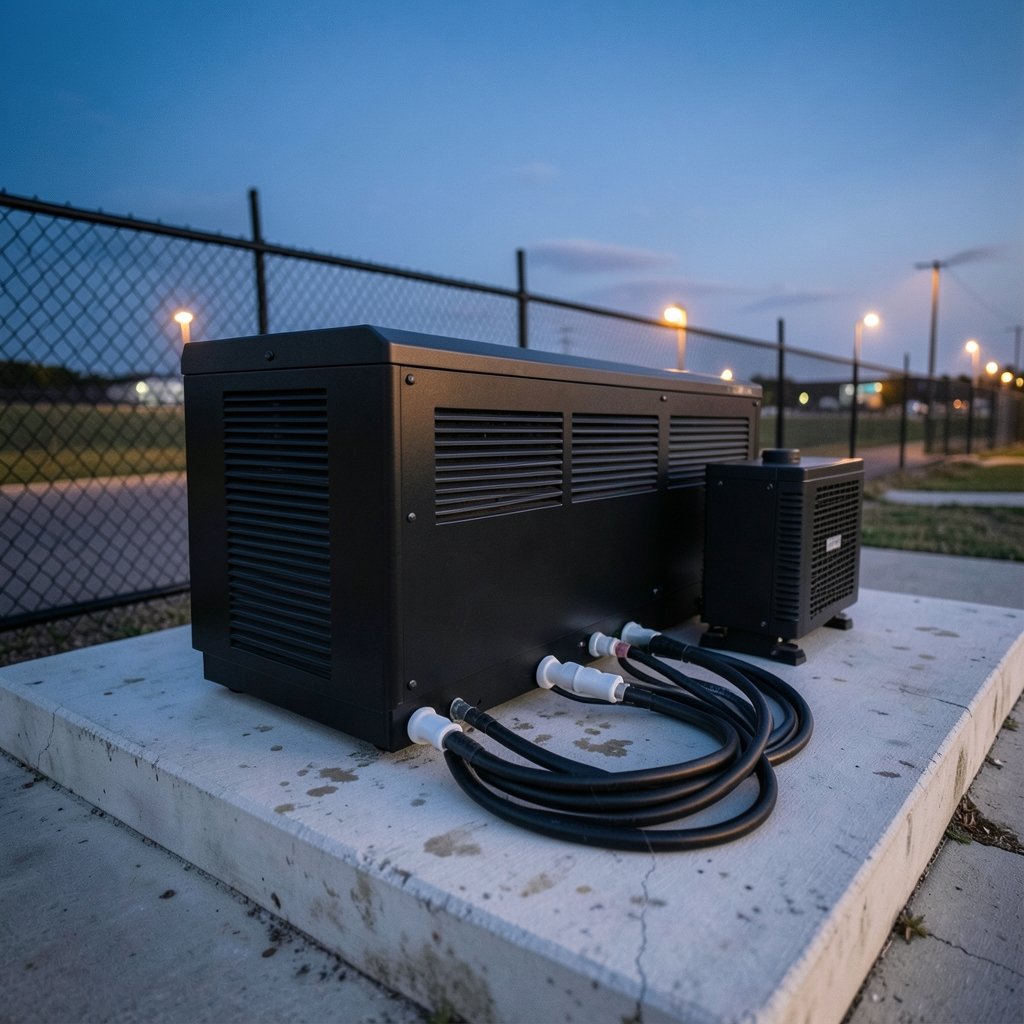
The headline announcement in this cycle is Vertiv’s PowerNexus MV UPS, a medium-voltage platform built for colocation, neocloud, and hyperscale operators. The key design choice is location: it is rated for outdoor deployment at the utility connection point, which keeps the electrical plant outside the building and leaves indoor square footage for revenue-generating compute.
The published figures are worth noting carefully. Vertiv says the system reaches up to 98.5% peak operating efficiency, and that when paired with long-duration battery systems it can support battery-backed operation for up to four hours. It combines the UPS itself with fault ride-through and AI power smoothing in one package, and the company positions it as a way to reduce reliance on diesel generators.
Timing matters for anyone planning a build. Shipments are expected to begin in mid-2027, so this is a design-phase decision, not a drop-in replacement for a system you need next quarter. The same platform also appears alongside the next-generation Vertiv Trinergy UPS, which is offered as a component of PowerNexus and is closely coupled with Vertiv PowerBoard switchgear to cut footprint and maintenance.
Practical tip: when a vendor quotes peak efficiency, ask for the efficiency curve across partial loads. Data centers rarely run at full load all day, and the number that shapes your power bill is the weighted figure at realistic utilization.
What medium voltage at the fence line really changes
Moving a UPS to medium voltage outdoors changes the entire electrical topology. The change goes beyond packaging: protection sits closer to the source instead of stepping down at the utility transformer and distributing low-voltage power deep into the hall.
That has three consequences worth weighing:
- Space. Indoor electrical rooms shrink, which is the entire point for operators paying premium land costs.
- Interconnection speed. Grid queues can delay deployments and revenue, and a system designed around utility requirements is easier to justify in a connection study.
- Maintenance access. Outdoor gear means weather ratings, service access planning, and a maintenance crew that is comfortable working outside the building envelope.
The reader who searches for UPS hardware announcements usually wants to know which of these trade-offs is real. The honest answer is that all three are real, but the second one is the reason these products exist.
The battery side: sodium-ion and the Salt Vault cabinet
Batteries rarely make headlines, yet they are where some of the most interesting announcements land. Proper Voltage, working with UNIGRID’s sodium-ion technology, launched the Salt Vault battery cabinet, built around NCO sodium-ion cells and pitched at AI workloads with an emphasis on power density, thermal safety, and cycle life.
Why sodium-ion matters: it sidesteps the lithium supply chain and, in principle, tolerates aggressive cycling better. For a data center where training clusters create sharp, repeated power transients, cycle tolerance is not a footnote. It is the whole ballgame.
Ampace made a related splash with the PU200, rated at up to 462 kW per cabinet and using semi-solid-state LFP chemistry. The detail worth flagging is a comparison problem: Ampace reported a UL 9540A fire propagation result for the older PU100, where propagation was confined to one module, but the company has not stated in verifiable material that the PU200 has been through the same test. A procurement team should ask for that data in writing before assuming the older result transfers. Higher discharge rates generate more heat, and cabinet layouts change how a fire moves.
If you are specifying batteries for a UPS refresh, treat fire test documentation as a gate, not a nice-to-have. Ask which edition of the standard was used, which product was tested, and whether the tested configuration matches what you are buying. That single habit catches more problems than any spec sheet comparison.
Skeleton GrapheneUPS and the grid-code angle
Skeleton Technologies announced GrapheneUPS, a high-density system aimed squarely at AI data centers. The pitch centers on compliance with tightening grid connection codes. As grid operators raise the bar on stability requirements, the argument goes, a UPS that actively stabilizes grid power during voltage dips, interruptions, and fluctuations earns its place.
That is a meaningful shift in framing. The UPS is no longer only protecting the load from the grid; it is also protecting the grid from the load. For operators in regions where connection approval is the binding constraint on a project schedule, that capability can be worth more than a point of efficiency.
For a broader view of how hardware decisions ripple through infrastructure planning, it helps to see how vendors are bundling compute, power, and charging products together, as in these Tesla hardware bets spanning robotaxi, Semi, and Roadster. The pattern is the same: the announcement is about a system, not a box.
Eaton at SEMICON Taiwan: 800V DC and the roadmap question
Eaton used SEMICON Taiwan to debut a 1.5 MW UPS (the 9395XR), a compact 3U power module line covering 60 to 600 kW, and an 800V medium-voltage solid-state transformer. The company also showed liquid cooling from Boyd Thermal, which it acquired, and outlined a view that AI data center power architecture will move from 48V toward 800V DC, with rack power demands potentially exceeding 300 kW.
It also announced investment in Taiwan, with cumulative spending across 2025 and 2026 exceeding NT$200 million and plans for a further NT$300 million over four years, targeting roughly 40% more UPS production capacity by 2030 and eventual local production of the 800V MV SST line.
Read that as a roadmap signal rather than a shopping list. The 800V DC direction is a multi-year transition that affects cabling, rack design, and cooling long before it affects your UPS purchase order.
Common mistakes when evaluating a UPS launch
Announcements reward hype; procurement rewards patience. These are the errors that show up again and again.
- Confusing announcement with availability. PowerNexus ships mid-2027. A product that exists in a press release is not a product you can install.
- Comparing peak efficiency across vendors. Peak numbers are measured at optimal load. Ask for part-load curves.
- Assuming a fire test transfers between models. It does not, as the Ampace PU100 versus PU200 gap shows.
- Ignoring the battery replacement path. A UPS is a 15-year asset with a 5-to-10-year battery. If you are already planning a swap, this guide to why UPS battery replacements fail to fit is worth reading before you commit to a cabinet format.
- Skipping the grid study. Medium-voltage gear at the fence line only helps if your utility accepts the topology.
There is a quieter mistake too: treating the UPS as an isolated decision. It sits inside a network of hardware choices, from the router offloading that keeps your CPU out of the packet path in the network closet to the security keys on the operations team’s keyrings. None of it is glamorous, but the monitoring and control plane for a modern UPS depends on that infrastructure working.
How to read a UPS announcement in ten minutes
A repeatable method beats a long checklist. Here is one that works.
- Find the availability date. Circle it. Everything else is secondary until you know when hardware ships.
- Identify the target customer. Colocation, neocloud, and hyperscale are named explicitly in the PowerNexus materials. If you run a 2 MW enterprise site, that product may not be aimed at you.
- Convert every efficiency claim into a load assumption. Peak, part-load, and weighted efficiency are three different numbers.
- Ask what standard the safety data covers. Model number, test edition, configuration.
- Check the service model. Outdoor medium-voltage equipment changes who maintains what.
- Look for the battery chemistry and cycle rating. Sodium-ion, LFP, and semi-solid-state LFP behave differently under transient loads.
Do this consistently and the marketing layer peels away quickly.
The bigger pattern behind the announcements
Three forces are driving this wave. First, grid queues: interconnection delays can hold up a data center for years, so anything that speeds approval has value. Second, AI load profiles: millisecond swings stress equipment that was designed for steady loads. Third, space economics: every square meter of electrical room is a square meter not earning revenue.
Vendors are responding by moving equipment outdoors, adding grid-support functions, and pushing power density per cabinet. The announcements differ in detail but share a thesis: the UPS is becoming an active participant in the power system rather than a passive shield.
For anyone tracking hardware across categories, the pattern is familiar. Announcements cluster, specs inflate, and the real differentiator ends up being documentation quality and service depth. The same discipline that helps you evaluate a hardware security key backup strategy applies here: assume failure, plan the recovery path, and verify the claim before you depend on it.
Conclusion
The current crop of UPS hardware announcements is more substantive than most launch cycles. Vertiv’s PowerNexus MV UPS genuinely rethinks where power protection lives. Skeleton’s GrapheneUPS reframes the UPS as a grid compliance tool. Proper Voltage’s sodium-ion Salt Vault and Ampace’s high-density cabinets push battery chemistry into the conversation. Eaton’s 800V DC roadmap signals where the architecture is heading.
None of that removes the burden on the buyer. Availability dates, part-load efficiency, fire test coverage, and service models still decide whether an announcement becomes a working installation. Read the date, question the peak number, demand the test report, and plan the battery swap before you sign. The vendors have done their part by shipping new ideas; the diligence is still yours.
FAQ
What is the Vertiv PowerNexus MV UPS?
It is a medium-voltage uninterruptible power supply designed for outdoor deployment at the utility connection point. Vertiv says it combines power protection, fault ride-through, and AI power smoothing, reaches up to 98.5% peak operating efficiency, and can support up to four hours of battery-backed operation with long-duration batteries. Shipments are expected to begin in mid-2027.
When will these new UPS products actually be available?
It varies by vendor. Vertiv’s PowerNexus shipments are expected in mid-2027. Other announcements in this cycle have not published firm dates in verifiable material, so buyers should confirm availability directly rather than inferring it from a launch date.
Why are UPS vendors suddenly focused on AI data centers?
AI training and inference clusters swing from idle to peak load in milliseconds, which creates sharp, repeated power transients. That stresses conventional UPS designs and pushes operators toward systems that can stabilize power and satisfy stricter grid connection codes.
Is sodium-ion a real alternative to lithium in UPS batteries?
It is being positioned that way. Proper Voltage’s Salt Vault cabinet uses UNIGRID’s NCO sodium-ion cells and emphasizes power density, thermal safety, and lifetime. Whether it fits your site depends on cycle requirements, cabinet compatibility, and available safety documentation.
Does a fire test result for one battery cabinet apply to a newer model?
No. Test results are tied to a specific product and configuration. Ampace reported a UL 9540A result for the PU100 with propagation confined to one module, but has not stated in verifiable material that the higher-power PU200 has been through the same test. Always request the report for the exact model you are buying.
What should I ask a vendor before trusting an efficiency claim?
Ask for the efficiency curve at partial loads, rather than the peak figure alone. Data centers rarely operate at full load continuously, so weighted efficiency at realistic utilization is the number that affects operating cost. Also confirm whether the figure includes auxiliary loads such as cooling.