When Apple Vision Pro launched in the United States on February 2, 2024, it arrived with a $3,499 starting price. That is roughly seven times what Meta was asking for its Quest 3, which started at $499.99 for the 128GB model when it shipped on October 10, 2023. Two standalone headsets, both capable of mixed reality, both worn on the face, separated by a price gap that could buy a used car. That single number explains most of the confusion buyers feel when they compare these devices. But price is only the loudest difference. Underneath it sit two very different ideas about what a headset is for.
This comparison breaks down the hardware, the software, the comfort trade-offs, and the honest reasons someone might pick one over the other. No hype, no brand loyalty, just the practical picture.
Two Different Products Wearing the Same Form Factor
Apple calls Vision Pro a spatial computer. Meta calls Quest 3 a mixed reality headset. Those labels are marketing, but they are also accurate.
Vision Pro runs visionOS, a platform built around floating windows, eye and hand tracking, and continuity with Apple’s other devices. There are no bundled controllers. You look at a target, pinch your fingers, and the system registers a click. It is a computing device first and a game machine second.
Quest 3 runs Meta Horizon OS, an Android-based platform built around apps, games, and social experiences. It ships with Touch Plus controllers, tracks them precisely, and treats gaming as a core use case rather than an afterthought. It can also do productivity work through apps and a browser, but nobody buys a Quest 3 primarily to write spreadsheets.
That distinction shapes everything else. If you want to understand how Apple’s broader hardware strategy affects pricing across its lineup, the same logic of premium positioning shows up in the Apple iPhone 18 Pro Max price discussion, where a single flagship carries the brand’s margin story. (Apple Vision Pro)
Display, Optics, and What Your Eyes Actually Notice
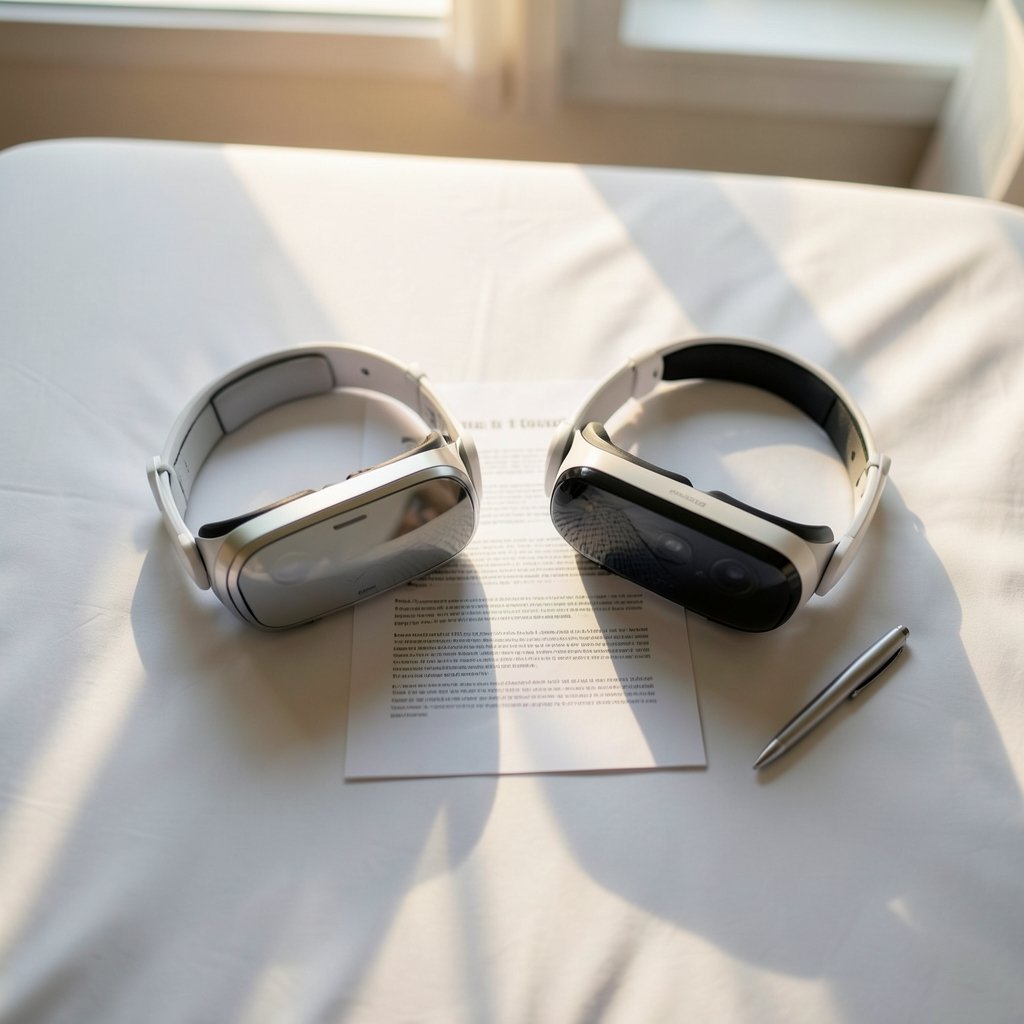
The display gap is real and it is the most defensible reason to pay Apple’s price.
| Feature | Apple Vision Pro | Meta Quest 3 |
|---|---|---|
| Display tech | Micro-OLED | LCD |
| Total pixels (claimed) | ~23 million | Lower per-eye resolution |
| Chip | M2 plus R1 co-processor | Snapdragon XR2 Gen 2 |
| Controllers | None bundled | Touch Plus included |
| Starting price at launch | $3,499 | $499.99 (128GB) |
| Passthrough | Color | Color |
Micro-OLED delivers deeper blacks and higher contrast than LCD, and the pixel density on Vision Pro is high enough that text stays legible. That matters enormously for reading documents, browsing the web, or watching a movie on a virtual screen. The R1 co-processor handles sensor input separately from the M2, which keeps passthrough latency low.
Quest 3’s LCD panels are perfectly serviceable for games and video. They are not as sharp for small text. In practice, most people notice this difference within minutes of putting both headsets on, and they notice it most when doing anything other than gaming.
The Practical Tip Nobody Mentions
Try reading a PDF on both devices before you buy. Bring a document with small print. Display specs on paper tell you less than five minutes of actual reading. This single test predicts satisfaction better than any benchmark, because text clarity is where the price gap becomes visible rather than theoretical.
Comfort, Battery, and the Reality of Wearing These Things
Both headsets are heavy enough that long sessions require breaks. Vision Pro uses an external battery pack connected by a cable, which shifts weight off your head but adds a tether to manage. Quest 3 puts the battery in the headset itself, which means more front-heavy weight but no cable.
Common mistakes buyers make:
- Judging comfort in the first ten minutes. Fit issues show up after 30 to 45 minutes, not immediately. Adjust the straps, then wear it for a full hour before deciding.
- Ignoring prescription lenses. Both platforms support corrective inserts, and skipping them leads to blurry text and eye strain that people wrongly blame on the display.
- Buying for a use case you haven’t tested. If you plan to work in the headset, test a real work session. If you plan to game, test a real game.
Vision Pro’s battery life lands in the roughly two-hour range for mixed use. Quest 3 runs similar or slightly longer depending on the app. Neither is a full workday device without a charger nearby.
Software, Apps, and the Pull of Apple Devices
This is where the two products diverge most sharply, and where buyer’s remorse is most common.
Quest 3 has a deep library of games and a growing set of productivity apps. It supports social spaces, fitness apps, and media streaming. The catalog is large because Meta has been building it since before the Quest 2 era.
Vision Pro launched with a smaller native app library but strong support for iPad and Mac apps, plus the ability to mirror a Mac display. For someone already using Apple devices, that continuity is genuinely useful. For someone who wants to play demanding VR games, it is largely irrelevant.
Apple’s app store economics have been under scrutiny, and those rules affect how developers price and distribute software. The ongoing debate around the Apple SCOTUS 27 percent App Store fee 2026 case shows how platform fees ripple into what apps exist and what they cost. Similarly, the Apple EU App Store fees game developers 2026 situation matters for anyone wondering why certain game genres arrive late or never on Apple’s platforms. (Apple Vision Pro)
Meta’s store takes its own cut, but Meta has historically subsidized hardware to grow the install base. That subsidy is the reason a $499 headset can exist at all.
Privacy and Cloud Processing
Vision Pro handles most sensor processing on-device, but Apple has expanded its cloud infrastructure for AI features. Understanding how that works is worth a few minutes of reading, and the explainer on Apple Private Cloud Compute Google Cloud 2026 covers the architecture in plain language. For privacy-minded buyers, this is a legitimate differentiator.
Gaming Versus Productivity: Pick Your Lane
Be honest about what you will actually do.
Choose Quest 3 if: you want to play VR games, you want fitness apps, you want to try mixed reality without spending a fortune, or you are buying for a household where multiple people will use it.
Choose Vision Pro if: you want a large virtual workspace, you watch a lot of video, you already use Apple devices, or you want the sharpest text available in a standalone headset.
The mistake people make is buying Vision Pro for gaming and then discovering the library is thin, or buying Quest 3 for productivity and then discovering the text is soft. Match the device to the dominant use case, not the aspirational one.
The Console Comparison Nobody Expects
It sounds odd to compare a headset to a game console, but the logic is identical: you are buying into a platform, and the platform’s library and pricing model matter more than raw specs. The debate over the PS5 Slim vs PS5 Pro comes down to whether the premium tier justifies its cost for your specific habits. The same question applies here, just with a much bigger multiplier.
If you are weighing a premium purchase generally, the breakdown of PlayStation 5 vs PlayStation 5 Pro follows the same pattern: mid-tier hardware covers most needs, and the top tier serves a narrower audience with specific demands. Supply and pricing quirks also matter, as the PS5 Pro shortage refurb price 1399 2026 story illustrates. Scarcity distorts value judgments, and headsets are not immune.
Which One Should Most People Buy?
For the average buyer, Quest 3 is the better value by a wide margin. It costs a fraction of the price, has more games, includes controllers, and delivers a genuinely good mixed reality experience. The compromises are real but manageable.
Vision Pro is the better product for a narrower group: people who will use it for work and media, who want integration with Apple’s other devices, and who can absorb the price without strain. It is not a better value. It is a better fit for a specific job.
The refurbished and secondary market complicates things further. Just as the PS5 Pro vs Slim comparison shifts when refurb units enter the picture, headset prices move too. A used Quest 3 at a discount is one of the best deals in consumer tech. A used Vision Pro is rarer and riskier, since fit and lens condition matter more.
Conclusion
Apple Vision Pro and Meta Quest 3 are not really competitors in the same weight class. One is a premium spatial computer priced for professionals and enthusiasts. The other is a mass-market mixed reality headset priced to sell. The right choice depends on what you will do in the headset, not which device wins a spec sheet.
Test both if you can. Read small text. Wear each for an hour. Then decide with your eyes and your wallet rather than the marketing copy.
Frequently Asked Questions
Is Apple Vision Pro worth the price compared to Meta Quest 3?
For most people, no. Quest 3 delivers solid mixed reality and a much larger game library for roughly one-seventh the cost. Vision Pro justifies its price only if you need sharp text for work, want integration with Apple’s other devices, and will use it regularly for productivity or media.
Can Meta Quest 3 do productivity work like Vision Pro?
Yes, but with limits. Quest 3 supports browsers, virtual monitors, and productivity apps, and it can connect to a computer. Text clarity is lower than Vision Pro’s micro-OLED displays, so long document sessions are less comfortable. It works for light tasks but is not a true desktop replacement.
Do I need controllers for either headset?
Quest 3 ships with Touch Plus controllers and most games expect them. Vision Pro ships with no controllers at all and relies on eye and hand tracking. If you mainly play games, the bundled Quest 3 controllers are a meaningful included value.
Which headset is better for watching movies?
Vision Pro wins on image quality thanks to micro-OLED contrast and high pixel density, which makes virtual screens look convincing. Quest 3 is perfectly watchable and far cheaper, so it is the better choice if movie watching is casual rather than a core reason for buying.
How long can you wear each headset before it gets uncomfortable?
Both become tiring within one to two hours for most users. Vision Pro uses an external battery that reduces head weight but adds a cable. Quest 3 carries the battery in the headset, making it front-heavy. Corrective lens inserts and proper strap adjustment make a large difference on both.
Will either headset replace my laptop or TV?
Not fully. Vision Pro comes closest for focused work and private viewing, but battery life, weight, and app limitations keep it a supplement rather than a replacement. Quest 3 is a gaming and media device first. Treat both as additions to your existing setup, not substitutes.
The takeaway is simple: buy the headset that matches the work you will actually do, not the one that photographs best in a review. Prices will keep moving, and new models will arrive, but the fundamentals here—display clarity, app libraries, and comfort over a full hour—will remain the deciding factors for years. If you are still undecided, wait. Neither device is essential, and a patient buyer almost always gets a better deal than an early adopter.