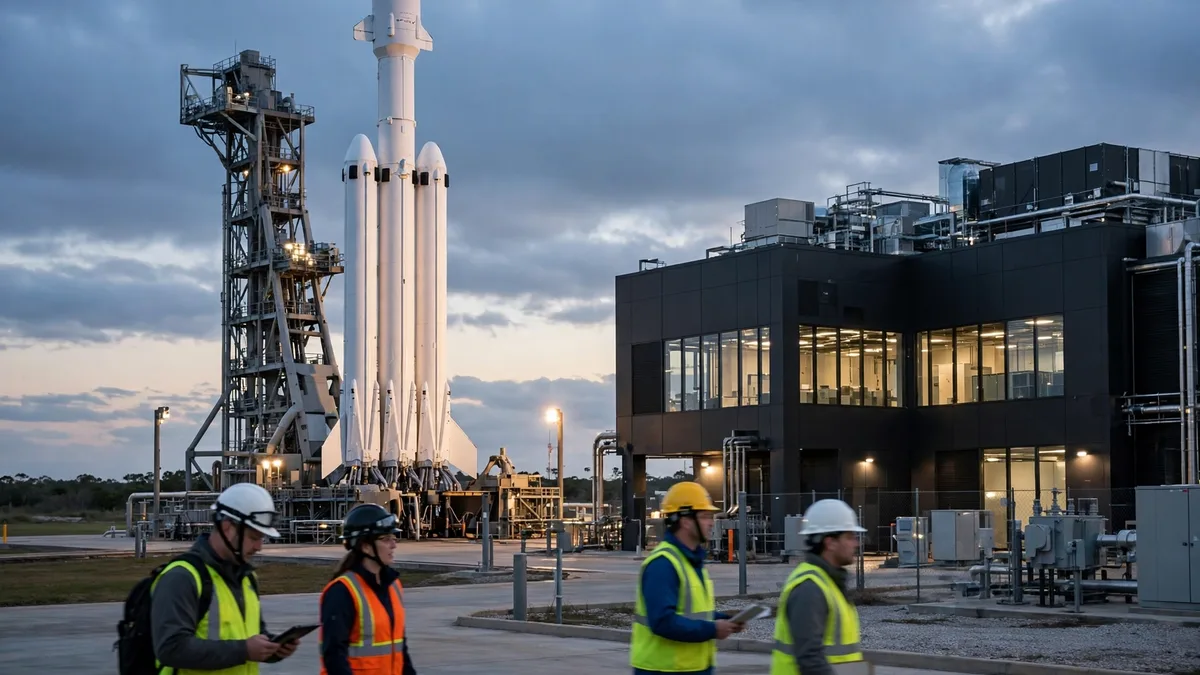
Google renting more compute from SpaceX moved from speculation to a public statement on Saturday, 28 November 2026, when Elon Musk said on X that the search giant had expressed interest in expanding the computing capacity it rents from his rocket company. The remark named no price and no volume, and neither company has announced a new agreement, yet it landed in the middle of the most expensive race in technology: securing enough computing power to train and run artificial intelligence systems.
Musk was replying to a user who suggested Google could end up buying more AI compute from SpaceX than Anthropic, the other large renter of SpaceX capacity. “Not sure who will buy more, but Google has expressed interest in renting more compute from us,” he wrote. Minutes later he added a second post about rental prices moving in opposite directions by order size.
The context matters because Google is already one of SpaceX’s largest computing customers. Under a multi-year cloud services agreement disclosed in June 2026, Google rents about 110,000 Nvidia graphics processing units, along with processors, memory and related components, and pays SpaceX $920 million a month from October 2026 through June 2029. Musk’s comment therefore points to an expansion of a relationship already worth tens of billions of dollars, not the start of a new one.
Key takeaways
- Elon Musk said on X on 28 November 2026 that Google has expressed interest in renting more compute from SpaceX.
- He gave no figure for how much more capacity Google wants, at what price, or when any expansion would happen, and no new agreement has been announced.
- Google already pays SpaceX $920 million a month for about 110,000 Nvidia GPUs under a deal running from October 2026 to June 2029.
- Musk also said rental prices for large blocks of compute configured for high-bandwidth AI training are rising, sometimes very significantly, while prices for small amounts below about 5,000 GPUs are falling.
- SpaceX is expanding capacity beyond its Memphis-area hub, with more than $74 billion planned for new facilities in Texas and Arizona.
| Item | Detail |
|---|---|
| New statement | Musk said on X on 28 November 2026 that Google has expressed interest in renting more compute from SpaceX |
| Existing monthly payment | $920 million a month from October 2026 to June 2029 |
| Capacity in the existing deal | About 110,000 Nvidia GPUs, plus CPUs, memory and related components |
| Full-term value | About $30.4 billion at the stated monthly fee |
| Termination clause | After 31 December, either side can end the deal with 90 days’ notice |
| Other large renter | Anthropic, which signed its own SpaceX compute deals in May 2026 |
| Expansion plans | More than $74 billion for new supercomputer facilities in Texas and Arizona |
What Musk Actually Said on X
The exchange began with speculation, not an announcement. A user on X suggested Google was likely to become a bigger buyer of SpaceX computing capacity than Anthropic. Musk replied in a single sentence, and the wording is worth reading carefully because it stops well short of confirming a deal. He did not say Google had signed anything, agreed a price, or committed to a volume. He said the company had expressed interest, which can mean anything from an early conversation to a negotiation already well advanced. Reuters reported that Musk, SpaceX and Google did not immediately respond to requests for comment.
The post appeared early on Saturday, 28 November 2026, at 1:52 a.m. according to the timestamp shown in coverage, before either company had issued a statement. For now, the public record consists of one sentence from Musk and the earlier filings describing the existing agreement.
At 2:01 a.m. Musk posted again, this time about pricing. He wrote that the rental price for large, coherent blocks of compute configured for high-bandwidth training was increasing, sometimes very significantly, while the price for small amounts of compute, below about 5,000 GPUs, was decreasing. He added that overall, the average rental price per GPU for SpaceX compute was rising. The two posts together tell a coherent story: demand for the largest blocks of capacity is strong enough to push prices up, and Google is among the buyers interested in more of them.
The Deal Google Already Has With SpaceX
SpaceX disclosed the Google cloud services agreement on 5 June 2026, before its public listing, and the terms were set out in regulatory filings. Google rents access to about 110,000 Nvidia GPUs, together with the central processing units, memory and other components around them, and pays $920 million a month from October 2026 through June 2029. At that monthly rate, the full term is worth about $30.4 billion, a figure calculated from the monthly fee in the filing.
Google described the arrangement as temporary bridge capacity, according to reporting on the deal, to handle unexpected demand for Gemini Enterprise, its AI platform for business customers. It was framed as a way to cover a gap while Google secures longer-term capacity, not as permanent outsourcing. A bridge can be extended, and Musk’s comment suggests Google may want it extended.

The deal also has an exit: after 31 December, either side can end it with 90 days’ notice. That gives Google room to walk away if its own capacity comes online, and SpaceX room to reallocate capacity if a better offer appears. It is one reason a statement of interest does not automatically mean a locked-in expansion.
Anthropic is the other large renter: it signed SpaceX compute deals in May 2026 covering about 325,000 Nvidia chips through May 2029. Reports differ on its exact monthly payment, so that figure is unconfirmed from the reporting reviewed here. Readers who want background on the hardware can start with what a GPU is.
Why Google Would Want More Compute
Demand for computing infrastructure has surged since generative AI services were introduced, and technology companies have responded by investing heavily in data centres equipped with advanced chips from Nvidia and other manufacturers. The bottleneck, in Musk’s account, is not the chips themselves. He has said the main constraint is power, not chips, and he named Google and Anthropic as examples of large firms leasing compute from SpaceX because of those power constraints. A data centre needs enormous amounts of electricity and cooling, and securing that power, along with land, permits and grid connections, can take longer than buying the chips.
Gemini, Google’s AI system, sits at the centre of this demand. Training large models requires vast, interconnected blocks of chips working together at high bandwidth, and serving those models to millions of users needs still more capacity. That is exactly the large-block capacity Musk said is rising in price. The regulatory side of the build-out is visible in the FCC approval for SpaceX AI data centres.
How Compute Prices Are Splitting in Two
Musk’s second post deserves attention on its own because it describes a market splitting in two. Large blocks of compute, the kind needed for high-bandwidth AI training, are getting more expensive, sometimes very significantly. Small amounts of compute, below about 5,000 GPUs, are getting cheaper. The average rental price per GPU for SpaceX compute is rising overall. Adding that capacity is not simple, as explained in why AI data centres are getting harder to build.
What SpaceX Is Building Next
SpaceX said in October that many customers were asking for compute and that it was actively building supply to meet internal and external demand. That statement, from a SpaceX executive on the 20 October earnings call, frames the expansion as a response to demand already visible before Musk’s posts.
The scale of the build-out is large. SpaceX said this month that it would spend more than $74 billion on a planned investment at a new supercomputer facility at Starbase in the Rio Grande Valley in Texas, and a second campus in Cochise County, Arizona. Those sites are in addition to the company’s existing Memphis-area hub, and they are intended to add capacity well beyond what the current facilities can provide.
What It Means for the AI Race
The immediate meaning of Musk’s comment is narrow: Google is interested in more SpaceX compute, and no deal has been announced. The wider meaning is about where the AI race is now being fought. It is no longer only a race to design better models or hire better researchers. It is also a race to secure power, buildings, chips and the operations to run them at scale, and the companies that control that infrastructure have leverage over the companies that need it.
For Google, the interest suggests its own data centre build-out has not kept pace with demand for large-block training capacity. That is a sign of how fast demand is growing, not of weakness. Every large AI company faces the same problem, and renting is one of the few ways to close the gap quickly.
Checklist: How to Read This Story
- Start with the quote: Musk said Google has expressed interest, not that a deal is signed.
- Check the existing deal: $920 million a month for about 110,000 Nvidia GPUs through June 2029.
- Look for the missing details: no volume, price or date was given for any expansion.
- Watch the pricing split: large training blocks are rising, small rentals below about 5,000 GPUs are falling.
- Follow the build-out: more than $74 billion planned for new facilities in Texas and Arizona.
- Wait for a filing or a company statement before treating an expansion as confirmed.
Frequently Asked Questions
Did Google sign a new deal with SpaceX?
No. Musk said Google has expressed interest in renting more compute, and he gave no volume, price or date. Neither company has announced a new agreement.
How much does Google already pay SpaceX?
Google pays $920 million a month from October 2026 through June 2029 under the agreement disclosed in June 2026, about $30.4 billion over the full term.
How many GPUs does the existing Google deal cover?
About 110,000 Nvidia GPUs, along with CPUs, memory and related components, under a multi-year cloud services agreement.
What did Musk say about compute prices?
He said rental prices for large blocks configured for high-bandwidth training are increasing, sometimes very significantly, while prices below about 5,000 GPUs are decreasing. Overall, the average rental price per GPU is rising.
Who else rents large amounts of compute from SpaceX?
Anthropic is the other large renter. It signed its own SpaceX compute deals in May 2026, covering about 325,000 Nvidia chips through May 2029. Reports differ on its exact monthly payment, so that figure is unconfirmed from the reporting reviewed here.
What is SpaceX building to add capacity?
SpaceX plans to spend more than $74 billion on a new supercomputer facility at Starbase in Texas and a second campus in Cochise County, Arizona, in addition to its existing Memphis-area hub.
The Bottom Line
Musk’s statement is small in words and large in implication. One sentence confirmed that Google, already paying $920 million a month for about 110,000 Nvidia GPUs, wants more SpaceX compute. It did not confirm a deal, a price or a timetable, and until a filing or company statement appears, the expansion should be treated as interest rather than fact.
The story to watch now is whether interest turns into a signed expansion, and on what terms. If it does, it will show that even the largest technology companies need outside help to meet AI demand. If it does not, it will show that interest alone is not a deal. Either way, the next filing or statement from either company will matter more than the next post.