
Sony launched the PS5 Pro on November 7, 2024, at $699.99, a price that raised eyebrows because it landed squarely in entry-level gaming PC territory. That collision of price points turned a simple hardware question into a genuinely interesting one: when a console costs as much as a starter desktop, what exactly are you paying for? The answer depends far less on raw specs than most people expect, and far more on how you actually play.
The Short Version: Two Different Products, Not Two Tiers of One
A gaming PC and a PS5 Pro are not competing versions of the same thing. They overlap in the middle, but they’re built around different assumptions.
The PS5 Pro is a fixed, sealed box tuned for one job: running PlayStation games at high frame rates and sharp resolutions on a TV. It has no upgrade path, no storefront competition, and no settings menus to wrestle with. A gaming PC is a platform. It runs games from multiple stores, doubles as a workstation, and can be upgraded part by part over years. (PlayStation 5 Pro)
That distinction matters more than any benchmark. A person who wants to sit on a couch, press a button, and play has very different needs from someone who wants to tinker, mod, and run a dozen windows at once.
What the PS5 Pro Actually Brings to the Table
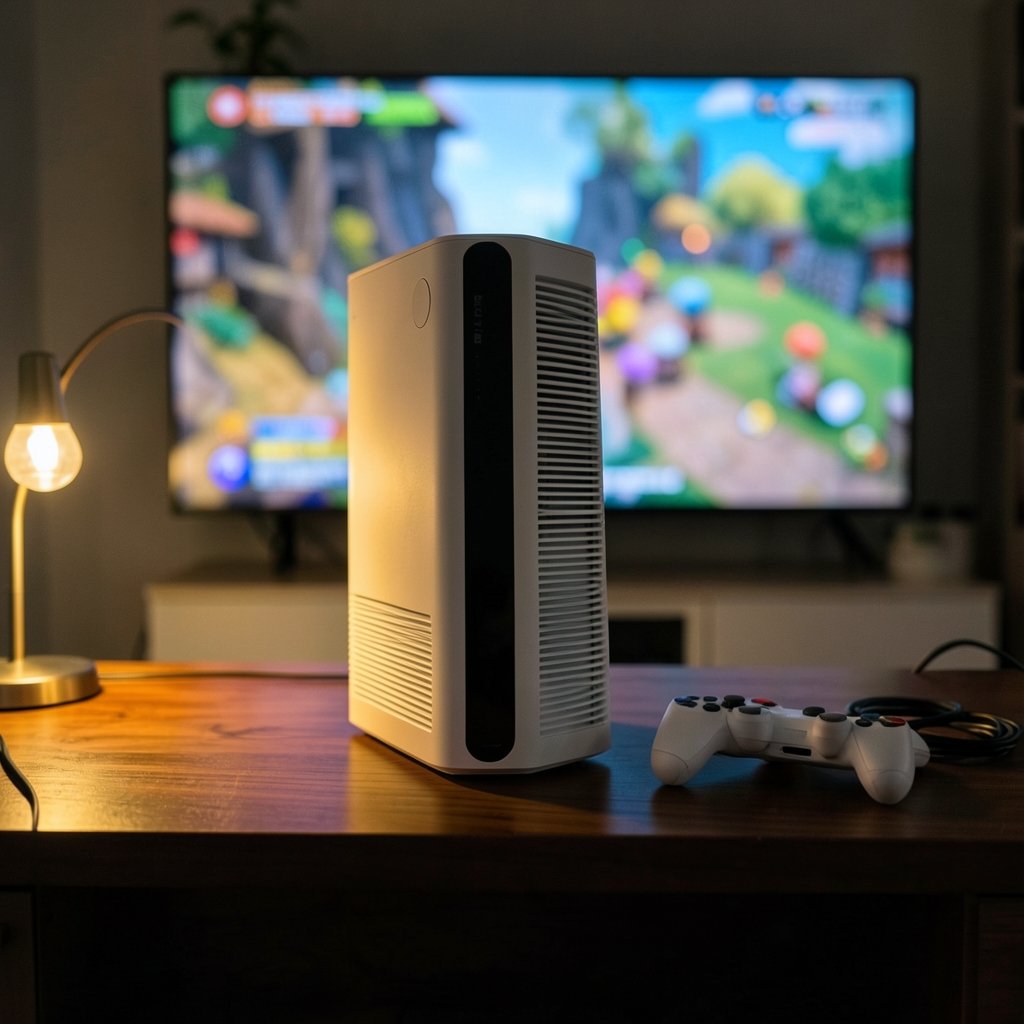
Sony’s pitch for the PS5 Pro rests on three pillars, and it’s worth being precise about them because marketing language tends to blur the details.
A Bigger GPU, Not a New CPU
Sony cited a GPU with roughly 67% more compute units and 28% faster memory than the base PS5. That’s a meaningful jump. What’s easy to miss is that the CPU is essentially the same architecture with a modest clock bump. Sony’s own materials leaned heavily on graphics gains, and that tells you where the console’s ceiling sits: it’s a machine built to push pixels, not to simulate sprawling worlds at 120 frames per second.
PSSR: The AI Upscaler
The headline feature is PSSR (PlayStation Spectral Super Resolution), Sony’s AI-driven upscaler. In practice, PSSR lets games render at a lower internal resolution and reconstruct a sharp 4K-style image. This is the same broad idea as DLSS on Nvidia cards and FSR on AMD cards, and it’s the single biggest reason the PS5 Pro looks better than a base PS5 on a 4K television.
Game Boost and Enhanced Titles
Sony said over 50 games would be enhanced at launch, with a “PS5 Pro Game Boost” mode improving performance for many existing PS4 and PS5 titles. This is genuinely useful for people with large libraries, but it’s also where expectations get inflated. Not every game gets a patch, and unpatched games benefit inconsistently.
The Hidden Costs
Two things are not in the box: a disc drive and a vertical stand. Both are sold separately. If you own physical games or want to play Blu-rays, budget for the drive. This is a small detail that quietly changes the value math, and it’s the kind of thing buyers discover after the fact.
What a Gaming PC Brings That a Console Can’t
A PC’s advantages aren’t about winning a spec sheet. They’re structural.
Upgradability is the big one. Swap a GPU in three years and the rest of the machine keeps working. Storefront competition matters too: Steam, Epic, GOG, and frequent deep discounts mean software costs less over time. Modding opens up entire categories of content that never reach consoles. And a PC is a general-purpose tool, handling work, streaming, and creative software in the same box.
The tradeoff is friction. Drivers need updating. Settings need tuning. Some games ship with stutter issues that console versions avoid entirely. The PC’s flexibility is real, but so is the maintenance burden.
Head-to-Head Comparison
| Factor | PS5 Pro | Gaming PC |
|---|---|---|
| Upfront cost | $699.99 plus optional disc drive and stand | Highly variable; entry builds often cost more once monitor and OS are included |
| Setup effort | Plug in and play | Build or configure, install OS and drivers |
| Performance ceiling | Fixed for the generation | Rises with upgrades |
| Game library | PlayStation exclusives plus third-party | Broadest library, multiple storefronts, mods |
| Upgradability | None | Component by component |
| Best display fit | 4K TV | Monitor, any resolution and refresh rate |
| Longevity | Until the next console generation | Indefinite with periodic upgrades |
Notice what’s absent: a clean performance verdict. Claims that the PS5 Pro matches a specific PC GPU tier are contested, and they depend heavily on the workload, the resolution, and whether upscaling is in play. PSSR versus DLSS versus FSR produces different results in different games. Anyone offering a tidy equivalence is oversimplifying.
The Cost Conversation Is Messier Than It Looks
The tempting comparison is sticker price versus sticker price. It rarely holds up.
A PC build needs a monitor, keyboard, mouse, and an operating system license, unless you already own them. A console needs a TV, which most households already have. On the other hand, a PC’s games are cheaper over time, online play doesn’t require a subscription, and the machine does double duty as a work computer.
There’s also timing. GPU prices swing with supply, demand, and tariffs, so a “comparable build” cost is a moving target that varies by region and month. The $699.99 figure is the 2024 US launch price and may not reflect current pricing. If you’re shopping now, verify live prices rather than trusting any published comparison, including this one.
For a deeper breakdown of how the console’s pricing has shifted in practice, including refurbished market dynamics, see this analysis of the PS5 Pro shortage and refurb pricing.
Performance in the Real World
Here’s where practical experience beats spec sheets.
On a 4K television, the PS5 Pro’s advantages are visible and immediate. Games that ran at 30 frames per second on base hardware often hit 60 with PSSR reconstruction that looks close to native 4K. The improvement is largest on a big screen, where resolution differences are obvious.
On a desk with a 1440p or 1080p monitor, the calculus changes. A mid-range PC can push high frame rates at those resolutions comfortably, and competitive players often prefer the higher refresh rates a PC enables.
The honest framing: the PS5 Pro is optimized for a living room with a large 4K display. A PC is optimized for flexibility. Neither is universally faster.
If you’re weighing the console against its own siblings, the PS5 Pro vs PS5 specs comparison lays out exactly where the extra money goes. And if you’re deciding between console models rather than platforms, the PS5 Slim vs PS5 Pro breakdown is a useful starting point. (PlayStation 5 Pro)
Common Mistakes Buyers Make
A few patterns show up again and again, and avoiding them saves real money.
Comparing a self-built PC to a console without counting peripherals. The console’s price includes everything needed to play if you own a TV. A PC’s doesn’t.
Assuming the Pro is a generational leap. It isn’t. It’s a mid-generation refresh with a stronger GPU and a better upscaler. Games built for base PS5 still run on base PS5.
Buying a high-end PC for a 1080p monitor. This is the most common waste of money in PC building. Match the hardware to the display, not to a benchmark chart.
Ignoring the disc drive. If you have a physical library, that’s an added cost that changes the comparison.
Forgetting about the subscription. Online play on PlayStation requires a paid membership. On PC, it doesn’t.
Overestimating future-proofing. No PC is future-proof. What a PC offers is the option to upgrade, which is different from immunity to aging.
Which Should You Buy?
The decision comes down to a handful of questions, and they’re mostly about lifestyle rather than hardware.
Choose the PS5 Pro if you play on a large 4K TV, prefer zero setup friction, want PlayStation exclusives on day one, and don’t care about mods or tinkering. The price is high, but the experience is seamless.
Choose a gaming PC if you want the widest game library, plan to upgrade over time, need the machine for work or creative tasks, or care about high refresh rates and modding. Expect more setup effort and a higher total cost once peripherals are counted.
There’s also a third option worth naming: a base PS5 plus a modest PC often covers more ground than either alone, and it’s frequently cheaper than a high-end build.
For a broader platform comparison that includes the competition, the PS5 Pro vs Xbox Series X analysis covers how the console landscape looks beyond Sony’s own lineup.
Conclusion
The PS5 Pro versus gaming PC question doesn’t have a universal winner, and anyone claiming otherwise is selling something. Sony built a machine that maximizes image quality on a 4K television with almost no user effort, and it charges a premium for that convenience. A PC trades that convenience for flexibility, a wider library, and a performance ceiling that rises whenever you decide to upgrade.
The right call depends on your display, your tolerance for setup, and whether you’ll actually use the PC for anything beyond games. Match the hardware to how you live, not to a benchmark chart, and the decision becomes much simpler than the spec sheets suggest.
FAQ
Does the PS5 Pro deliver more performance than a gaming PC?
No single answer applies. The PS5 Pro is a fixed platform with a GPU roughly 67% larger than the base PS5’s and an AI upscaler called PSSR. A high-end gaming PC will outperform it comfortably. A budget PC may not. Claims that the Pro matches a specific GPU tier are disputed and depend heavily on the game, resolution, and upscaling method used.
Is the PS5 Pro worth $699.99?
It depends on your setup. If you have a large 4K television and want the best-looking PlayStation experience with zero configuration, the value is straightforward. If you play on a 1080p monitor or already own a capable PC, the money is usually better spent elsewhere. Remember that the disc drive and vertical stand cost extra.
Does the PS5 Pro include a disc drive?
No. The PS5 Pro ships without a disc drive and without a vertical stand. Both are sold separately. If you own physical games or want Blu-ray playback, factor that into the total price before comparing it to a PC build.
Can a gaming PC at the same price beat the PS5 Pro?
Often in raw performance, rarely in total cost. A PC at a similar price typically needs a monitor, keyboard, mouse, and operating system license, which pushes the real total higher. The PC’s advantage shows up over time through cheaper games, no online subscription, and upgradability rather than in the initial purchase.
What is PSSR on the PS5 Pro?
PSSR stands for PlayStation Spectral Super Resolution. It’s Sony’s AI-based upscaling technology, which renders games at a lower internal resolution and reconstructs a sharper image. It’s conceptually similar to DLSS on Nvidia graphics cards and FSR on AMD cards, and it’s the main reason the PS5 Pro looks noticeably sharper than a base PS5.
Should I buy a PS5 Pro or upgrade my PC?
If you already own a PC with a decent GPU, a targeted upgrade such as a new graphics card usually delivers more performance per dollar than adding a console. If you don’t own a gaming PC at all and play primarily on a television, the PS5 Pro is the simpler and often cheaper path to high-quality 4K gaming.