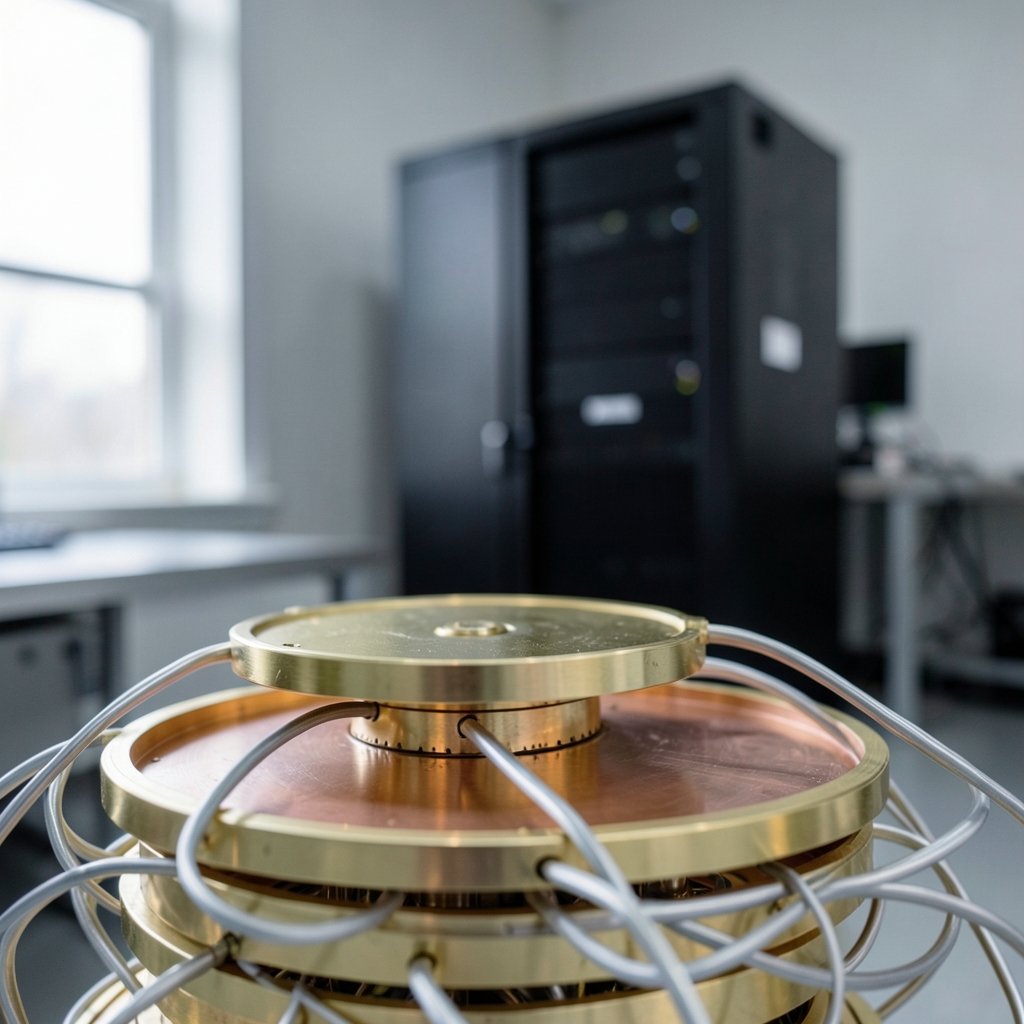
In 2019, a Google processor called Sycamore finished a sampling task in about 200 seconds. Google estimated the same job would take a classical supercomputer roughly 10,000 years. IBM quickly pushed back, arguing that with enough disk storage and smarter classical methods, the gap was far smaller. That fight is the whole story of quantum computing vs classical computing in miniature: a stunning claim, a serious rebuttal, and a field still arguing about what counts as a win.
The Bit and the Qubit: A Difference You Can Feel
A classical computer runs on bits. Each bit is a 0 or a 1, and that’s the end of it. Every photo, spreadsheet, and video game on your laptop is built from billions of these switches flipping in sequence.
A qubit plays by different rules. It can be 0, 1, or a superposition of both at once, described by complex amplitudes. That sounds like magic, but it’s really a statement about probability and phase. The practical consequence is that a quantum computer explores many computational paths simultaneously, then collapses to a single answer when measured.
The catch hides in that word “measure.” You get one answer per run. Quantum algorithms aren’t magic shortcuts; they’re carefully designed interference patterns that make wrong answers cancel out and right answers amplify. If you want the mechanics in plain language, a solid primer on what quantum computing is and how it works is worth twenty minutes.
Where Quantum Actually Wins: Two Algorithms That Matter

Most quantum hype collapses under scrutiny. Two algorithms survive it.
Shor’s algorithm, published by Peter Shor in 1994, factors large integers in polynomial time. Classical factoring is slow enough that RSA encryption depends on it. A large enough fault-tolerant quantum computer would break RSA. Not “might.” Would.
Grover’s algorithm, from Lov Grover in 1996, searches an unsorted list with a quadratic speedup. It’s less dramatic than Shor but applies far more broadly, from database search to optimization subroutines.
Notice what’s missing: quantum computers are not faster at everything. They’re not faster at email, video editing, or running a web server. They’re faster at a narrow set of problems with specific mathematical structure. This is the single most misunderstood point in the entire debate, and it’s why a direct quantum computing vs classical computing comparison always comes down to the workload, not the machine.
A Side-by-Side Comparison That Holds Up
| Feature | Classical Computing | Quantum Computing |
|---|---|---|
| Basic unit | Bit (0 or 1) | Qubit (superposition of 0 and 1) |
| Error behavior | Rare, correctable with checksums | Constant, requires full error correction |
| Best at | General-purpose logic, memory, I/O | Factoring, simulation, some optimization |
| Maturity | Decades of production tooling | Research labs and early cloud access |
| Scaling challenge | Heat and power density | Decoherence and gate fidelity |
| Operating temperature | Room temperature | Often near absolute zero (superconducting) |
| Programming model | Deterministic instructions | Circuits, shots, and probabilistic results |
| Current status | Ubiquitous | NISQ: noisy, intermediate-scale |
That last row matters most. The NISQ era describes today’s devices: enough qubits to be interesting, too much noise to be reliably useful for problems classical machines can’t already handle.
The Error Correction Wall
Here’s the part marketing decks skip. Qubits are fragile. They lose their state through decoherence when heat, vibration, or stray electromagnetic fields interfere. A single logical qubit might require hundreds or thousands of physical qubits to protect it through error-correcting codes.
The threshold theorem says fault-tolerant quantum computing is possible if physical error rates fall below a certain threshold. That threshold varies by code and hardware assumptions, so any single number quoted online should be treated as context-dependent. The overhead, though, is not in dispute: error correction is expensive.
Practical advice for anyone evaluating quantum claims: when a company announces a breakthrough, ask whether they demonstrated a logical qubit that outperforms its constituent physical qubits, and whether the result is peer-reviewed. Those two questions filter out most noise. For a running view of where the field stands, tracking the latest breakthroughs in quantum computing is more useful than reading press releases in isolation.
Quantum Supremacy: A Contested Trophy
The 2019 Sycamore announcement is the most cited “supremacy” result, and also the most contested. Google’s team reported the sampling task in roughly 200 seconds against an estimated 10,000 classical years. IBM’s rebuttal argued the classical estimate was too pessimistic, and later tensor-network simulation work narrowed the gap further on similar tasks.
The honest reading: quantum supremacy is time-sensitive and hardware-specific. A result that beats classical simulation today may not beat it in three years, because classical algorithms improve too. Supremacy demonstrations also tend to use contrived sampling problems with no practical application. That’s fine for physics, but it’s not a product.
If you want the broader trajectory rather than one headline, the background on quantum computing versus classical computing helps separate genuine milestones from marketing.
Hardware: No Consensus Winner
Four platforms dominate the research landscape, and each has real tradeoffs.
- Superconducting circuits lead on gate speed and manufacturing maturity, but need dilution refrigerators near absolute zero.
- Trapped ions offer excellent fidelity and connectivity, at the cost of slower gates.
- Photonic systems run at room temperature and suit networking, but photon loss is brutal.
- Neutral atoms scale well in arrays and are advancing fast, though control precision remains a work in progress.
Nobody knows which wins. Anyone who tells you otherwise is selling something.
What Classical Computing Still Does Better (Almost Everything)
It’s worth being blunt. Classical computers win on general-purpose logic, memory hierarchy, I/O throughput, cost per operation, and tooling maturity. Every quantum computer built today is controlled by a classical computer. Classical machines handle the calibration, the error decoding, and the result processing.
Quantum advantage is problem-specific. For 99% of real workloads, a classical CPU or GPU is adequate—and dramatically better. This is the practical takeaway most articles bury: you don’t replace classical computing with quantum computing, you attach it.
The Cryptography Clock
Shor’s algorithm creates a genuine deadline. Encrypted data captured today could be decrypted later by a future quantum computer, a threat model called “harvest now, decrypt later.” NIST has run a multi-year post-quantum cryptography standardization process to replace vulnerable schemes, and organizations with long-lived sensitive data are already migrating.
This is the one area where quantum computing’s impact is concrete and near-term, even without a working cryptographically relevant quantum computer. For a deeper look at how the two paradigms differ architecturally, this comparison of quantum and classical computing covers the systems-level view. (IBM Quantum)
Common Mistakes People Make
A few traps show up again and again.
Assuming quantum is faster, full stop. It isn’t. Speedups come from specific algorithmic structure.
Ignoring the classical simulation baseline. Every quantum advantage claim should be measured against the best classical algorithm, not the naive one.
Confusing qubit count with capability. A thousand noisy qubits can be less useful than a hundred good ones with better connectivity and fidelity.
Treating announcements as peer-reviewed results. Many milestones are preprints. Wait for replication.
Overlooking the software gap. Quantum programming tools are immature. Compilers, debuggers, and error mitigation libraries are still being built.
What Actually Works in Practice
For teams evaluating the space, the pragmatic approach is straightforward. Start with classical simulation of quantum circuits on GPUs to prototype algorithms. Use cloud quantum access to test small instances. Track logical qubit milestones rather than physical qubit counts. And keep post-quantum cryptography migration on the roadmap regardless of hardware timelines.
There’s also a quiet convergence happening. Quantum machine learning research overlaps heavily with classical AI, and the boundary is blurring. If that interests you, how quantum computing could change artificial intelligence is a reasonable place to start, and the emerging field of quantum AI covers the algorithmic side. Meanwhile, neuromorphic computing offers a third path that borrows from biology rather than quantum mechanics. (Quantum computing)
Conclusion
Quantum computing vs classical computing is not a fight to the death. It’s a division of labor that hasn’t fully arrived yet. Classical machines remain the workhorses of modern civilization, and they will stay that way for the foreseeable future. Quantum machines offer genuine, mathematically proven advantages on a narrow but important set of problems, provided the error correction problem gets solved at scale.
The realistic near-term picture: hybrid systems, where classical processors orchestrate and quantum co-processors accelerate specific subroutines. The realistic long-term picture: cryptography migration now, optimization and simulation gains later, and a lot of hype to filter along the way. Patience, in this field, is a competitive advantage.
FAQ
What is the main difference between quantum and classical computing?
Classical computers use bits that are either 0 or 1 and process them sequentially through deterministic logic gates. Quantum computers use qubits that can exist in superposition, allowing them to explore many computational states at once through interference. The difference isn’t raw speed; it’s the type of problem each machine handles well.
Is quantum computing always faster than classical computing?
No. Quantum computers offer proven speedups for specific problems like integer factoring and unstructured search. For general-purpose tasks such as word processing, web serving, or video editing, classical computers are dramatically faster and cheaper. Quantum advantage is problem-specific, not universal.
What is quantum supremacy and is it real?
Quantum supremacy refers to a quantum device completing a task faster than any classical computer can. Google’s 2019 Sycamore result is the best-known example, but IBM disputed the classical runtime estimate, and later classical simulation work narrowed the gap. These claims are time-sensitive and hardware-specific, and the tasks used are usually not practically useful.
Why do quantum computers need error correction?
Qubits lose their state through decoherence caused by heat, vibration, and electromagnetic interference. Error-correcting codes can protect quantum information, but they require many physical qubits per logical qubit. The threshold theorem states that fault-tolerant quantum computing is possible if physical error rates fall below a certain threshold, which varies by code and hardware.
Will quantum computers break encryption?
A sufficiently large fault-tolerant quantum computer running Shor’s algorithm could break RSA and similar public-key schemes. That machine doesn’t exist yet, but the risk model called “harvest now, decrypt later” means long-lived sensitive data is already exposed. NIST has run a post-quantum cryptography standardization effort to address this, and migration is underway.
Do I need to replace my classical computer with a quantum one?
No. Every quantum computer today is controlled by classical hardware, and classical machines handle calibration, error decoding, and result processing. The realistic future is hybrid: classical processors orchestrating quantum co-processors for specific accelerated subroutines. For nearly all workloads, classical computing remains the better choice.
The hybrid model is already visible in cloud offerings: classical orchestration layers submitting circuits, queuing shots, and post-processing results. That architecture is likely to persist even after fault tolerance arrives, because the surrounding control stack is classical by necessity.
Watch three signals over the next few years: logical qubit counts that beat their physical constituents, error rates crossing published thresholds for specific codes, and classical simulation baselines that quantum hardware struggles to match. Progress on any one is meaningful; progress on all three is transformative. Until then, the sensible posture is informed skepticism, steady investment in post-quantum cryptography, and experimentation confined to problems where the mathematics genuinely favors quantum machines. The field rewards patience, and the division of labor between the two paradigms will be settled by evidence, not announcements.