Can a $15 smart plug really handle a space heater? That question sits behind more singed sockets and tripped breakers than almost any other issue in home automation. The answer is more interesting than a simple yes or no, because the number printed on the box is rarely the whole story.
Most smart plugs are rated somewhere between 10 and 15 amps, which sounds generous until you translate it into watts and realize a single portable heater can eat the entire allowance. Understanding maximum load means understanding three separate limits that all apply at once: the plug itself, the wall circuit behind it, and the appliance you plug in. Get any one of those wrong and the weakest link fails, usually quietly, usually warm to the touch.
What Does Maximum Load Actually Mean on a Smart Plug?
Maximum load is the highest amount of electrical power a smart plug is designed to pass through continuously without overheating. Manufacturers usually express it in amps (current) rather than watts, which is where a lot of confusion starts. To convert, multiply amps by your local mains voltage.
| Region | Typical plug rating | Mains voltage | Approximate watt limit |
|---|---|---|---|
| United States | 15 A | 120 V | 1,800 W |
| United Kingdom | 13 A | 230 V | 3,000 W |
| European Union | 10–16 A | 230 V | 2,300–3,680 W |
Those figures are the plug’s own ceiling, not a promise that everything below them is safe. The rating assumes a resistive load, meaning a device that draws current steadily, like a lamp or a kettle. It does not assume a motor, a compressor, or anything with a surge.
It also assumes the plug is installed correctly, in a circuit that can supply that current, and that the plug is genuine. Counterfeit units with fake certification marks exist, which is why checking the certification body’s own database matters more than trusting the logo printed on the plastic.
Why Amps and Watts Get Confused So Often
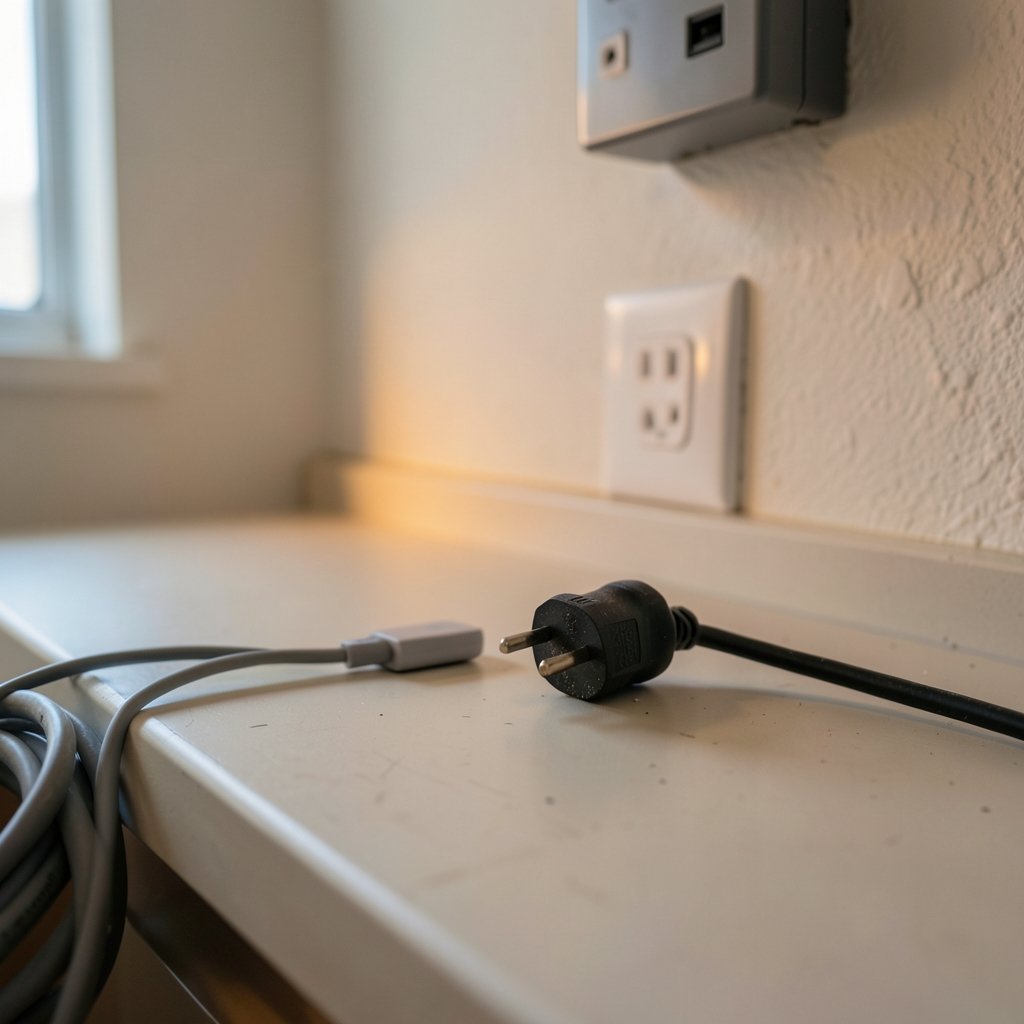
Shoppers see “15 A” on a US plug and “3,000 W” on a UK plug and assume the UK product is twice as powerful. It isn’t. The UK plug simply runs on a higher voltage, so the same current delivers more power. This is the single most common misunderstanding in the category.
The practical rule: watts = amps × volts. A 15 A plug on a 120 V circuit is capped near 1,800 W. A 13 A plug on a 230 V circuit is capped near 3,000 W. Neither plug cares about the other’s number.
There is a second layer too. The wall circuit may be the tighter constraint. In many homes the breaker or fuse protecting the outlet is rated lower than the plug’s maximum, and a licensed electrician is the only person who can confirm which limit binds in your specific wiring. If you are building out a connected home and want devices that play nicely with these limits, a sensible starting point is a curated list of the best smart home devices for beginners, which tend to be low-draw by design.
Resistive vs. Inductive Loads: The Difference That Melts Plugs
This is where real-world failures happen. A resistive load draws current in a steady, predictable way. An inductive load contains a motor, compressor, or transformer, and it pulls a brief inrush current at startup that can be several times its running current.
| Load type | Examples | Behavior |
|---|---|---|
| Resistive | Lamps, kettles, irons, fan heaters on high | Steady draw, matches rating |
| Inductive | Fridges, freezers, pumps, power tools, dehumidifiers | High startup surge, lower running draw |
| Electronic | TVs, chargers, LED drivers | Low draw, sensitive to relay type |
A plug rated for 13 A of resistive load may be unsafe for a fridge whose compressor spikes well above that for a fraction of a second, every time it kicks in. Many manufacturers publish a separate, lower motor rating, but plenty do not. When the datasheet is silent, assume the plug is not intended for motor loads and choose a different control method.
This matters for anyone automating appliances. Guides on the best smart thermostats to save energy often recommend pairing heating control with smart plugs for portable heaters, and that advice only holds if the heater’s draw stays comfortably under the plug’s continuous rating.
The 80 Percent Rule Nobody Mentions
Electrical codes in many jurisdictions treat a load running for three hours or more as continuous, and continuous loads are typically limited to 80 percent of the circuit’s rating. That principle is a useful safety margin even where it isn’t legally required for the plug itself. (OSHA Electrical Safety)
In practice, this means a plug rated at 1,800 W should carry roughly 1,440 W of long-running load, not the full figure. A space heater running all evening is exactly that scenario. A lamp that is on for two hours is not.
Manufacturers rarely publish duty-cycle curves, so the 80 percent habit is a judgment call rather than a spec. It is, however, the difference between a plug that lasts years and one whose internal relay welds itself closed after a winter.
Metering Plugs Have a Lower Ceiling
Energy-monitoring smart plugs are genuinely useful, but they add components: a current-sensing shunt and often a bulkier relay. Many metering models carry a lower maximum load than the plain switch version of the same brand.
If you are comparing products, check both figures. A plug that reports watts beautifully but tops out lower than you need is a trap. The same caution applies across categories, which is why roundups such as this guide to the best smart speakers for home automation stress checking the actual spec sheet rather than the marketing headline.
Common Mistakes People Make With Smart Plugs
Mistake one: trusting the box over the label. The retail box says “max 16 A.” The label on the plug body says 10 A. The label wins, every time.
Mistake two: daisy-chaining. Plugging a smart plug into a power strip, or a power strip into a smart plug, stacks limits and creates loose connections. Neither device was evaluated for that arrangement.
Mistake three: ignoring the appliance’s startup behavior. A chest freezer that draws 1.5 A running might spike to 10 A on compressor start. The running figure is the one people check; the startup figure is the one that matters.
Mistake four: covering the plug. Smart plugs sit low on the wall, behind furniture, under rugs. Heat has nowhere to go. If the plug is warm to the touch in normal operation, it is working too hard.
Mistake five: buying uncertified units. Look for UL or ETL listing in North America and CE or UKCA marking in Europe, then verify the mark through the certifier’s database. A logo is not proof.
How to Calculate Your Own Safe Limit
Follow these steps before plugging anything expensive or heat-producing into a smart plug.
- Find the appliance’s rated wattage on its label or manual.
- If only amps are given, multiply by your mains voltage to get watts.
- Check the smart plug’s label for its rated current and voltage.
- Convert the plug’s rating to watts using the same method.
- Apply an 80 percent margin if the appliance runs for three hours or more.
- Confirm the appliance is resistive. If it has a motor or compressor, look for a separate motor rating or choose another solution.
- Verify the wall circuit’s breaker rating is at least as high as the plug’s rating.
If any step leaves you uncertain, the safe answer is a dedicated circuit or a purpose-built controller rather than a plug.
Where Smart Plugs Genuinely Shine
None of this is an argument against smart plugs. It is an argument for using them where they are strongest: lamps, fans, holiday lighting, coffee makers, irons on a timer, and anything that benefits from scheduling or remote shutoff. Automation platforms increasingly handle the logic side, and the broader shift toward on-device processing, explored in this explainer on Apple private cloud compute and Google cloud in 2026, means more of that scheduling happens locally and reliably even when the internet drops.
For heavier appliances, a hub-based approach with proper relays is often the better architecture. Devices like the Home Center Lite smart home hub exist precisely because some loads need more than a plug can offer. And if a plug failure ever does cause damage, knowing what your policy covers before you need it is worth an afternoon; this breakdown of home and household insurance coverage options is a reasonable place to start.
Security-minded buyers should note that plugs controlling locks or entry lighting sit in a different risk category. The best smart locks for home security run on their own power for good reason, and no one should route a lock’s power through a plug rated for a table lamp. (AC power plugs and sockets)
Conclusion
Smart plug maximum load comes down to three numbers that must all agree: the plug’s rated current, the circuit’s capacity, and the appliance’s actual draw, including startup surge. Amps are not watts, resistive loads are not motors, and the box is not the label. Respect the 80 percent margin for long-running devices, verify certification, and keep heat-producing appliances on dedicated control rather than a general-purpose plug. Do that, and the humble smart plug becomes one of the safest and most useful pieces of automation in the house.
Frequently Asked Questions
Can a smart plug handle a space heater?
Usually not safely. A typical 1,500 W space heater consumes most or all of a 15 A plug’s 1,800 W ceiling on a 120 V circuit, leaving no margin for continuous operation. Many manufacturers explicitly exclude heaters. Use a plug rated well above the heater’s draw, or better, a heater with built-in smart control.
What happens if I exceed a smart plug’s maximum load?
The internal relay and housing heat up. In mild cases the plug fails and stops switching. In worse cases the relay welds closed, the plastic deforms, or the plug scorches the outlet. Breakers protect wiring, not the plug, so the plug can overheat before the breaker ever trips.
Is a 15 A smart plug the same as 1,800 W?
Only on a 120 V circuit. Watts equal amps multiplied by volts, so 15 A at 120 V is 1,800 W, while 15 A at 230 V is roughly 3,450 W. Always check the voltage stated on the plug’s label alongside the current rating.
Can I use a smart plug with a fridge or freezer?
Risky without a published motor rating. Compressors draw a large inrush current at startup that can exceed a plug’s resistive rating even when running draw looks modest. If the datasheet lists no inductive or motor rating, the plug is not intended for that load.
Why is my smart plug warm to the touch?
Some warmth is normal, but a plug that is noticeably hot is carrying more current than it comfortably should, is poorly ventilated, or is failing. Unplug it, check the appliance’s draw against the plug’s rating, and stop using the plug if the heat persists at low load.
Do I need an electrician to check my circuit’s capacity?
For anything drawing high current continuously, yes. Breaker and fuse ratings, wire gauge, and shared circuit loads are not things to estimate from a label. A licensed electrician can confirm which limit binds first in your home before you add a high-draw appliance to a smart plug.