Why does a four-piece kitchen appliance bundle often cost less than buying the same fridge, range, dishwasher, and microwave one at a time, yet still leave some buyers feeling like they paid too much? The answer isn’t a secret discount code. It comes down to how bundles are priced, what they quietly exclude, and whether the individual machines inside them are actually the ones you want. Get those three things right and a bundle can be a genuinely smart purchase. Get them wrong and you’ve saved $400 up front only to spend $600 on a warranty you didn’t need and a delivery fee nobody mentioned.
This guide walks through how bundles really work, where the savings hide, and the mistakes that turn a good deal into a headache.
What a Kitchen Appliance Bundle Actually Is
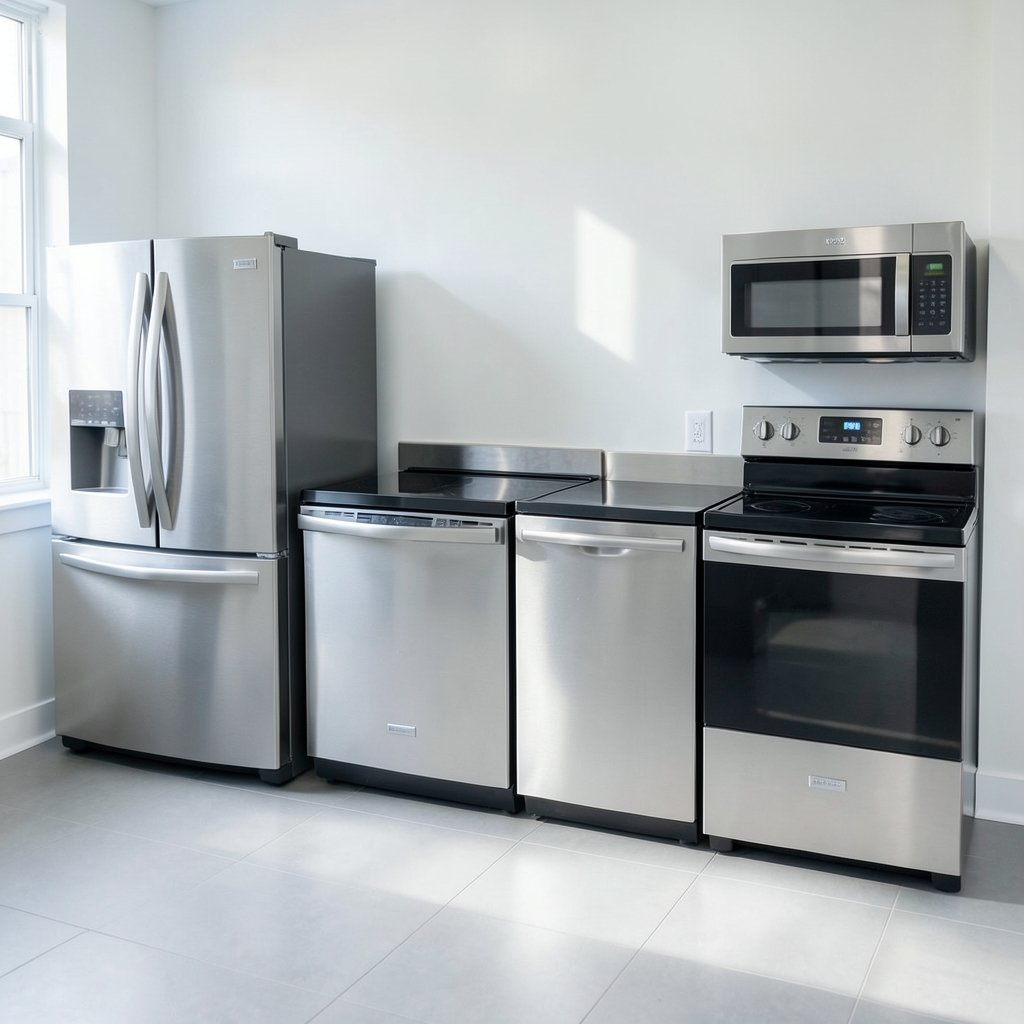
A kitchen appliance bundle is a group of appliances sold together by a retailer, usually at a combined price that’s lower than the sum of the individual sticker prices. The most common package is the “kitchen suite”: refrigerator, electric or gas range, over-the-range or countertop microwave, and dishwasher. Some retailers add a range hood, a garbage disposal, or a wine cooler to push the total higher.
Here’s the part most shoppers don’t realize: there is no regulated definition of a bundle. No agency decides what must be inside one, how the discount must be calculated, or what warranty terms apply. That means two retailers can advertise a “4-piece kitchen package” and mean completely different things. One might include a mid-tier dishwasher; another might include the cheapest model in the lineup to hit a price point.
Because bundle terms are set entirely by the retailer, the fine print is where the real story lives. Delivery, installation, haul-away of old units, and warranty coverage are frequently itemized separately, and those fees can swing by hundreds of dollars between stores. Two bundles with identical appliance lists can end up costing very different amounts once the extras are added in.
Where the Savings Actually Come From

Retailers don’t discount bundles out of generosity. The economics work in a few predictable ways.
First, volume purchasing. A store that commits to buying thousands of a specific refrigerator model gets better pricing from the manufacturer, and some of that margin gets passed along when the unit is sold as part of a multi-appliance package. Second, attachment rate. Selling four appliances to one customer is far cheaper than marketing to four separate customers, so the store can afford a thinner margin per unit. Third, inventory clearing. Bundles are a convenient way to move last year’s models or less popular finishes without slapping a clearance tag on them.
The practical upshot: the deepest bundle discounts usually land on mid-range and outgoing models, not on the newly released flagship appliances. If you have your heart set on this season’s newest French-door refrigerator, expect a smaller bundle discount, or none at all.
| Buying Method | Typical Advantage | Typical Catch |
|---|---|---|
| Full bundle from one retailer | Lowest combined sticker price, one delivery | Limited model choice, fees may be bundled in |
| Mix and match across stores | Exact models you want | Separate delivery fees, no combined discount |
| Bundle plus extended warranty | Single service contract | Often duplicates manufacturer coverage |
| Bundle during a holiday sale | Extra stacking discounts | Popular models sell out fast |
Check the Energy Numbers Before the Price Tag
A bundle discount of a few hundred dollars can be erased over several years by a machine that drinks electricity. This is where shoppers get lazy: they compare the bundle price to the individual price and stop there.
The EnergyGuide label, required on many new appliances, shows estimated annual energy use or cost, which lets you compare units inside a bundle against each other. In the US, the Energy Star program sets efficiency criteria for refrigerators, dishwashers, and ranges, and those criteria get revised periodically, so a model that qualified a few years ago may not qualify under the current version. In the EU, energy labels were rescaled in 2021, dropping the old A+/A++ classes and returning to a plain A–G scale, with product data published in the EPREL database.
What does this mean in practice? If a bundle pairs an efficient dishwasher with a power-hungry older fridge, the “deal” may cost more over a decade than a slightly pricier bundle of efficient models. Run the annual energy figures on each appliance, add them up, and compare that total across bundles. It takes ten minutes and it’s the single most useful thing you can do before checkout.
The Fees Nobody Puts in the Headline
This is the most common mistake buyers make, and it’s an easy one to avoid. The advertised bundle price is rarely the final number. Watch for these line items:
- Delivery fees, which may be waived for the bundle but charged per unit if you later swap something out.
- Installation charges, especially for dishwashers (plumbing) and over-the-range microwaves (venting and mounting).
- Haul-away fees for removing your old appliances, sometimes free only if you bought the replacement from the same store.
- Connecting kits and cords, which are often sold separately for ranges and dishwashers.
- Restocking fees if you return one piece of a bundle, which can sometimes void the discount on the whole package.
Ask for the full out-the-door quote in writing before you commit. A store that won’t itemize delivery, installation, and haul-away is a store worth walking away from.
The same discipline applies to small kitchen purchases, where sloppy measurement causes returns and wasted money. Getting your units straight, whether you’re working out how many oz in a cup for a recipe or how many tablespoons are in a cup before buying new measuring gear, saves the same kind of avoidable hassle. The bundle equivalent is measuring your doorway, your cabinet opening, and your refrigerator alcove before the truck arrives.
Warranties, Rebates, and Right to Repair
Extended warranties are the highest-margin item in the appliance aisle, and consumer organizations have questioned their value for years. Most appliances already carry a manufacturer warranty, often one year for parts and labor, with longer coverage on sealed systems like compressors. An extended plan sold at the register frequently overlaps with that coverage. Before adding one, check what the manufacturer already covers and how long the sealed-system warranty runs.
Rebates and tax incentives are the opposite: money people leave on the table. Federal and state programs for appliance upgrades exist and change often, and they can interact with bundle purchases in ways that aren’t obvious. Confirm eligibility before you buy, because most programs require specific models and proof of purchase, and some require proper disposal of the old unit.
Repair access is the newer variable. Right-to-repair rules in the EU and in several US states are gradually requiring spare parts availability and repair information for certain appliances. That matters for bundle buyers because a bundle sometimes ties multiple appliances to a single service contract. If one machine is hard to repair, the whole package becomes less attractive.
Matching the Bundle to Your Actual Kitchen
A bundle is only a good deal if the appliances fit your space and your habits. A few practical checks that experienced buyers swear by:
- Measure the opening, not the old appliance. Cabinet openings, door swings, and hallway widths all matter. Standard-depth refrigerators are around 30 inches deep; counter-depth models are shallower but often wider.
- Check the fuel type. A gas range bundle won’t work if your kitchen is set up for electric, and switching means added electrical or plumbing costs.
- Confirm finish availability. Bundle discounts often apply only to specific finishes. If the fridge comes in stainless but the dishwasher discount is on black stainless, you may be stuck.
- Verify the microwave mounting. Over-the-range units need the right cabinet height and venting configuration.
- Think about the next five years. If you plan to remodel, a bundle that locks you into a specific size may constrain the layout later.
If a full remodel is on the horizon, budget-friendly upgrades like small kitchen remodeling ideas that don’t blow the budget can change which appliance sizes make sense. Lighting matters too: if you’re planning under-cabinet LEDs, a diffuser for LED strips that kills the dots and glare is a cheap fix that makes a new kitchen feel finished.
When a Bundle Is the Wrong Choice
Bundles aren’t universally better. Skip them when:
- You need one specific high-end model that isn’t in any package.
- Your appliances are failing at different times, so replacing all four at once strains your budget.
- You rent, and the landlord replaces appliances anyway.
- You want mismatched finishes on purpose for a design reason.
- The bundle’s “free” extras are things you’d never buy, like a wine cooler in a kitchen with no space for one.
In those cases, buying individually and hunting for separate sales often wins. The bundle discount is real, but it’s not magic, and it’s not worth paying for appliances you don’t need. The same logic applies to any bundled purchase: a perfume mystery box or blind-buy fragrance bundle only makes sense if you’d genuinely use what’s inside.
A Simple Buying Sequence That Works
Here’s the order that keeps buyers out of trouble:
- Measure your space, doorways, and fuel hookups.
- Pick two or three specific models you actually want.
- Find bundles that include at least two of them.
- Request an itemized out-the-door quote including delivery, installation, haul-away, and cords.
- Check energy figures for every appliance in the bundle.
- Compare the bundle total against buying the same models separately, fees included.
- Confirm rebate eligibility and warranty terms before signing.
Most people do steps 1 through 3 and skip 4 through 7, which is exactly where the savings evaporate.
Conclusion
Kitchen appliance bundles can be a genuinely efficient way to replace a whole kitchen at once, and the discounts are usually real rather than imaginary. But the savings live in the details: which models are included, what the fees add up to, how much energy each machine will draw over its lifetime, and whether the warranty and rebate terms actually favor you. Do the measuring, demand the itemized quote, and run the energy numbers. A bundle that survives those checks is a good deal. One that doesn’t is just a bigger receipt.
Frequently Asked Questions
Are kitchen appliance bundles actually cheaper than buying separately?
Usually, yes, but only when you compare the full out-the-door price rather than the sticker price. Bundles frequently save a few hundred dollars on the appliances themselves, but delivery, installation, haul-away, and cord fees can eat into that gap. Always request an itemized quote for both options before deciding.
What should a standard kitchen appliance bundle include?
Most bundles include a refrigerator, a range, a dishwasher, and a microwave. Some add a range hood or disposal. No regulated definition exists, so contents vary widely by retailer. Read the list carefully and confirm the exact model numbers rather than only the appliance categories.
Is an extended warranty worth adding to a bundle?
Often not. Most appliances already include a manufacturer warranty, typically one year for parts and labor with longer coverage on sealed systems. Extended plans frequently overlap with that coverage. Check what the manufacturer covers first, then decide whether the extra protection fills a real gap.
Do bundle discounts apply to any model I choose?
Rarely. Bundle pricing is usually tied to specific models and finishes, often mid-range or outgoing lines rather than brand-new flagship appliances. If you want a particular high-end model, expect a smaller discount or none, and be prepared to buy that piece separately.
How do I compare energy costs across bundles?
Use the EnergyGuide label figures for each appliance and add up the estimated annual energy use or cost across the whole package. Compare those totals between bundles. A bundle with a slightly higher price but efficient appliances can cost less within a few years.
Can I return just one appliance from a bundle?
Sometimes, but it often triggers a restocking fee or cancels the bundle discount on the remaining items, which can make the return more expensive than expected. Ask about the return policy for individual pieces before you buy, and get the answer in writing if you’re unsure.