Learning who owns AI-generated content copyright rules is essential before you publish, sell or claim anything an AI tool made. The short answer is that nobody owns purely AI-generated content in the United States in the copyright sense, because US copyright protects only works of human authorship — but the tool’s terms may still assign you whatever rights exist, and your own editing can create copyright in the human parts.
“Owning” an output under a contract, holding copyright in it, and being able to stop someone else copying it are three different things.
Key takeaways:
- In the US, copyright requires a human author. Purely AI-generated material is not protected, and prompts alone are not enough.
- In the UK, a computer-generated work can in theory be protected, with authorship given to the person who made the arrangements.
- In the EU, there is no AI-specific rule, but courts require a work to be the author’s own intellectual creation.
- OpenAI, Anthropic and Google all say you own or may use the output — but that is a contract promise, not a guarantee of copyright.
- Keep records of your prompts, drafts and edits.
Ownership, copyright and control are three different things
Most confusion comes from using “own” to mean three separate things. First, contractual ownership: what the tool’s terms say. Most major tools now assign the output to you, or state that they claim no ownership. That settles the question between you and the provider, not between you and the rest of the world. Second, copyright: the legal right to stop other people copying, publishing or adapting a work. Copyright arises automatically in most countries, but only if the law recognises an author. If there is no author in the eyes of the law, there is no copyright to enforce. Third, practical control: whether you can use the output, sell it or license it. Best for most creators: treat AI output as usable but weakly protected, unless you have added substantial human expression of your own.
What US law says: a human author is required
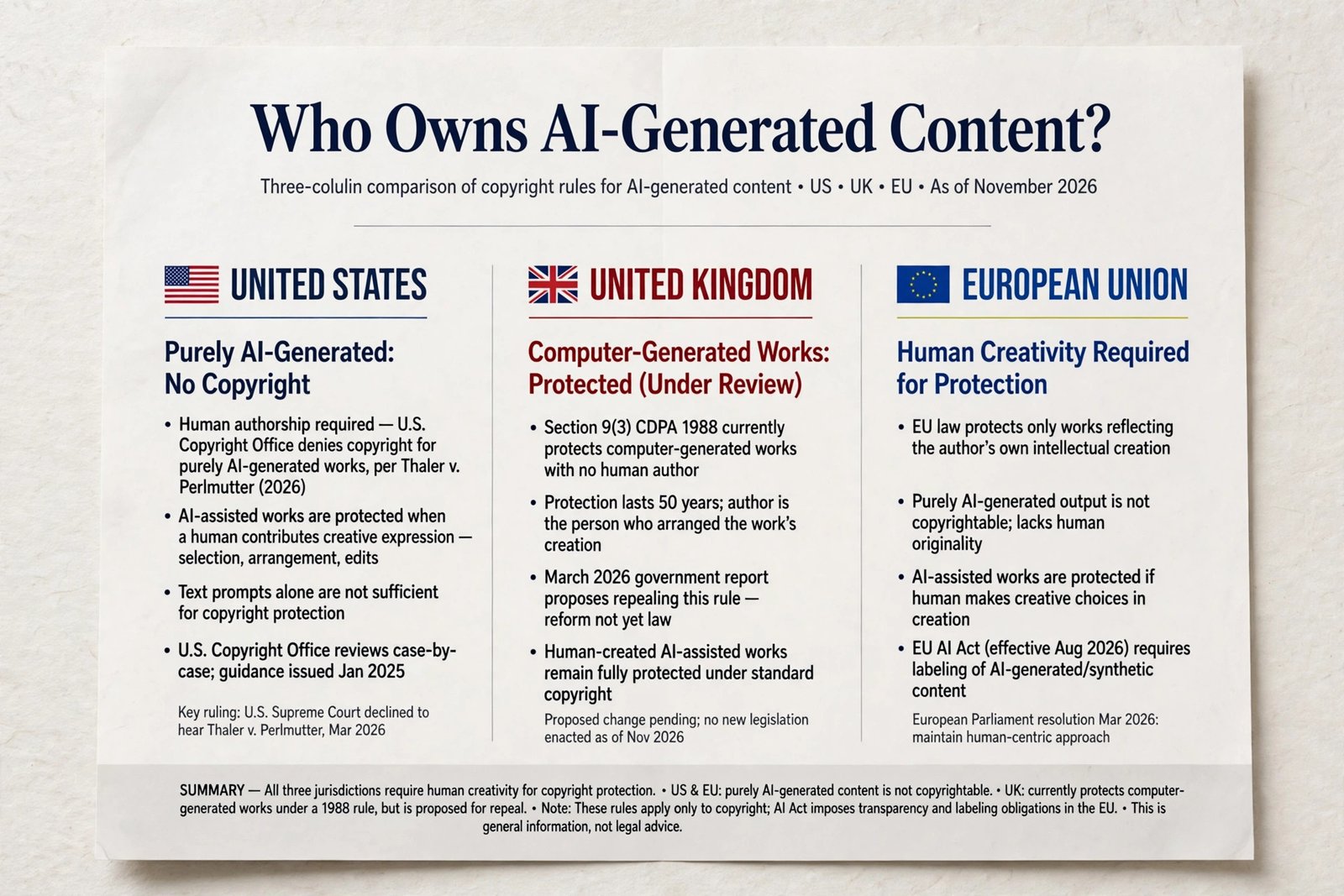
The US Copyright Office has consistently held that copyright protects only works of human authorship, and it will refuse to register a claim if a human being did not create the work. That position was tested in Thaler v. Perlmutter, where the Copyright Office refused to register an image identified as AI-authored. The lower courts agreed, and in March 2026 the US Supreme Court declined to hear the case. The Copyright Office returned to the question in Part 2 of its report on copyright and AI, published on 29 January 2025. It concluded that copyright does not extend to purely AI-generated material, or to material where a human lacks sufficient control over the expressive elements. Prompts alone do not provide sufficient control, because models do not consistently follow instructions. AI-assisted work can still be protected where a human-authored input remains perceptible in the output, where there is a creative selection or arrangement of AI-generated material, or where a human has creatively modified the output. In each case, protection covers the human part only.
What UK law says: an older rule, still untested for modern AI
Section 9(3) of the Copyright, Designs and Patents Act 1988 (CDPA) states that, for a computer-generated literary, dramatic, musical or artistic work, “the author shall be taken to be the person by whom the arrangements necessary for the creation of the work are undertaken”. Section 178 defines a computer-generated work as one generated by a computer in circumstances such that there is no human author. Copyright lasts for 50 years, and the deemed author has no moral rights. That provision was written in 1988, long before modern generative AI, and it has barely been tested in court. In Nova Productions Ltd v Mazooma Games Ltd, the High Court held that the programmer who wrote the code had made the arrangements, not the player. No court has yet decided who “made the arrangements” when a user types a prompt into a general-purpose AI tool. The UK government suggested in 2024 that the provision might be repealed.
What EU law says: no AI-specific rule, but a human standard
The EU has no specific rule on the copyrightability of AI-generated works, and the AI Act does not settle the question. What it does have is a court-made standard of originality: a work must be its author’s own intellectual creation, reflecting free and creative choices. That standard comes from cases such as Infopaq and Painer, decided by the Court of Justice of the European Union before generative AI existed. The emerging consensus, as the European Parliamentary Research Service put it in October 2026, is that purely AI-generated content with minimal human creativity does not qualify for protection, while works made with AI may still be protected where substantial human creativity has been exercised.
The US, UK and EU compared
| Jurisdiction | Purely AI-generated work | What can still be protected | Main uncertainty |
|---|---|---|---|
| United States | Not protected; human authorship required | Human inputs, creative selection or arrangement, creative modifications | How much control future tools give users |
| United Kingdom | May be protected under CDPA section 9(3) | The same human contributions, plus the statutory route | Who “made the arrangements” for a prompt-based tool |
| European Union | Not expected to qualify; no AI-specific rule | AI-assisted work with substantial human creativity, case by case | Where the line falls between prompting and editing |
How the US, UK and EU treat AI-generated content.
What the tools’ terms actually give you
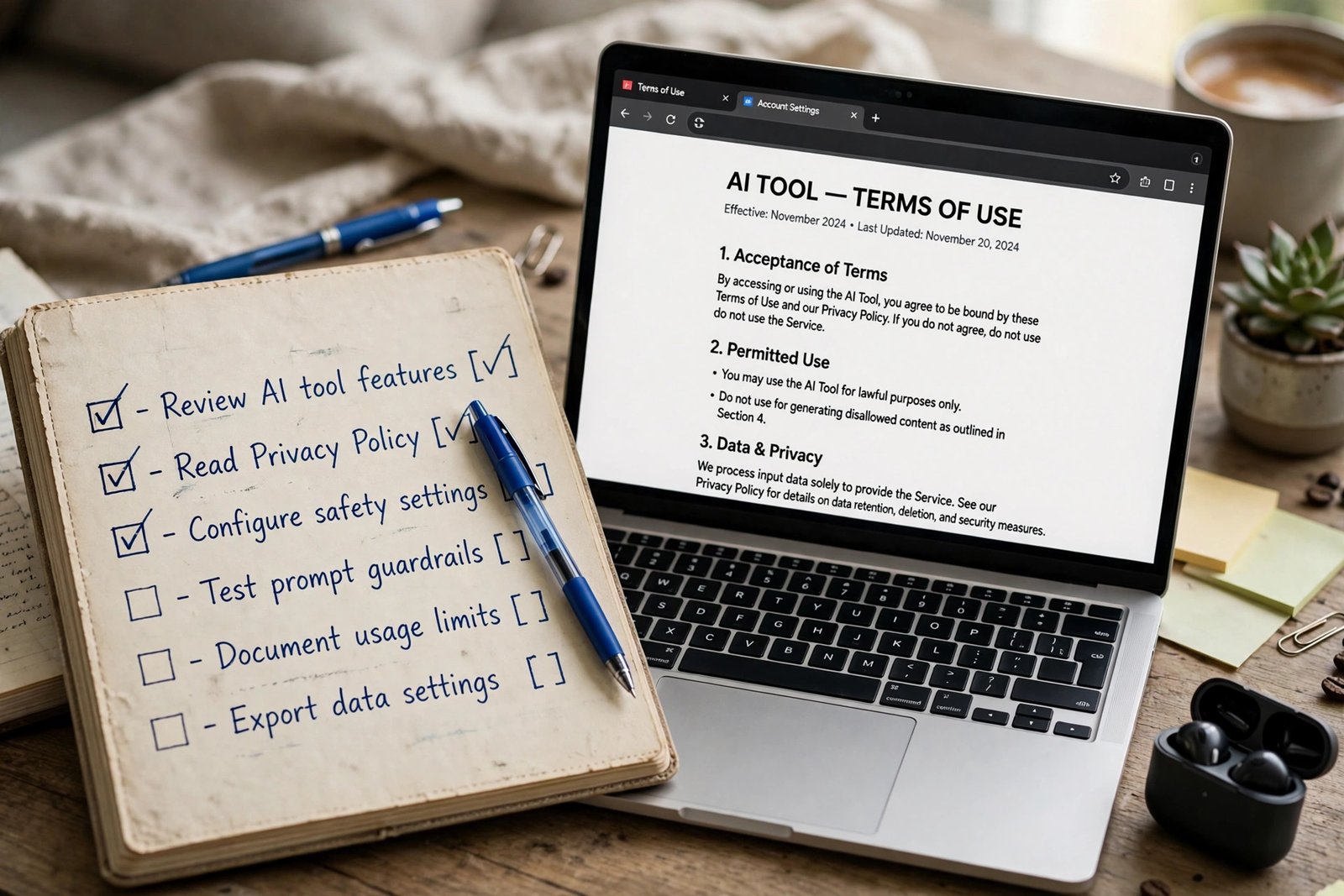
The contract position is simpler than the copyright position. All the major providers have converged on the same approach: they assign output ownership to the user, or state that they claim no ownership. OpenAI’s Terms of Use, effective 1 January 2026, state that you retain your ownership rights in your input and you own the output, and that OpenAI assigns to you all its right, title and interest, if any, in and to the output. Anthropic’s commercial terms enable customers to retain ownership rights over outputs. Google states that it will not claim ownership over generated content. None of that changes the copyright analysis. A provider can only assign rights it holds, and if no copyright exists in a purely AI-generated output, there is nothing to assign. What the terms do give you is permission to use the output, including commercially in most cases. Before you rely on a tool, check ownership, commercial use and indemnity for your plan.
How much human input is enough?
There is no fixed percentage. The question is about the nature of the human contribution, not its size alone. A single short prompt is unlikely to be enough: the Copyright Office’s view is that prompts function more like instructions to a commissioned artist than like authorship itself, because the model, not the user, decides the specific expressive elements. Substantial rewriting usually helps, because the rewritten passages are your expression. So does genuine selection and arrangement, and a human-authored input that survives into the output is the strongest case of all. If you are a freelancer, the value you sell is not the prompt; it is the judgment, editing and fact-checking you add afterwards, as explained in how freelancers can use AI to write client proposals faster.
Can you use AI content commercially?
In most cases, yes — with two conditions. First, the tool’s terms must allow commercial use, which the major providers generally do. Second, you must be comfortable that the output does not infringe someone else’s rights, covered below. Commercial use without copyright is still commercial use. You can publish an AI-assisted blog post, sell a design, or use AI-generated music in a video. What you cannot reliably do is stop a competitor using the same material, if the parts they copied were purely AI-generated. Do not sell a client exclusive rights in a purely AI-generated image or text as though it were a fully copyrighted original. A written AI policy helps here, as set out in how to write an AI policy for small business.
The other risk: infringing someone else’s work
Ownership is only half the question. The other half is whether the output copies someone else’s copyrighted work. AI models are trained on large amounts of material, including copyrighted text, images and music, and they can occasionally produce output that closely resembles a particular source. That risk is not removed by the fact that you typed the prompt in good faith. Do not ask a tool to reproduce a living artist’s style, a specific song, a character or a passage from a known book, and check distinctive phrases and images against a search before you publish. If an output looks strikingly like a known work, do not use it. Liability, if an output does infringe, will generally fall on the person who publishes it, not on the tool. Keep the same care with privacy and data that applies to any AI use at work, as covered in how to use AI safely at work without sharing private data.
A checklist before you publish or sell AI-assisted work
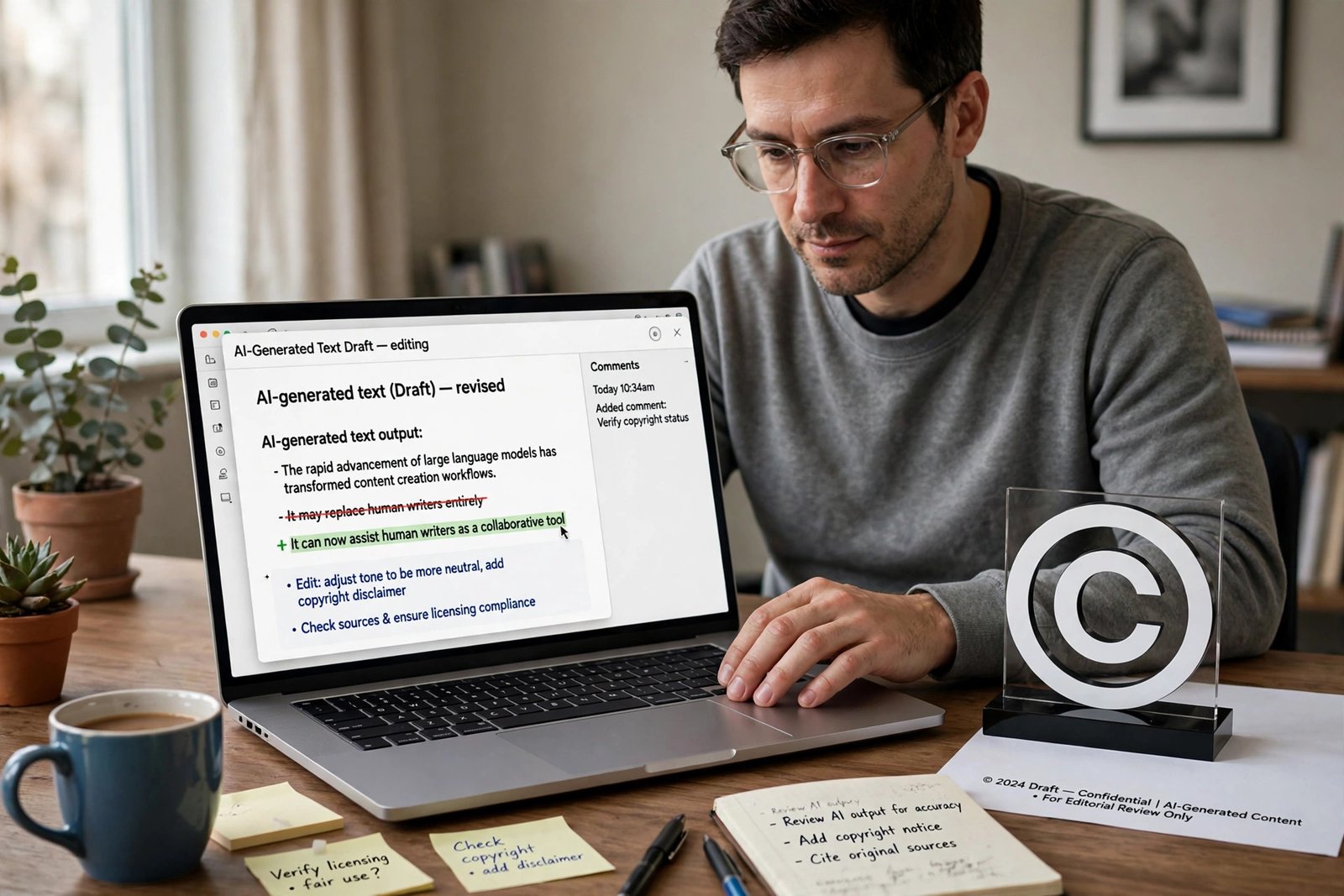
- Did a human shape the expression? Can you point to passages or images you wrote, rewrote, selected or arranged — not just a prompt?
- Is it documented? Do you have the prompt, the first draft, and your edited version, with dates?
- Do the terms allow this use? Is commercial use permitted on your plan?
- Have you checked for copying? Have you searched distinctive phrases and reverse-image searched key visuals?
- Are you claiming only what you can defend? Are you selling the work as AI-assisted, rather than promising exclusive copyright in purely AI-generated material?
Frequently asked questions
Who owns AI-generated content?
In most cases, the tool’s terms assign the output to you. Whether you also hold copyright is separate, and in the US and EU the answer for purely AI-generated material is generally no.
Can I copyright AI-generated art or text?
In the US, you cannot register copyright in purely AI-generated material. You can claim copyright in the human-authored parts: your own input, a creative selection or arrangement, or creative modifications.
Can I sell AI-generated content?
Usually, yes, if the tool’s terms allow commercial use on your plan. You may not be able to promise a buyer exclusive copyright in purely AI-generated material, or stop others using similar output.
What if someone copies my AI-generated work?
If the copied parts were purely AI-generated, you may have no copyright to enforce in the US or EU. If they copied your human edits, your original input, or your creative arrangement, you may have a claim in those parts.
The bottom line
Who owns AI-generated content is not one question but three: what the terms give you, whether copyright protects it, and whether you can stop someone else using it. In the US, purely AI-generated material has no copyright, and prompts alone do not make you its author. In the UK, an older statutory rule may offer protection, but it has not been tested for prompt-based tools. In the EU, the human-creativity standard points the same way as the US. Use AI as a starting point, not as the finished work: add your own expression, check the output for copying, and keep a record of what you did. Start with one step this week. Pick a piece of AI-assisted work you have already published or sold, and run it through the checklist above.
This article is general information, not legal advice. Copyright law in this area is unsettled and varies by country, and it is changing as courts and governments respond to new tools. For a specific dispute or a high-value commercial decision, seek advice from a qualified intellectual property lawyer.